Apple varieties, United States
Macoun
McIntosh × Jersey Black, crossed at Geneva in 1909 and named after the Canadian pomologist W. T. Macoun
History
Macoun came from a programme at the New York State Agricultural Experiment Station in Geneva that sought an apple with the virtues of McIntosh but better colour and a later season1,3. In 1909 Richard Wellington crossed McIntosh, as the seed parent, with Jersey Black1,2. The seedlings went into the nursery in 1910; selections were made in 1912 as trees were moved into the orchard, and from the 33 kept, one was finally chosen1. Its fruit was first described in 19182,3. Named after the Canadian pomologist W. T. Macoun, it was introduced in 19231,3. SNP data confirm both parents4.
Jersey Black, which Beach listed in 1905 as Black Jersey, was by then “an old variety now practically obsolete”, a pleasant dessert apple of dark red, almost black colour5. Wellington also crossed it with Canada Baldwin, Jonathan, Louise and Rome, but only the cross with McIntosh gave useful offspring1. Macoun in turn is recorded as the seed parent of Holiday, Liberty and Burgundy3.
A survey of western New York in 1970 counted 10,000 young trees, one to six years old1. In 1997 Cornell’s breeders called it “still very popular” and said it often fetched a premium price; New York had grown about 2,300 tonnes (5 million pounds) in 19956.
The fruit
The fruit is medium-sized and flat, more oblate than either parent; at the National Fruit Collection it measured 65 mm wide and 49 mm high1,3. Nine-tenths of the skin is striped dark red, from deep red to almost black, under a heavy bloom that Houser traces to Jersey Black; the skin is smooth, glossy, thick and tough1. The flesh is white or tinged with red, firmer than McIntosh’s, fine-grained, tender and rather juicy, with a mild, subacid flavour and a fine aroma1; the National Fruit Collection finds it crisp and sweet3. The USDA calls it “one of the highest quality eating apples known”2, and Houser reports that some experts rated it the best dessert apple of the north-eastern United States1.
The stalks are short and thick and the fruit is borne in clusters, so the apples push one another off as they ripen1; they also bruise easily2. Stored at −0.6 °C (31 °F) they keep about 110 days, somewhat longer than McIntosh, and in controlled atmosphere until May or June1,2.
Growing
Macoun is slow to start bearing, at about nine years, later than either parent1. The tree is vigorous and upright, with stiff, leggy branches that need extra pruning, and its many spurs set too much fruit, so that it tends to crop in alternate years unless thinned1,2. Its long chilling requirement unfits it for warm regions, but tree and buds are hardy enough for cold districts1. It flowers late and is self-unfruitful, but its pollen sets fruit on McIntosh, Cortland and Northern Spy1. It is diploid1,4. The USDA rates it very resistant to fire blight2.
Where the sources disagree
- Ripening. Houser has Macoun ripening about a month after McIntosh, which ripens from mid-September to early October1, and the USDA several weeks after2; at the National Fruit Collection in Kent it is picked in mid-September3.
- Trials. Houser says it was introduced in 1923 “without the benefit of further trials”1; the USDA inventory has it “introduced for trial” that year2.
Family tree
Parents, grandparents and great-grandparents, as the entries in the atlas record them.
- Macoun United States, 1909
- Seed parent McIntosh Canada, 1811
- Pollen parent Jersey Black United States, by 1817
Offspring in the atlas
Sources
- Origin of the Macoun Apple Cultivar, Jean A. Houser, Fruit Varieties Journal 34(2): 45–48, American Pomological Society, 1980. Supports: a breeding aim of an apple with McIntosh's good qualities but better colour and later ripening; the cross McIntosh × Jersey Black made by Richard Wellington in 1909, McIntosh the pistillate and Jersey Black the staminate parent; seedlings in the nursery in 1910, selections in 1912 when trees were moved to the orchard, and one tree chosen from 33; the name after the Canadian pomologist W. T. Macoun; introduction in 1923 "without the benefit of further trials"; Wellington's crosses of Jersey Black with Canada Baldwin, Jonathan, Louise and Rome giving no desirable progeny; no bearing until about nine years old; ripening about one month after McIntosh, which ripens mid-September to early October; a longer chilling requirement than McIntosh, unsuited to warm regions, but hardy tree and buds; stiff, leggy, upright branches needing extra pruning, many spurs, oversetting and biennial bearing; diploid, viable pollen, late bloom, self-unfruitful, pollen setting fruit on McIntosh, Cortland, Northern Spy and others; medium fruit, more oblate than either parent; skin "90% dark stripe", deep red to blackish, smooth, glossy, thick and tough, with a heavy bloom attributed to Jersey Black; short thick stems and clustered fruit causing drop; flesh pure white or tinged red, firmer than McIntosh, fine-grained, tender, rather juicy, mild subacid with a fine aroma; about 110 days at 31 °F, somewhat longer than McIntosh, and until May or June in controlled atmosphere; 10,000 trees one to six years old in a 1970 survey of western New York; some experts considering it the highest quality dessert apple of the north-east.
- Plant Inventory No. 204, Part II (Plant Materials Introduced July 1 to December 31, 1995), p. 117: PI 589895, Macoun, R. A. Norris (ed.), USDA Agricultural Research Service, 1996-08. Supports: developed by Richard Wellington; "Seed produced 1909; first fruit described 1918; introduced for trial 1923"; drops readily and bruises easily; vigorous, hardy, spur-type, productive tree of upright habit, needing training and thinning, biennial; "Very resistant to fire blight"; blooms late; ripens "several weeks after McIntosh"; "One of the highest quality eating apples known"; "Storage 110 days at 31 degrees F".
- Macoun (accession 1929-040), National Fruit Collection, Brogdale, Kent (Defra). Supports: raised at the New York State Agricultural Experiment Station, Geneva, by Richard Wellington; first described in 1918 and introduced in 1923; parentage "McIntosh x Jersey Black"; synonym Mekaun; mother of Holiday, Liberty and Burgundy; a dessert apple, medium-sized and flat, 49 mm high and 65 mm wide; striped red over whitish yellow; crisp, tender, white flesh with "a sweet, scented flavour"; picking in mid-September at Brogdale.
- Cultivar fingerprinting and SNP-based pedigree reconstruction in Danish heritage apple cultivars utilizing genotypic data from multiple germplasm collections in the world, Bjarne Larsen and others, Genetic Resources and Crop Evolution 72: 2397, with supplementary Table S5, 2025. Supports: Table S5: Macoun diploid, with McIntosh and Jersey Black confirmed as its parents by SNP data.
- The Apples of New York, vol. I, p. 79: Black Jersey, S. A. Beach, New York Agricultural Experiment Station, Internet Archive, 1905. Supports: Jersey Black as a synonym of Black Jersey; "Fruit medium, dark red, almost black. A pleasant flavored, dessert apple"; "It is an old variety now practically obsolete".
- The Cornell University Apple Breeding Program: Past, Present, and Future, Susan K. Brown and David E. Terry, Fruit Varieties Journal 51(4): 199–204, American Pomological Society, 1997. Supports: Macoun (1923) "still very popular" and often commanding a premium price; New York's 1995 production of 5 million pounds.
More from United States
-
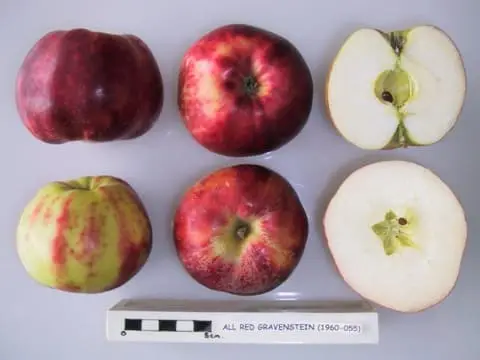
All-Red Gravenstein
-
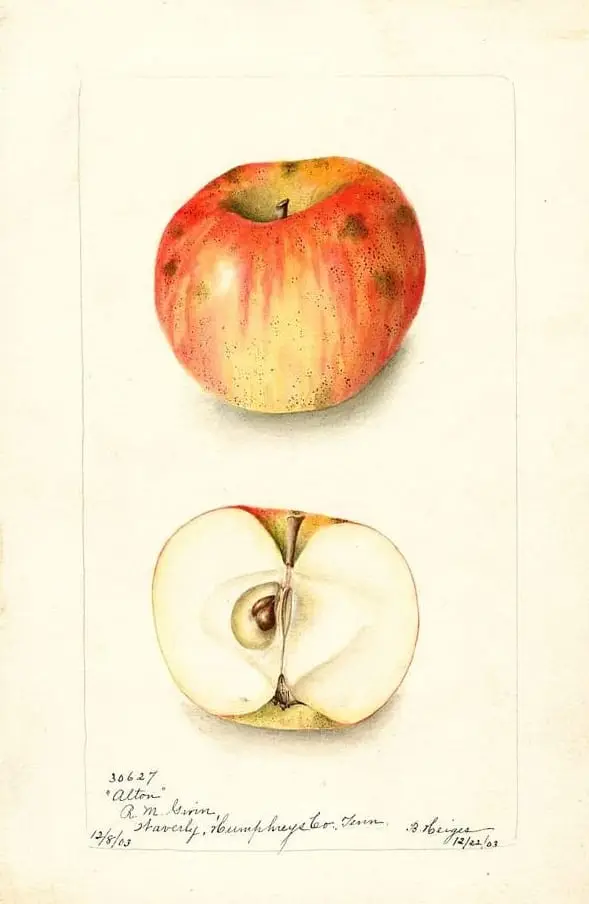
Alton
-
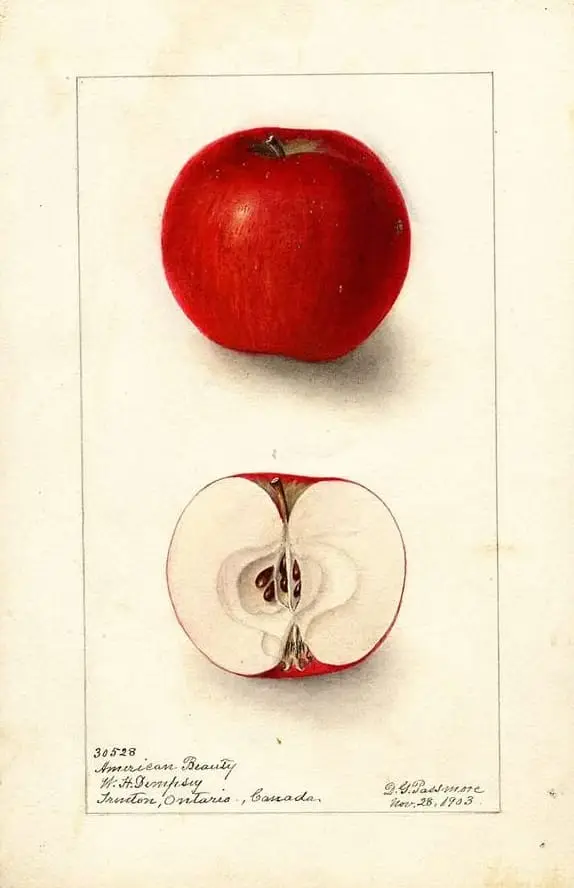
American Beauty
-
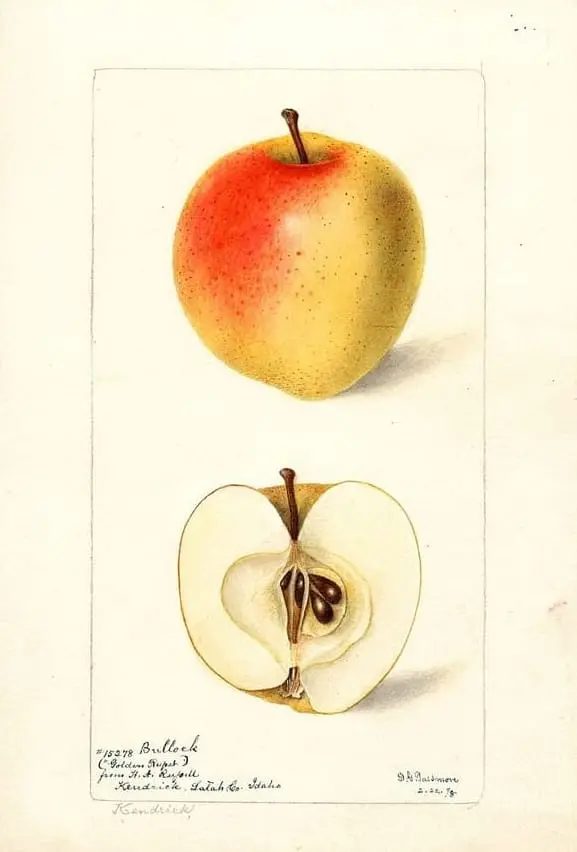
American Golden Russet
A small New Jersey russet whose flesh Downing likened to a buttery pear; Coxe knew it in 1817 as Sheep-nose
-
American Grindling
-
American Summer Pearmain
-
Ames
-
Arkansas