Melba
Raised at Ottawa from McIntosh seed sown in 1898, first fruiting in 1908; a parent of at least ten later apples
History
Melba was raised at the Central Experimental Farm in Ottawa by W. T. Macoun1,2. In 1898 Macoun, expecting natural pollination in an orchard of 400 to 500 named varieties to produce every sort of combination of characters, had seed saved from some of the best-flavoured apples then fruiting there, McIntosh among them2. Seedlings from this and later sowings were planted out from 1901 until about 2,000 trees stood in the orchard2. By the time of his 1916 bulletin 1,211 had fruited and 99 of the best had been named, and the largest share of promising ones had come from McIntosh, Langford Beauty, Northern Spy and Wealthy2.
Melba grew from McIntosh seed sown in the autumn of 1898; its tree was planted in the spring of 1901, first fruited in 1908 and was first described in 19092, the year given for its introduction1,3. In 1927 the American Pomological Society awarded it the Silver Wilder Medal1.
Because the seed came from natural pollination, Macoun knew only the mother2. SNP data published in 2020 confirm McIntosh as a parent4, and SNP data analysed by Larsen and colleagues identify the other parent as Tetofsky5.
The USDA’s 1996 germplasm record quotes Coutts (1991) on Melba: “Tender, but good breeder”3. In the 2020 SNP study it appears as a parent of ten cultivars, among them Jamba (with James Grieve), Norland, Parkland, Patterson and Silva4. The National Fruit Collection lists two sports, Red Melba and Hunter Melba1.
The fruit
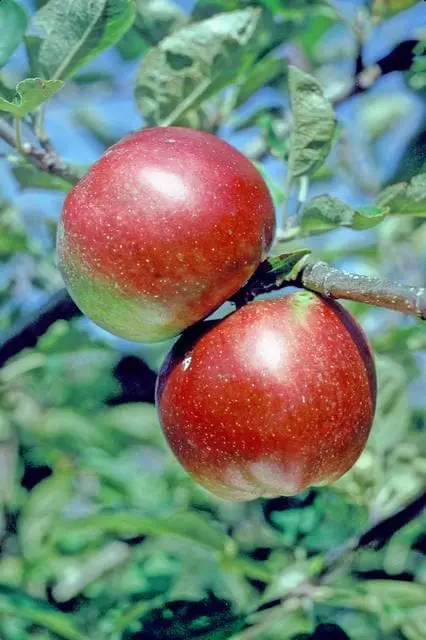
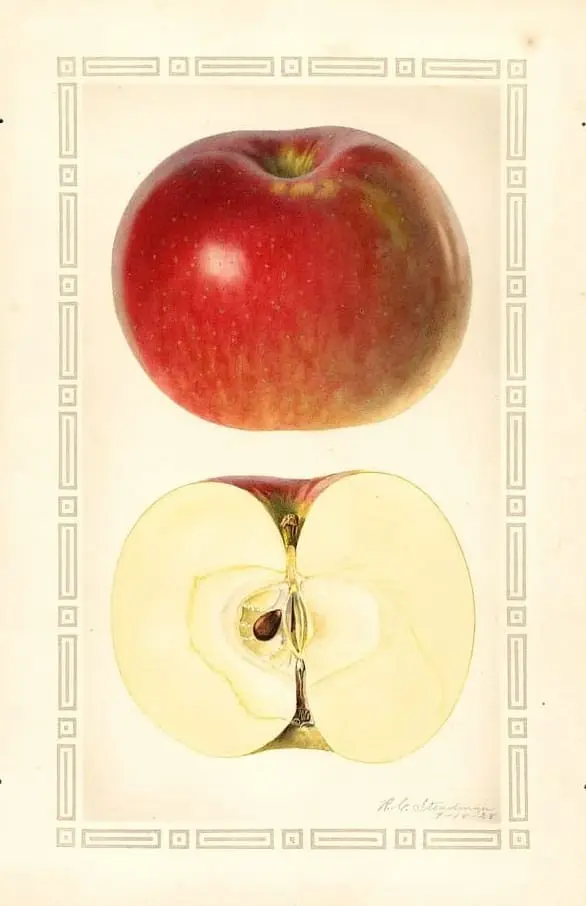
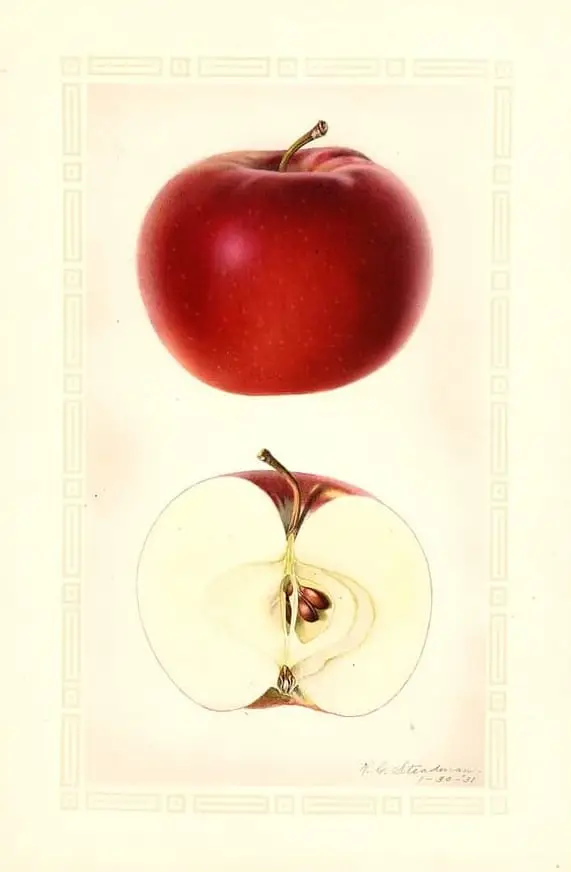
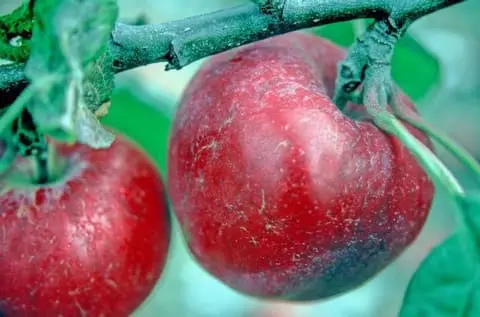
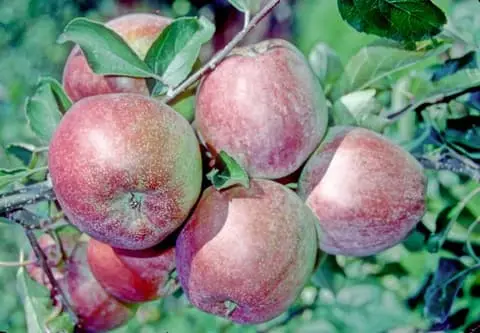
The fruit is of medium size, 57–63 by 44–51 mm in the USDA record, flattish to truncate-conical and ribbed on the body and at the eye1,3. The pale yellow skin is marked with pinkish stripes and flecks under a white bloom1,3, and the skin itself is aromatic1. The very white flesh is firm, crisp and juicy, with what the National Fruit Collection calls “a refreshing vinous flavour”1; the USDA describes it as subacid and sweet3.
It is an early apple with a short shelf life3. At Brogdale, Kent, it begins to flower around 3 May and is picked in mid-August1. Melba is diploid4,5.
Where the sources disagree
Family tree
Parents, grandparents and great-grandparents, as the entries in the atlas record them.
- Melba Canada, 1898
- Seed parent McIntosh Canada, 1811
- Pollen parent Tetofsky
Offspring in the atlas
- Beverly Hills × Early McIntosh; United States, 1939
- Caravel × Crimson Beauty (Canada); Canada, by 1964
- Jamba 69 × James Grieve; Germany, 1954
- June Crewdson × Devonshire Quarrenden; United Kingdom, by 1943
- Pirja × Huvitus; Finland, 1961
- Ranger × Crimson Beauty (Canada); Canada, by 1964
- Red Melba Canada, about 1936
- Redfree × Raritan; United States, by 1981
- Silva × Stenbock; Sweden, 1945
10 varieties in the atlas descend from Melba.
Sources
- Melba (accession 1925-021), National Fruit Collection, Brogdale, Kent (Defra). Supports: "Raised in 1898 by W.T. Macoun at the Central Experimental Farm, Ottawa, Canada. Introduced in 1909"; the Silver Wilder Medal of the American Pomological Society in 1927; firm, crisp, white, juicy flesh "with a refreshing vinous flavour"; "Skin is aromatic"; parentage "McIntosh x Unknown"; the sports Red Melba and Hunter Melba; a dessert apple, ribbed on body and at eye, pale yellow with pinkish stripes and flecks, flesh very white; 10% flowering on 3 May and picking in mid August at the collection.
- The Apple in Canada: its cultivation and improvement (Bulletin 86), pp. 16 and 32, W. T. Macoun, Dominion Horticulturist, Department of Agriculture, Canada; Canadiana microfiche CIHM 82881, Internet Archive, 1916. Supports: p. 16: in 1898 Macoun had seed saved from some of the best-flavoured apples then fruiting in the orchard of the Central Experimental Farm, Ottawa, which held "between 400 and 500 named varieties", McIntosh among them, expecting natural pollination to combine their characters; the seedlings of these and of later sowings planted out from 1901 until about 2,000 trees; 1,211 fruited "during the past twelve years", 378 were being propagated for further test and 99 of the best had been named; the largest proportion of promising seedlings among those of McIntosh, Langford Beauty, Northern Spy and Wealthy. p. 32, "Names given to apples originated in the Horticultural Division": Melba, female parent McIntosh, seed sown in autumn 1898, tree planted in spring 1901, first fruiting 1908, fruit described "R. 1909, P. 111".
- Plant Inventory No. 204, Part I (Plant Materials Introduced January 1 to June 30, 1995), p. 377: PI 589112, Melba, R. A. Norris (ed.), USDA Agricultural Research Service, 1996-08. Supports: developed by W. T. Macoun, Central Experimental Farm, Ottawa; "Pedigree - McIntosh x Raised 1898; intro: 1909"; size medium, "57-63;44-51mm"; shape flat to intermediate, rectangular to truncate-conic, ribbed on body and at eye; skin pale yellow with pinkish stripes and flecks, white bloom; flesh firm, crisp, very white; flavour subacid, sweet; season early; "Tender, but good breeder", Coutts (1991); "Shelf life short".
- Using whole-genome SNP data to reconstruct a large multi-generation pedigree in apple germplasm, Hélène Muranty and others, BMC Plant Biology 20:2, with Additional files 1, 3 and 6, 2020. Supports: Additional file 6 (Table S5): Melba and McIntosh a parent–offspring duo with no Mendelian errors, McIntosh the parent, with Melba's documented parents given as McIntosh and Liveland Raspberry; Melba the parent in duos with Maikki, Norland, Parkland, Patterson, Pirja, Samo, Silva and Carrol; Additional file 3 (Table S3): Melba a parent of Jamba, with James Grieve (both documented parents confirmed), and of June Crewdson, with Devonshire Quarrenden; Additional file 1 (Table S1): Melba diploid, dated 1898.
- Cultivar fingerprinting and SNP-based pedigree reconstruction in Danish heritage apple cultivars utilizing genotypic data from multiple germplasm collections in the world, Bjarne Larsen and others, Genetic Resources and Crop Evolution 72: 2397–2411, with supplementary Table S5, 2025. Supports: Table S5: the SNP-confirmed parents of Melba (MUNQ 167) given as McIntosh (Parent1, the mother where pedigree records exist) and Tetofsky; ploidy 2 (diploid).