Apple varieties, United Kingdom
Worcester Pearmain
Bright red and early, from Worcester in the 1870s; a parent of Discovery, Merton Worcester and many more
History
Worcester Pearmain came from Worcester in the early 1870s. Hogg received it in 1873 from the nursery firm of Richard Smith & Co.2, and the Herefordshire Pomona said it was produced at Smith’s St John’s Nurseries that year3. Bunyard and the National Fruit Collection name a Mr Hale of Swan Pool, near Worcester, as its raiser, and Smith’s firm as its introducer in 18741,4.
Its looks made its name. Hogg wrote that “the great beauty of the fruit” made it a favourite in the markets2, and Bunyard called it “an esteemed market variety, seldom failing to crop”4. In England and Wales it covered 213 hectares of commercial orchard in 2004, and 115 hectares in 20126. In 2025, growers representing 92 per cent of the British apples and pears sold to supermarkets and other major retailers reported 3.11 hectares7.
It has been a prolific parent. The National Fruit Collection lists Discovery, Lord Lambourne, Merton Worcester and Tydeman’s Early Worcester among its offspring1. A 2020 SNP study of more than 1,400 cultivars inferred it as a parent in twelve complete parent–offspring trios, seven of which confirmed recorded pedigrees, among them those of Discovery, Katja and Akane5.
The fruit
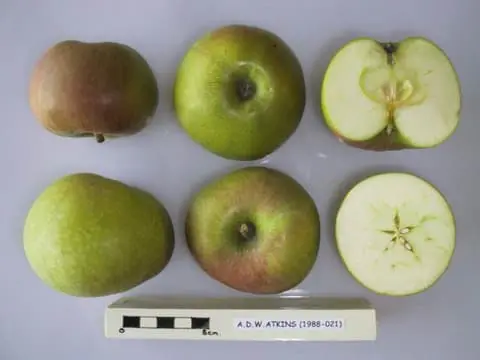
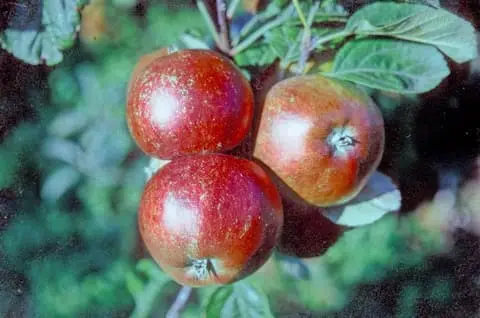
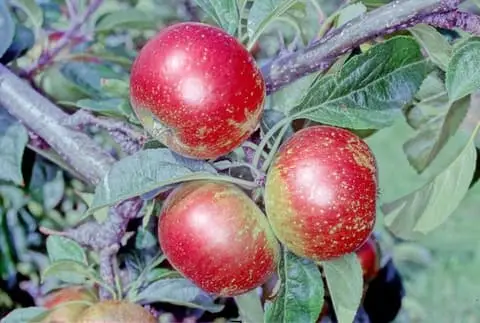
The fruit is medium-sized and conical1,2,4. Its very smooth skin is almost entirely flushed bright red over a pale yellow ground, dotted with fawn freckles, with some russet at the base1,2. The flesh is white, firm and crisp1; Hogg found it very juicy, “sweet, and sprightly”2, while the collection calls it only a little juicy, with a sweet, pleasant flavour1. Bunyard detected “a pleasant strawberry flavour”, and thought that flavour underrated because the fruit was usually picked and eaten “far before it is ripe”4.
At Brogdale, Kent, it reaches 10 per cent flowering at the start of May, and the fruit is picked in early September1. Hogg and the Pomona gave its season as August and September2,3, Bunyard as September and October4.
Growing
The Pomona found the tree hardy, very productive and quick to start bearing3; Hogg called it a free bearer2, and Bunyard “very regularly fertile”, of moderate growth, and making a neat, round-headed standard4. It is diploid5.
Uses
Hogg and the Pomona treated it as both a dessert and a kitchen apple2,3; Bunyard and the National Fruit Collection class it as a dessert apple1,4.
Where the sources disagree
- Raiser. The Pomona says Richard Smith produced it at his St John’s Nurseries in 18733; Bunyard and the National Fruit Collection name Mr Hale of Swan Pool as the raiser, and Smith’s firm only as the introducer, in 18741,4.
- Parentage. Hogg called it a seedling of Devonshire Quarrenden2, and the collection records “Devonshire Quarrenden x Unknown”1, but the Pomona thought the descent “not known with certainty”3. A 2020 SNP study that genotyped both varieties did not identify Devonshire Quarrenden as a parent5.
- Award. The Pomona dates its first-class certificate from the London Horticultural Society to 18743; the collection names the Royal Horticultural Society and 18751.
Family tree
Parents, grandparents and great-grandparents, as the entries in the atlas record them.
- Worcester Pearmain United Kingdom, by 1873
- Seed parent Devonshire Quarrenden United Kingdom, by 1678
Offspring in the atlas
- Acme × Rival; United Kingdom, 1944
- Akane × Jonathan; Japan, 1937
- Aldwick Beauty × Beauty of Bath; United Kingdom, by 1969
- Beauty of Blackmoor × Beauty of Bath; United Kingdom, 1947
- Discovery × Beauty of Bath; United Kingdom, about 1949
- Elton Beauty × James Grieve; United Kingdom, by 1952
- Eros × Charles Ross; United Kingdom, 1947
- Exeter Cross × Beauty of Bath; United Kingdom, 1924
- Flame × Rival; United Kingdom, 1925
- Garnet × Rival; United Kingdom, by 1936
- Hunter's Majestic United Kingdom, before 1914
- Jester × Starkspur Golden Delicious; United Kingdom, 1966
- Katja × James Grieve; Sweden, 1947
- Laxton's Early Crimson × Gladstone; United Kingdom, 1908
- Laxton's Herald × Beauty of Bath; United Kingdom, 1906
- Laxton's Leader × Gladstone; United Kingdom, 1905
- Lord Lambourne × James Grieve; United Kingdom, 1907
- Merton Worcester × Cox's Orange Pippin; United Kingdom, 1914
- Mio × Oranie; Sweden, 1932
- Opal (Seabrook) × Rival; United Kingdom, by 1936
- Pearl × Rival; United Kingdom, 1933
- Pioneer (1) × Cox's Orange Pippin; United Kingdom, by 1934
- Red Army × Chatley's Kernel; United Kingdom, by 1945
- Robin Pippin × Beauty of Bath; United Kingdom
- Sylvia × Gyllenkroks Astrakan; Sweden
- Tydeman's Early Worcester × McIntosh; United Kingdom, 1929
- Tydeman's Harvest × Devonshire Quarrenden; United Kingdom, 1930
- Tydeman's Michaelmas Red × McIntosh; United Kingdom, 1929
- Wayside × Cox's Orange Pippin; United Kingdom, 1930
- William Crump × Cox's Orange Pippin; United Kingdom, by 1908
- Winston × Cox's Orange Pippin; United Kingdom, 1920
- Winston coloured sport × Cox's Orange Pippin; United Kingdom, by 1952
40 varieties in the atlas descend from Worcester Pearmain.
Sources
- Worcester Pearmain (accession 1973-192), National Fruit Collection, Brogdale, Kent (Defra). Supports: "Raised by Mr Hale of Swan Pool, near Worcester, England. Introduced by Smith of Worcester in 1874"; a First Class Certificate from the Royal Horticultural Society in 1875; "firm, white, a little juicy flesh with a sweet and pleasant flavour"; synonyms Worcester and Pearmain de Worcester; parentage "Devonshire Quarrenden x Unknown"; listed as a parent of Discovery, Lord Lambourne, Merton Worcester and Tydeman's Early Worcester, among others; medium, globose-conical fruit; from the National Apple Register (Smith, 1971) as shown on the record, a pale yellow ground "almost entirely flushed bright red", russet at the base, white, firm, crisp flesh and a "sweet, perfumed" flavour; 10% flowering on 1 May (accession 1973-192) or 2 May (a second accession) and picking in early September at Brogdale; a dessert apple.
- The Fruit Manual, 5th ed., p. 250: Worcester Pearmain, Robert Hogg, Journal of Horticulture Office, Internet Archive, 1884. Supports: "Messrs. Richard Smith & Co., of Worcester, sent me this in 1873. It is a seedling from Devonshire Quarrenden"; medium-sized, conical fruit; very smooth skin covered with brilliant red, with fawn-coloured freckles and russet over the base; flesh "very tender, crisp, very juicy, sweet, and sprightly"; "A handsome early kitchen or dessert apple, ripe in August and September"; a free bearer, and "from the great beauty of the fruit is a favourite in the markets".
- The Herefordshire Pomona, vol. I, plate III: Worcester Pearmain, Robert Hogg and H. G. Bull (eds), Woolhope Naturalists' Field Club, Internet Archive, 1876–1885. Supports: "produced in the St. John's Nurseries, Worcester, in 1873, by Mr. Richard Smith"; a first-class certificate from the London Horticultural Society in 1874; "supposed to be a seedling from the Devonshire Quarrenden, but this is not known with certainty"; useful "both for dessert and culinary purposes"; ripe in August and September; the tree hardy, bearing "at a very early age", and very productive.
- A Handbook of Hardy Fruits, vol. I, p. 137: Worcester Pearmain, E. A. Bunyard, John Murray, Internet Archive, 1920. Supports: a dessert apple, September to October; medium, round-conical; bright crimson on a golden-yellow ground; crisp, very sweet flesh "with a pleasant strawberry flavour"; growth moderate, "very regularly fertile", making "a neat, round-headed standard"; "Originated at Swan Pool, near Worcester, by a Mr. Hale, Introduced by Messrs. Smith, of Worcester, in 1874"; "An esteemed market variety, seldom failing to crop"; flavour "greatly underrated" because it is usually gathered and eaten "far before it is ripe".
- Using whole-genome SNP data to reconstruct a large multi-generation pedigree in apple germplasm, H. Muranty and others, BMC Plant Biology 20: 2, with Additional files 1, 3 and 7, 2020. Supports: a study of more than 1,400 mostly old cultivars; Worcester Pearmain (dated 1874) and Devonshire Quarrenden (dated 1678) both genotyped as diploids (Table S1); Worcester Pearmain inferred as a parent in 12 trios, 7 of them confirming recorded pedigrees, those of Akane, Discovery, Katja, Merton Worcester, Mio, Sylvia and Tydeman's Early Worcester (Table S3); no trio or parent–offspring pair with Worcester Pearmain as the offspring, and none linking it with Devonshire Quarrenden (Tables S3 and S6).
- Survey of Orchard Fruit at October 2012, England and Wales, Department for Environment, Food and Rural Affairs (Defra), 2013-05-30. Supports: Table 2, area of commercial apple orchard in England and Wales: Worcester Pearmain 213 ha in 2004 and 115 ha in 2012.
- Orchard and Storage Census Report 2025, British Apples & Pears Limited, 2025. Supports: respondents representing 92% of the annual picked crop of British apples and pears sold to UK supermarkets and other major retailers; "Worcester" on 3.11 ha (908 trees), 0.06% of their apple hectares (Appendix I).