Apple varieties, United Kingdom
Discovery
Raised in Essex about 1949 and first called Thurston August; DNA confirms Worcester Pearmain and Beauty of Bath
History
Discovery was raised in about 1949 by Mr Drummer, a workman on a fruit farm in Essex1. First named Thurston August, it was renamed Discovery in 1962 and introduced by J. Matthews, a nurseryman at Thurston in Suffolk1. Its recorded parents are Worcester Pearmain and Beauty of Bath1, and SNP data published in 2025 confirm both2.
In England and Wales, Discovery covered 301 hectares of commercial orchard in 2004 and 157 hectares in 20123. In 2025, growers representing 92 per cent of the British apples and pears sold to supermarkets and other major retailers reported 9.85 hectares4. It has been a parent in its turn: the National Fruit Collection lists Limelight as its offspring1, and the 2025 study found it to be a parent of Josefine Kallehave, with Spartan, and of Tom Haalk, with James Grieve2.
The fruit
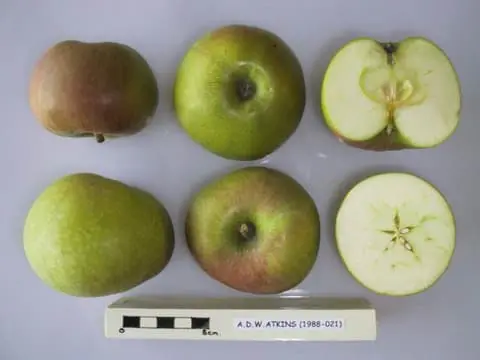
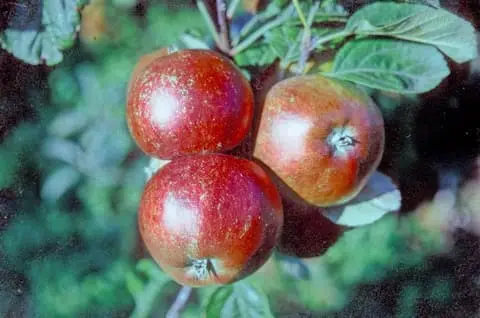
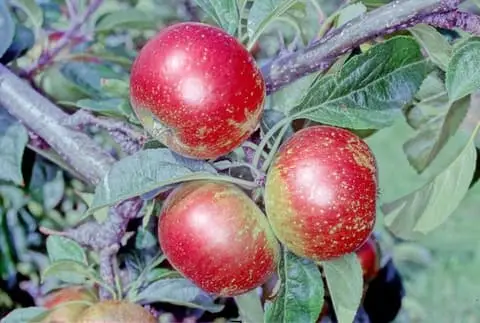
The fruit is medium-sized and flat; the collection’s staff measured it at 63 mm wide and 45.38 mm high1. Its pale greenish-yellow skin is flushed bright red, solidly or in stripes, with little russet1. The flesh is yellowish white tinged with pink, firm, fine-textured, crisp and juicy, with a fairly sweet, pleasant flavour1.
At Brogdale, Kent, it reaches 10 per cent flowering around 7 May and is picked in mid-August1. It does not keep long: UK storage guidance is 10 days in cold air at 1.5–2.0 °C, or 45 days in a controlled atmosphere5.
Growing
In unsprayed trials in Denmark from 1987 to 1990, Discovery was one of the three varieties out of fifteen least susceptible to scab, and it showed low susceptibility to powdery mildew6. Other studies had rated its scab susceptibility low or medium6. It had the most canker of the fifteen, though the differences were small, and it was attacked by fruit tree red spider mite6. It is diploid2.
Uses
Discovery is a dessert apple1.
Family tree
Parents, grandparents and great-grandparents, as the entries in the atlas record them.
- Discovery United Kingdom, about 1949
- Seed parent Worcester Pearmain United Kingdom, by 1873
- Seed parent Devonshire Quarrenden United Kingdom, by 1678
- Pollen parent Beauty of Bath United Kingdom, about 1864
- Parent Margaret United Kingdom, by 1665
- Seed parent Worcester Pearmain United Kingdom, by 1873
Offspring in the atlas
- Limelight × Greensleeves; United Kingdom, about 1985
Sources
- Discovery (accession 1973-189), National Fruit Collection, Brogdale, Kent (Defra). Supports: "Raised in about 1949 by Mr Drummer, a workman on an Essex fruit farm"; "first named 'Thurston August' but renamed Discovery in 1962 and introduced by nurseryman J. Matthews, Thurston, Suffolk"; "firm, fine-textured, juicy flesh with a fairly sweet and pleasant flavour"; parentage "Worcester Pearmain x Beauty of Bath"; mother to Limelight; from the National Apple Register (Smith, 1971) as shown on the record, a pale greenish-yellow ground flushed bright red, little russet, yellowish-white flesh tinged pink, crisp texture and subacid flavour; from the collection's own characterisation, a medium, flat fruit 63.00 mm wide and 45.38 mm high, with a striped or solid flush and low russet; 10% flowering on 7 May and picking in mid-August at Brogdale; a dessert apple.
- Cultivar fingerprinting and SNP-based pedigree reconstruction in Danish heritage apple cultivars utilizing genotypic data from multiple germplasm collections in the world, B. Larsen and others, Genetic Resources and Crop Evolution 72: 2397, supplementary Table S5, 2025. Supports: Discovery diploid, with Worcester Pearmain and Beauty of Bath as SNP-confirmed parents, parent 1 (Worcester Pearmain) being "the mother" where known from pedigree records; Discovery an SNP-confirmed parent of Josefine Kallehave (with Spartan) and of Tom Haalk (with James Grieve).
- Survey of Orchard Fruit at October 2012, England and Wales, Department for Environment, Food and Rural Affairs (Defra), 2013-05-30. Supports: Table 2, area of commercial apple orchard in England and Wales: Discovery 301 ha in 2004 and 157 ha in 2012.
- Orchard and Storage Census Report 2025, British Apples & Pears Limited, 2025. Supports: respondents representing 92% of the annual picked crop of British apples and pears sold to UK supermarkets and other major retailers; Discovery on 9.85 ha (21,523 trees), 0.18% of their apple hectares (Appendix I).
- Storage conditions recommended for major apple varieties in the UK, NIAB, Apple Best Practice Guide. Supports: Discovery stored in air at 1.5–2.0 °C for "10 days", and in controlled atmosphere at 1.5–2.0 °C (8% carbon dioxide unscrubbed, or under 1% carbon dioxide with 2% oxygen) for "45 days".
- Susceptibility of 15 apple cultivars to apple scab, powdery mildew, canker and mites, H. Lindhard Pedersen, J. Vittrup Christensen and P. Hansen, Fruit Varieties Journal 48(2): 97–100, 1994. Supports: fifteen cultivars grown without pesticides in Denmark and assessed in 1987–1990; Discovery, Filippa and Bramley's Seedling the group with low susceptibility to scab; Discovery of low susceptibility to powdery mildew; other studies rating its scab susceptibility low or medium (Table 3); Discovery with the highest incidence of canker, "but the differences were small"; Discovery among the cultivars attacked by fruit tree red spider mite.