Apple varieties, United Kingdom
Beauty of Bath
An August apple from Bailbrook, near Bath, about 1864; once the most important early commercial apple in the UK
History
Beauty of Bath was raised at Bailbrook, Batheaston, near Bath, and brought to notice about 1864 by Messrs Cooling of Bath1,2. The Royal Horticultural Society gave it a First Class Certificate in 18872. In 1920 Bunyard called it “a very attractive fruit” that was “now largely grown for market purposes”1, and the National Fruit Collection describes it as once the most important early commercial apple in the United Kingdom2.
Its parentage was not recorded2,3. SNP studies have since found one parent: Margaret, an old variety that the 2020 study dates to 16653,4. The other parent is unknown3,4.
Beauty of Bath is itself a parent of several apples. The 2020 study confirmed the recorded parentage of Discovery, a cross of Worcester Pearmain and Beauty of Bath, and of Maidstone Favourite, and inferred it as a parent in seven complete families in all3. Its sports include Crimson Beauty of Bath and Tim’s Early2.
The fruit
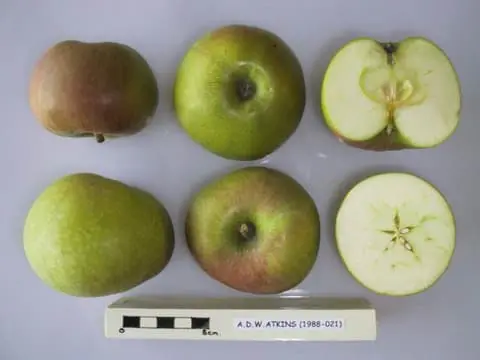
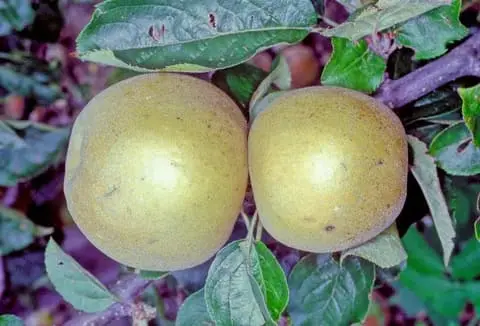
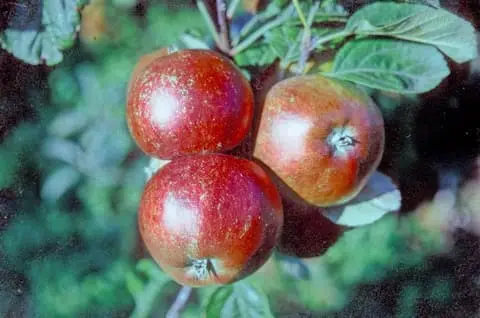
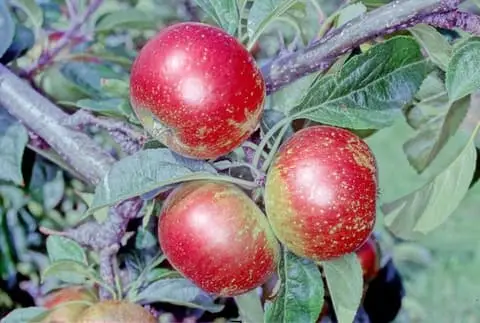
The fruit is small to medium and much flattened1; the 1971 National Apple Register gives it as 64 mm wide and 45 mm high2. The skin is pale yellow, flushed and striped with red, and a little rough to the touch1,2. The flesh is soft and juicy2, yellowish and often stained with red1; the collection finds it sweet and a little acid, “with a distinctive flavour”2.
At Brogdale, Kent, it reaches 10 per cent flowering about 2 May and is picked in early August2, the season Bunyard also gave1.
Growing
Bunyard found the tree of moderate growth and very fertile1. Its “chief fault”, he wrote, was dropping its fruit too soon, which led many growers to lay straw beneath the trees to keep the apples from damage1. It is diploid3.
Where the sources disagree
Family tree
Parents, grandparents and great-grandparents, as the entries in the atlas record them.
- Beauty of Bath United Kingdom, about 1864
- Parent Margaret United Kingdom, by 1665
Offspring in the atlas
- Aldwick Beauty × Worcester Pearmain; United Kingdom, by 1969
- Beauty of Bedford × Lady Sudeley; United Kingdom, before 1913
- Beauty of Blackmoor × Worcester Pearmain; United Kingdom, 1947
- Discovery × Worcester Pearmain; United Kingdom, about 1949
- Duchess of Bedford × Cellini; United Kingdom, by 1918
- Eastbourne Pippin × Emneth Early; United Kingdom, 1930
- Exeter Cross × Worcester Pearmain; United Kingdom, 1924
- Jennifer × Duchess's Favourite; United Kingdom
- Laxton's Herald × Worcester Pearmain; United Kingdom, 1906
- Maidstone Favourite × Aport; United Kingdom, by 1913
- Redstart × Cox's Orange Pippin; United Kingdom, about 1950
- Robin Pippin × Worcester Pearmain; United Kingdom
13 varieties in the atlas descend from Beauty of Bath.
Sources
- A Handbook of Hardy Fruits, vol. I, p. 23: Beauty of Bath, E. A. Bunyard, John Murray, Internet Archive, 1920. Supports: a dessert apple, "early August"; small to medium, round, much flattened; pale yellow with red flush and stripes, "a little rough to touch"; flesh tender, yellowish, "often stained with red", sweet and pleasant; growth moderate, very fertile; "raised at Bailbrook, Batheaston, near Bath, and brought to notice by Messrs. Cooling, about 1864"; "a very attractive fruit, which is now largely grown for market purposes"; "Its chief fault is premature dropping which leads many growers to place straw beneath the trees to prevent injury".
- Beauty of Bath (accession 1966-146), National Fruit Collection, Brogdale, Kent (Defra). Supports: "Originated at Bailbrook, Bath, Somerset and introduced by Cooling of Bath in about 1864"; a First Class Certificate from the Royal Horticultural Society in 1887; "once the most important early commercial apple in the U.K."; fruits "soft, juicy, sweet and a little acid, with a distinctive flavour"; a dessert apple; the synonym Cooling's Beauty of Bath; no parentage given; sports Crimson Beauty of Bath and Tim's Early; from the National Apple Register (Smith, 1971), marked b: flat, height 45 mm, width 64 mm, a yellow ground flushed and striped red, flesh "yellowish, stained red", soft; from NFC staff, marked a: a whitish green ground, white flesh, picking in early August (Brogdale); 10% flowering on 2 May (accession 1966-146).
- Using whole-genome SNP data to reconstruct a large multi-generation pedigree in apple germplasm, H. Muranty and others, BMC Plant Biology 20: 2, with Additional files 1, 3 and 7 (Tables S1, S3 and S6), 2020. Supports: Beauty of Bath diploid, dated 1864 (Table S1); no parents in the literature consulted, and Margaret (dated 1665) inferred as its parent with one Mendelian error, the pair oriented by date (Table S6); the documented parentage of Discovery (Worcester Pearmain × Beauty of Bath) and of Maidstone Favourite (Alexander × Beauty of Bath) confirmed, and Beauty of Bath inferred as a parent in seven trios in all (Table S3).
- Cultivar fingerprinting and SNP-based pedigree reconstruction in Danish heritage apple cultivars utilizing genotypic data from multiple germplasm collections in the world, B. Larsen and others, Genetic Resources and Crop Evolution 72: 2397, supplementary Table S5, 2025. Supports: Table S5: Beauty of Bath, ploidy 2, with Margaret as its one SNP-confirmed parent and the other unknown.