UEB 32642
A scab-resistant cross of Golden Delicious and Topaz, selected in Czechia in 1999; sold under the trade mark Opal
History
UEB 32642 was bred at the Institute of Experimental Botany of the Czech Academy of Sciences, which has bred apples for resistance to scab since 19661. It came from a planned cross between Golden Delicious, the seed parent, and Topaz, the pollen parent, aimed at high disease resistance, high yield and excellent fruit2,3. The seedling was singled out in the autumn of 1999 and first propagated in the spring of 20002. Jaroslav Tupý, Otto Louda and Jan Zima are named as its breeders2,5.
Czech plant breeders’ rights were applied for in November 2001; the United States patent, granted in September 2005, gave the denomination as UEB 3264/2 and noted that the apple was also known as Opal in the Czech Republic2. European Union rights, number 16749, followed on 30 January 2006, and national rights in Turkey in 2012 and Morocco in 20153.
UEB 32642 is a club variety, its trees available only to selected professional growers who are club members, and its fruit is sold under the trade mark Opal3,4, owned by fruit.select in Germany and Varieties International in the United States3. The institute writes that it is gaining ground above all in the United States, Chile and Spain, gradually replacing the similar but scab-susceptible Golden Delicious1. It is among the institute’s most popular varieties, with an average of 240,000 trees planted a year and about 3.5 million in all by 2026, mostly in Europe and the United States3.
The fruit
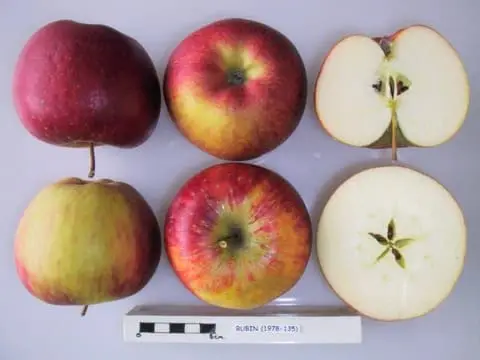
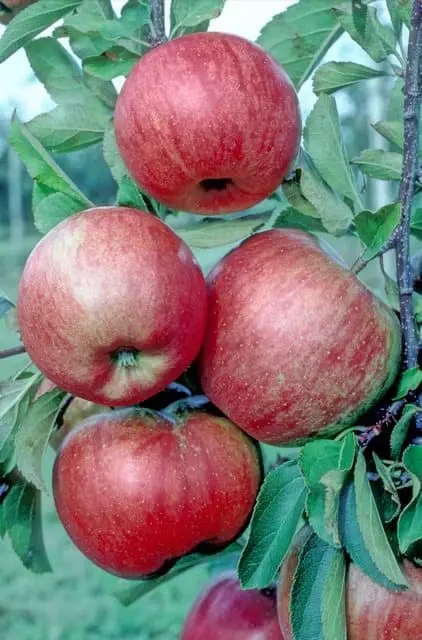
The patent describes fruit picked on 6 October 2003 and examined three months later: globose and slightly conical, about 75 mm wide and 69 mm high, with a smooth skin free of bloom and greasiness, a yellow-orange ground, no overcolour or only a slight orange blush, and russet around the stalk2. The flesh is yellow to yellow-orange, firm and juicy2,3, crisp, and does not brown when cut3; its sweet, aromatic, well-balanced flavour2 is honey-sweet and slightly tart, at 15.2 °Brix3. It shares the taste, shape and yellow ground of Golden Delicious but keeps longer, whereas Topaz is flatter, red-striped and rather tart2.
It ripens in early October, with Golden Delicious3. A late dessert apple, it ships well and keeps for about six months, in a cellar until April2,3.
Growing
The tree is of medium vigour, upright to spreading and well branched; it crops early and regularly on spurs and one-year-old shoots, and flowers early to mid-season, a day or two before Golden Delicious2,3. It carries the Vf resistance to scab and tolerates powdery mildew2; the breeder adds that it tolerates fire blight and does not suffer from bitter pit, and that light thinning keeps its crops high and regular3. The breeder recommends it for sunny, drier districts, especially wine-growing ones, and for intensive orchards with drip irrigation, integrated or organic3. It is diploid2.
Where the sources disagree
Family tree
Parents, grandparents and great-grandparents, as the entries in the atlas record them.
- UEB 32642 Czechia, 1999
- Seed parent Golden Delicious United States, 1905
- Parent Grimes Golden United States, by 1804
- Pollen parent Topaz Czechia, after 1984
- Seed parent Rubin Czechia, 1960
- Seed parent Lord Lambourne United Kingdom, 1907
- Pollen parent Golden Delicious United States, 1905
- Pollen parent Vanda
- Seed parent Rubin Czechia, 1960
- Seed parent Golden Delicious United States, 1905
Sources
- Station of Apple Breeding for Disease Resistance: basic information, Institute of Experimental Botany of the Czech Academy of Sciences. Supports: breeding for scab resistance begun "as early as 1966"; the station securing variety rights and plant patents and licensing the propagation and sale of trees and the production of fruit to business partners; UEB 32642 "known under the trademark" Opal, "gaining success especially in the USA, Chile and Spain, where it is gradually replacing the similar scab-susceptible variety 'Golden Delicious'".
- US Plant Patent 15,963: Apple tree named 'UEB 3264/2', Jaroslav Tupý, Otto Louda and Jan Zima, for the Institute of Experimental Botany; United States Patent and Trademark Office, via Google Patents, 2005-09-13. Supports: varietal name UEB 3264/2, "also known as 'Opal' in the Czech Republic"; discovered in the autumn of 1999 in the Czech Republic, from a planned cross of Golden Delicious (female) and Topaz (male) aimed at high disease resistance, high yield and excellent fruit quality; inventors Jaroslav Tupý, Otto Louda and Jan Zima, assignee the Institute of Experimental Botany; Czech plant breeders' rights application filed on 13 November 2001; first propagated by budding and grafting, mostly on M9, in the spring of 2000; filed on 7 June 2004 and granted on 13 September 2005; similar to Golden Delicious in taste, shape and yellow ground colour, but with a shorter stalk, a broader eye basin, Vf resistance to scab and longer storage; unlike Topaz (flat globose, orange-red to dark red stripes over 75% of the surface, rather tart) globose to globose-conical, with no overcolour or a slight orange blush, and sweet; late, dessert-type, diploid; tree of medium vigour, upright to spreading, ramified, precocious, cropping regularly, bearing annually on spurs and one-year-old shoots; blooming early to medium, 1–2 days before Golden Delicious; fruit picked on 6 October 2003 and described three months later: 69 mm high and 75 mm wide, globose, slightly conical; skin medium-thick, smooth, without bloom or greasiness, russet around the cavity, ground colour yellow-orange, overcolour absent or an orange blush; flesh yellow-orange, firm and juicy, with a very good, sweet, well-balanced aromatic flavour; "Late dessert variety for conventional and ecological fruit growing"; shipping quality very good; keeping quality very good, "approximately 6 months under natural storage"; Vf resistance against scab, tolerant to powdery mildew.
- Opal ('UEB 32642'): stolní odrůda jabloně (dessert apple variety; in Czech), Station of Apple Breeding for Disease Resistance, Institute of Experimental Botany of the Czech Academy of Sciences. Supports: a club variety, doing best in sunny, drier, especially wine-growing districts, and suited to intensive commercial orchards with drip irrigation, in integrated or organic production; flesh that does not brown when cut; one of the institute's most popular varieties, with on average 240,000 trees planted a year; grown and sold under club conditions under the trade mark Opal, owned by fruit.select (Germany) and Varieties International (USA); about 3.5 million trees planted so far by professional growers, mostly in Europe and the USA; parents Golden Delicious × Topaz; Community plant variety right 16749, granted on 30 January 2006; Turkish rights TR 2012/023, granted on 29 June 2012; Moroccan rights No. 013/15, granted on 15 January 2015; monogenic resistance to scab, tolerance of powdery mildew and fire blight, no bitter pit; growth branched, upright to spreading, of medium vigour, with many branches; flowering early to medium-late, about 1–2 days before Golden Delicious; ripening at the beginning of October, at the same time as Golden Delicious; fruit medium-sized, globose to slightly conical; golden yellow to slightly orange, with russet mainly around the stalk cavity, without bloom or greasiness; flesh yellow, firm, crisp, fine to medium-coarse, moderately juicy; flavour full, aromatic, honey-sweet (15.2 °Brix), slightly tart; cropping early, as Golden Delicious does, high and regular with light thinning; keeping about 6 months in cellar storage (until April); trees and propagating material available worldwide only to selected professional growers who are members of the club.
- International Standards for Fruit and Vegetables: Apples, pp. 49 and 59: Non-Exhaustive List of Apple Varieties, OECD Publishing, Paris (explanatory brochure on the UNECE standard for apples, FFV-50, 2020 version), 2021. Supports: a list whose fourth column gives known trade marks under which a variety may be marketed, "for information only", the first three columns being meant for varietal names and synonyms, not trade marks (p. 49); the variety written UEB32642, with Opal as its trade mark (p. 59).
- UEB 3264/2 (Opal), Fruit and Nut Cultivars Database (the Register of New Fruit and Nut Cultivars), American Pomological Society. Supports: the denomination written UEB 3264/2; origin the Institute of Experimental Botany, Czech Republic, by J. Tupý, O. Louda and J. Zima; Golden Delicious × Topaz, selected in 1999; US Plant Patent 15,963 of 13 September 2005.