Tsugaru
Japan's second most planted apple in 2018, from a 1930 Aomori cross; DNA shows its unrecorded father was Jonathan
History
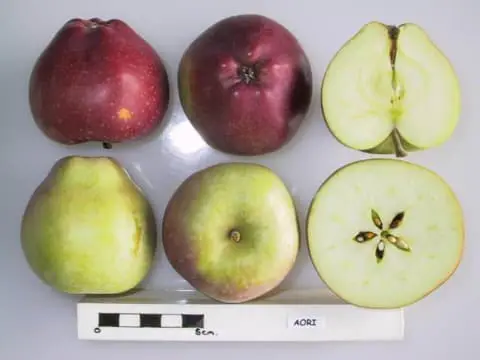
Tsugaru (つがる) was bred at the Aomori Apple Experiment Station at Kuroishi, in Aomori Prefecture1,3. It was selected from four seedlings of a 1930 cross on Golden Delicious, and its pollen parent was not known1. The tree first fruited in 1941 and was chosen in 1943; in 1970 it received the provisional name Aori 2, and in 1975 it was registered as Tsugaru under the Agricultural Seeds and Seedlings Act1,2. Writing in 1974, Yoshida and Mink described Aori 2 as a sweet early apple of good quality that was replacing McIntosh in warmer districts, and gave Kogetsu, Korin, Nishiki and Golden Fumei as other names for it3.
DNA has since supplied the missing parent. In 2005 Kitahara and colleagues, using S-RNase analysis and SSR markers, identified Jonathan as the pollen parent4, and SNP data published in 2025 confirm Golden Delicious and Jonathan as its parents5. Aomori’s apple council now gives its parentage as Golden Delicious × Jonathan2.
In 2018 Tsugaru covered 4,193.7 hectares, 11.7 per cent of Japan’s apple orchards, second only to Fuji6. Aomori Prefecture grew more than 60 per cent of Japan’s apples in 2024, and there Tsugaru covered 2,266 hectares in 2025, 11 per cent of the prefecture’s apple area; it is the only early variety among the prefecture’s four leading apples7.
The fruit
The fruit weighs about 250 grams in the Hokkaido trials and about 300 grams by the Aomori council’s account1,2. It is oblong and even in size, with a yellow-green ground broadly striped in dark red1, or bright red stripes over red2. The flesh is yellowish white1, fine-textured and fairly firm2, and very juicy1,2. It is very sweet with little acid: about 14 per cent sugar and 0.4 grams of acid per 100 millilitres in Hokkaido1,2. Fully ripe fruit can show a little watercore1.
In Aomori it is picked in early and mid-September and sold in September and October2; in Hokkaido it ripened in late September and early October1. It is good to eat as soon as it is picked and keeps for about a month in ordinary storage, during which the skin turns greasy1.
Growing
The tree is of medium vigour, upright when young and spreading with age, and comes into bearing early1. More and more fruit drops as harvest approaches, so Hokkaido’s growers were advised to spray against it1. It is fairly resistant to Alternaria blotch1 but susceptible to bitter pit3. Its pollen is highly fertile, which makes it useful for pollinating other varieties1. After trials in 1980–85, in which it was the most productive variety of its season, Hokkaido’s experiment stations recommended it for planting throughout the island1.
Where the sources disagree
- Pollen parent. The breeders recorded only Golden Delicious: Yoshida and Mink named that parent alone, and Hokkaido’s report on its 1980–85 trials called the pollen parent unknown1,3. Two DNA studies name Jonathan4,5, and Aomori’s apple council now does too2.
- Keeping. Yoshida and Mink gave about three weeks3; the Hokkaido trials found about a month in ordinary storage1.
Family tree
Parents, grandparents and great-grandparents, as the entries in the atlas record them.
- Tsugaru Japan, 1930
- Seed parent Golden Delicious United States, 1905
- Parent Grimes Golden United States, by 1804
- Pollen parent Jonathan United States, by 1826
- Parent Esopus Spitzenburg United States, before 1790
- Parent Reinette Franche France, by 1540
- Parent Esopus Spitzenburg United States, before 1790
- Seed parent Golden Delicious United States, 1905
Offspring in the atlas
- Akibae × Senshu; Japan, 1981
- Meku × American Summer Pearmain; Japan, 1959
- Michinoku × Kitakami; Japan
- Shinano Sweet × Fuji; Japan, 1978
Sources
- Apple "Tsugaru": recommendation for Hokkaido (in Japanese), Hokkaido National Agricultural Experiment Station and Hokkaido Central Agricultural Experiment Station, Hokkaido Research Organization. Supports: bred by the Aomori Apple Experiment Station, which in 1930 selected it from four seedlings of Golden Delicious crosses, "the pollen parent is unknown"; first fruit 1941, selected 1943, given the provisional name Aori 2 in 1970 and registered as Tsugaru in 1975 under the Agricultural Seeds and Seedlings Act; medium vigour, upright when young and spreading with age; early bearing; fruit about 250 g, oblong and even, yellow-green with broad dark red stripes, yellowish-white flesh, juicy, about 14 per cent sugar and 0.4 g acid per 100 mL, a little watercore when fully ripe; ripe late September to early October in Hokkaido trials of 1980–85 (Showa 55–60), where it was the most productive variety of its season; good to eat from harvest, keeping about a month in ordinary storage, the skin turning greasy; increasing pre-harvest drop needing sprays; fairly resistant to Alternaria blotch; highly fertile pollen, useful for pollination; recommended for planting throughout Hokkaido.
- Apple varieties (in Japanese), Aomori Prefecture Apple Council (Aomori-ken Ringo Taisaku Kyōgikai). Supports: Tsugaru (つがる): (mother) Golden Delicious × (father) Kōgyoku, that is Jonathan; bred by the Aomori Apple Experiment Station and registered in 1975; picked in early to mid-September and sold in September and October; about 300 g; red skin with bright red stripes; fairly firm, fine-textured flesh, very juicy and very sweet, with almost no acidity.
- Japanese apple varieties, Y. Yoshida and G. I. Mink, Fruit Varieties and Horticultural Digest 28(1):7–8, American Pomological Society, 1974. Supports: the Aomori Apple Experiment Station "located at Kuroishi City in Aomori Prefecture"; Aori #2, of Golden Delicious parentage: early to mid-season, red stripes, medium size, yellow, juicy, sweet flesh, "Good quality for early apple", storing about three weeks, susceptible to bitter pit, replacing McIntosh in warmer regions; synonyms Kogetsu, Korin, Nishiki and Golden Fumei.
- Parent identification of eight apple cultivars by S-RNase analysis and simple sequence repeat markers, K. Kitahara, S. Matsumoto and others, HortScience 40(2):314–317 (abstract), 2005. Supports: Jonathan identified by S-RNase analysis and SSR markers as the paternal parent of Tsugaru, which had been described as having an unknown paternal parent.
- Cultivar fingerprinting and SNP-based pedigree reconstruction in Danish heritage apple cultivars utilizing genotypic data from multiple germplasm collections in the world, B. Larsen and others, Genetic Resources and Crop Evolution 72:2397, supplementary Table S5, 2025. Supports: Table S5: Tsugaru diploid, with Golden Delicious and Jonathan as its SNP-confirmed parents.
- Apple area by variety, 2018 (in Japanese), National Agriculture and Food Research Organization (NARO), Institute of Fruit Tree and Tea Science, from the Ministry of Agriculture, Forestry and Fisheries' survey of the 2018 crop. Supports: Tsugaru on 4,193.7 ha, 11.7 per cent of Japan's 35,895.7 ha of apples, second to Fuji (2018).
- Aomori apple production (in Japanese), Aomori Prefecture Apple Council, from the Aomori Prefecture apple and fruit-tree division. Supports: Aomori apples "more than 60 per cent" of Japan's production in 2024; Tsugaru on 2,266 ha in Aomori Prefecture in 2025 (survey at the end of June), 11 per cent of the prefecture's apple area; of the four leading varieties, all but the early Tsugaru keep well.
More from Japan
-
Akane
-
Akibae
A Nakano grower's 1981 cross of Senshu and Tsugaru; its dark fruit was ignored in Tokyo but welcomed in Kyushu
-
Amanishiki
-
Aori
-
Fuji
Bred at Fujisaki, Aomori, from a 1939 cross; by a 2025 estimate it makes up 70 per cent of China's apples
-
Fukunishiki
-
Fukutami
-
Golden Melon