Apples of Japan
38 varieties in the atlas came from Japan. The oldest is Indo, dated by 1930.
Harvest
Japan grew 658,377 tonnes of apples in 2024, 0.67% of the world's harvest; it ranked 21st among the world's producers.1 FAOSTAT estimated this figure; it is not one Japan reported.
The figures
| Year | Tonnes |
|---|---|
| 2024 | 658,377 (estimated by FAOSTAT) |
| 2023 | 604,000 |
| 2022 | 737,100 |
| 2021 | 661,900 |
| 2020 | 763,300 |
| 2019 | 701,600 |
| 2018 | 756,100 |
| 2017 | 735,200 |
| 2016 | 765,000 |
| 2015 | 811,500 |
| 2014 | 816,300 |
| 2013 | 741,700 |
| 2012 | 793,800 |
| 2011 | 655,300 |
| 2010 | 786,500 |
| 2009 | 845,600 |
| 2008 | 910,700 |
| 2007 | 840,100 |
| 2006 | 831,800 |
| 2005 | 818,900 |
| 2004 | 754,600 |
| 2003 | 842,100 |
| 2002 | 925,800 |
| 2001 | 930,700 |
| 2000 | 799,600 |
| 1999 | 927,700 |
| 1998 | 879,100 |
| 1997 | 993,300 |
| 1996 | 899,200 |
| 1995 | 962,600 |
| 1994 | 989,300 |
| 1993 | 1,011,000 |
| 1992 | 1,039,000 |
| 1991 | 760,300 |
| 1990 | 1,053,000 |
| 1989 | 1,045,000 |
| 1988 | 1,042,000 |
| 1987 | 997,900 |
| 1986 | 986,100 |
| 1985 | 910,300 |
| 1984 | 811,700 |
| 1983 | 1,048,000 |
| 1982 | 924,500 |
| 1981 | 845,700 |
| 1980 | 960,100 |
| 1979 | 852,700 |
| 1978 | 844,000 |
| 1977 | 958,800 |
| 1976 | 879,400 |
| 1975 | 897,900 |
| 1974 | 850,400 |
| 1973 | 962,700 |
| 1972 | 959,100 |
| 1971 | 1,006,000 |
| 1970 | 1,021,000 |
| 1969 | 1,085,000 |
| 1968 | 1,136,000 |
| 1967 | 1,125,000 |
| 1966 | 1,059,000 |
| 1965 | 1,132,000 |
| 1964 | 1,090,000 |
| 1963 | 1,155,000 |
| 1962 | 1,000,000 |
| 1961 | 955,400 |
Estimated or imputed by FAOSTAT, not a figure the country reported.
Growing regions
Varieties from Japan, oldest first
-
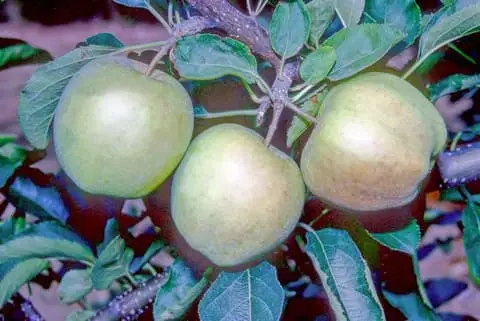
Mutsu
Raised at Aomori in 1930, a big triploid that turns pink when grown in paper bags; renamed Crispin in Britain in 1968
-
Sekai Ichi
A very large Aomori apple, often 500 grams or more, named after advertising that called it the biggest in the world
-
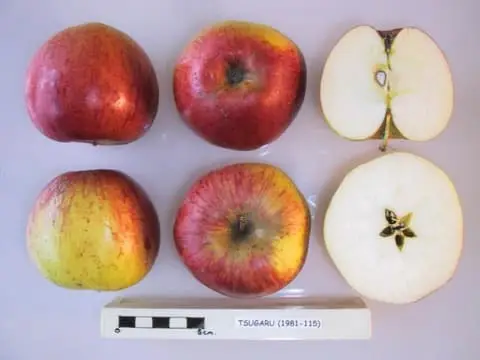
Tsugaru
Japan's second most planted apple in 2018, from a 1930 Aomori cross; DNA shows its unrecorded father was Jonathan
-
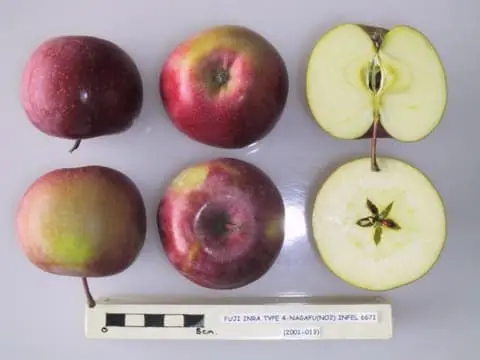
Fuji
Bred at Fujisaki, Aomori, from a 1939 cross; by a 2025 estimate it makes up 70 per cent of China's apples
-
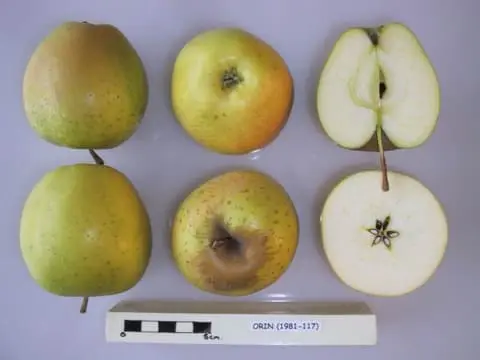
Ōrin
A Fukushima farmer's apple, first fruiting in 1943, that spread without official registration to rank third in Japan
-
Senshu
Bred in Akita from a 1966 cross of Tōkō and Fuji; a parent of Shinano Gold, Akibae and Kiō
-
Shinano Sweet
A soft, sweet October apple bred in Nagano from Fuji and Tsugaru; fifth in Japan by area in 2018
-
Akibae
A Nakano grower's 1981 cross of Senshu and Tsugaru; its dark fruit was ignored in Tokyo but welcomed in Kyushu
-
Hokuto
A triploid Aomori apple registered in 1983 as Fuji × Mutsu; DNA studies have since ruled Mutsu out as its father
-
Shinano Gold
A yellow Nagano apple from a 1983 cross; licensed to South Tyrol in 2016, the first Nagano variety licensed abroad
-
Toki
A yellow Aomori apple named after its raiser; registered as Ōrin × Kogetsu, its father is now given as Fuji
And 27 more in the catalogue, A to Z
- Akane 1937
- Amanishiki 1936
- Aori by 1977
- Fukunishiki 1933
- Fukutami 1933
- Golden Melon 1931
- Hatsuaki 1939
- Horei 1931
- Indo by 1930
- Jumbo Ohrin 1985
- Kinrei 1932
- Korei 1935
- Kougetsu
- Kyokko 1931
- Mahe 1956
- Maruba by 1981
- Megumi 1931
- Meku 1959
- Michinoku
- Murasaki 1935
- Nebuta 1981
- New Jonagold
- Sensyu 1984
- Shin Indo 1930
- Shinko 1931
- Shinsei 1930
- Toyo by 1935
Sources
- FAOSTAT: Production: Crops and livestock products, Food and Agriculture Organization of the United Nations (FAO), Updated 31 December 2025. Supports: each country's apple harvest by year (item 515, apples, in tonnes, 1961 to 2024), the shares of the world's harvest and the ranks worked out from them, and which figures FAOSTAT estimated or imputed.