Shinano Sweet
A soft, sweet October apple bred in Nagano from Fuji and Tsugaru; fifth in Japan by area in 2018
History
Shinano Sweet (シナノスイート) was bred at the Nagano Fruit Tree Experiment Station at Suzaka1,2. From the 1970s Japanese apple growing came to centre on the late Fuji and the early Tsugaru, but no mid-season apple had become established, so in 1978 the station began breeding for that season2. That year it crossed Fuji with Tsugaru; 97 seedlings were raised the following year and grafted onto M.26 dwarfing rootstock in 19802. The seedling that became Shinano Sweet first fruited in 1984, was chosen in 1987 for its fruit and in 1991 for its keeping and few physiological disorders, and after trials at five growers’ orchards was completed in 19932. Nagano Prefecture applied for registration in March 1994, and the variety was registered on 22 August 19961,2.
Nagano made it a promoted variety in 1997, and because young trees were also sold outside the prefecture it spread across Japan: in 2014 it was grown on 1,048 hectares in 18 prefectures, among them Aomori, Akita and Yamagata, more than any other apple registered since 19892. In 2018 it covered 1,107.8 hectares, 3.1 per cent of Japan’s apple orchards, the fifth largest area after Fuji, Tsugaru, Ōrin and Jonagold3. Nagano grew it on 676 hectares in 2024, producing 10,130 tonnes4. It has also been well received as an export to Taiwan, Hong Kong and Singapore2.
The fruit
The registration describes a large, oblong fruit of about 380 grams, its yellow-green ground covered in red with clear stripes, with little russet and little gloss1. In trials in 1998–2002 the fruit averaged 335 grams, 15 °Brix and 0.26 per cent malic acid2. The flesh is yellow and juicy, of medium firmness and texture, with little or no watercore1,2. Komatsu notes that its soft, juicy flesh, low acidity and strong sweetness set it apart from earlier varieties, for which firm flesh and a balance of sweetness and acid had been sought2. The flesh does not readily turn mealy, and the fruit stays fresh for about three weeks at room temperature2.
At Suzaka the main harvest falls in early to mid October, about 160 days after full bloom and roughly midway between Tsugaru and Fuji2. Nagano Prefecture gives its harvest as starting around mid-October5 and plans to centre its shipping on mid- to late October4.
Growing
The tree is of medium size and vigour, more vigorous than Tsugaru, and between upright and spreading in habit1,2. It is self-incompatible but sets fruit with Fuji, Tsugaru and Ōrin; its S-alleles are S1S72. Its skin is hard to colour: trials across Nagano showed colour falling as the mean temperature of the three weeks before harvest rose, and found that deep red fruit could be grown reliably at 500 metres or more2. Core mould, caused by Alternaria and Fusarium fungi, became serious enough to threaten the variety as breeding ended. Delaying the first thinning of the fruitlets was found to reduce it, and removing fruit that colours early keeps affected fruit out of the harvest2. To grow fruit of 300–350 grams with 14–15 °Brix, Nagano advises about 60 leaves for each fruit2.
Where the sources disagree
Family tree
Parents, grandparents and great-grandparents, as the entries in the atlas record them.
- Shinano Sweet Japan, 1978
- Seed parent Fuji Japan, 1939
- Seed parent Ralls Janet United States, about 1800
- Pollen parent Delicious United States, 1872
- Parent Winesap United States, by 1817
- Pollen parent Tsugaru Japan, 1930
- Seed parent Golden Delicious United States, 1905
- Parent Grimes Golden United States, by 1804
- Pollen parent Jonathan United States, by 1826
- Parent Esopus Spitzenburg United States, before 1790
- Seed parent Golden Delicious United States, 1905
- Seed parent Fuji Japan, 1939
Sources
- Registered variety database: Shinano Sweet, registration no. 5139 (in Japanese), Ministry of Agriculture, Forestry and Fisheries (MAFF), plant variety registration database, 1996-08-22. Supports: シナノスイート (Shinano Sweet), applied for on 31 March 1994 and registered on 22 August 1996 by Nagano Prefecture; raised by crossing Fuji with Tsugaru; a mid-season variety maturing in mid-October at the breeding site (Suzaka, Nagano Prefecture); tree of intermediate habit and medium size and vigour; fruit oblong, about 380 g, yellow-green ground covered in red with clear stripes, russet only in the stalk cavity and none to slight, weak gloss; flesh yellow, medium firmness and texture, none to slight watercore, weak acidity, juicy; low self-fruitfulness; ordinary storage fairly long; core mould moderate.
- Breeding of 'Shinano Sweet' and 'Shinano Gold' apples and development of their management techniques to stably produce high-quality fruits (in Japanese), Hiromitsu Komatsu, Nagano Prefectural Fruit Tree Experiment Station, Horticultural Research (Japan) 17(3):269–277, Japanese Society for Horticultural Science, J-STAGE, 2018. Supports: from the 1970s Japanese apple growing centred on late Fuji and early Tsugaru, with no established mid-season variety; mid-season breeding at the station from 1978; the 1978 cross of Fuji and Tsugaru, 97 seedlings raised the next year and grafted on M.26 in 1980; first fruit 1984, first selection 1987 for fruit quality, second selection 1991 for storage and few physiological disorders, trials top-worked at five growers' sites, breeding completed 1993; application in March 1994 and registration on 22 August 1996; adopted as a Nagano promoted variety in 1997; young trees sold outside Nagano; 1,048 ha in 18 prefectures including Aomori, Akita and Yamagata in 2014, fifth after Fuji, Tsugaru, Ōrin and Jonagold and the largest of the varieties registered in the Heisei era; well received in exports to Taiwan, Hong Kong and Singapore; tree more vigorous than Tsugaru; peak harvest early to mid October at Suzaka, about 160 days after full bloom, about midway between Fuji and Tsugaru; cross-compatible with Fuji, Tsugaru and Ōrin, not self-compatible, S-RNase genotype S1S7; 1998–2002 trials: harvested 26 September to 5 October, 335 g, 15 °Brix, 0.26 per cent malic acid; juicy, soft, low-acid, very sweet flesh, unlike earlier varieties bred for balanced flavour and firm flesh; not mealy, fresh for about three weeks at room temperature; poor colour, colour falling with higher mean temperature in the three weeks before harvest, deep red fruit reliably above 500 m in Nagano; core mould, not seen early in breeding, became a serious problem at its completion, caused by Alternaria and Fusarium spp., reduced by later preliminary thinning and by removing early-coloured fruit before harvest; about 60 leaves per fruit for fruit of 300–350 g and 14–15 °Brix.
- Apple area by variety, 2018 (in Japanese), National Agriculture and Food Research Organization (NARO), Institute of Fruit Tree and Tea Science, from the Ministry of Agriculture, Forestry and Fisheries' survey of the 2018 crop. Supports: Shinano Sweet on 1,107.8 ha, 3.1 per cent of Japan's 35,895.7 ha of apples, fifth after Fuji, Tsugaru, Ōrin and Jonagold (2018).
- Nagano Prefecture fruit-growing promotion plan, p. 5, table 2, and pp. 5–6 (in Japanese), Nagano Prefecture, 2026-03. Supports: Shinano Sweet in Nagano on 676 ha with 10,130 t in fiscal 2024; its shipping to be centred on mid- to late October, as it is popular with consumers and buyers.
- Do you know Shinshū's farm produce? Apples (in Japanese), Nagano Prefecture, 2025-08-22. Supports: harvest of Shinano Sweet in Nagano from around mid-October.
More from Japan
-
Akane
-
Akibae
A Nakano grower's 1981 cross of Senshu and Tsugaru; its dark fruit was ignored in Tokyo but welcomed in Kyushu
-
Amanishiki
-
Aori
-
Fuji
Bred at Fujisaki, Aomori, from a 1939 cross; by a 2025 estimate it makes up 70 per cent of China's apples
-
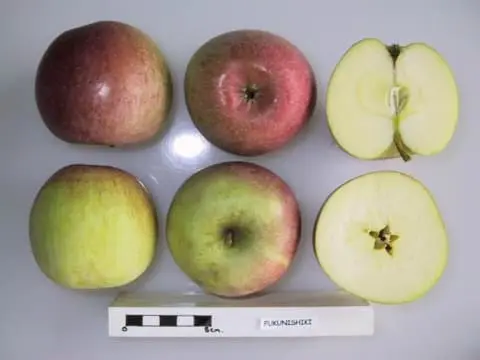
Fukunishiki
-
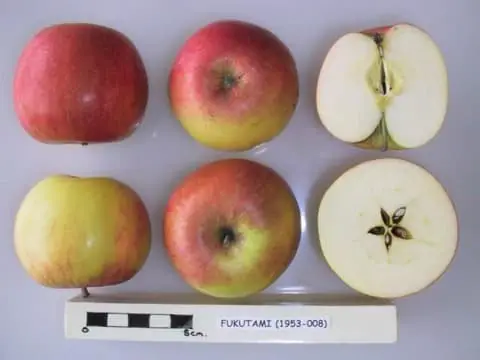
Fukutami
-
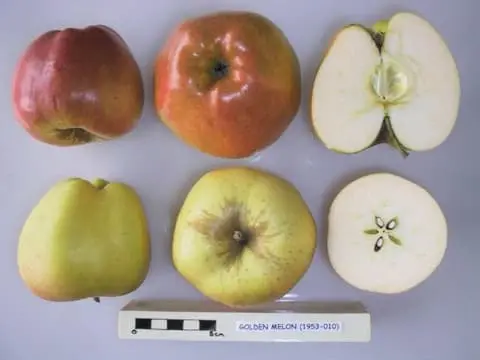
Golden Melon