Ōrin
A Fukushima farmer's apple, first fruiting in 1943, that spread without official registration to rank third in Japan
History
Ōrin (王林) was raised by Tadanosuke Ōtsuki, a farmer at Kōri in Fukushima Prefecture1,3,7. He had once traded in silkworm eggs; in the early Shōwa period, when fruit growing was being encouraged, he became interested in breeding apples, and he would sow the pips of good apples in a seedling plot1. Ōrin first fruited in 19431. The head of the nearby Date agricultural cooperative noticed how good it tasted and in 1952 named it Ōrin, calling it the king of apples; from that year it began to reach the Tokyo market1,3.
The Ministry of Agriculture and Forestry did not register it: according to Toshihiko Nishio, writing in 1996, it reportedly failed the examination because of its poor looks and conspicuous dots, but growers took it up regardless1. In 1961 forty-five Kōri growers formed an Ōrin association, which worked out how to grow it without bags1. By 1994 it covered 4,800 hectares of bearing orchard, 9 per cent of Japan’s apple area, third after Fuji and Tsugaru, and it was grown in Aomori, Nagano and other prefectures1. In 2018 it was still third, on 2,641.7 hectares, or 7.4 per cent4.
Ōtsuki died in 1972, aged 851. A committee to preserve the original tree was founded in Kōri in 1992; that tree rotted and fell around 2005, but a second-generation tree, grown from a shoot at its base, now bears fruit2.
The fruit
The fruit weighs 250 to 300 grams3,5 and is oblong5. Its greenish-yellow skin is marked with prominent russeted dots3,5. The flesh is firm, fine-textured and very juicy, with hardly any acid; the flavour is sweet with a distinctive aroma3,5,7. Aomori’s apple council calls it a pioneer among yellow apples3.
In Aomori it is picked from late October to early November and sold from store until August3; at the National Fruit Collection in Kent it is picked in late October7. Norton and colleagues rated it an excellent keeper and found the tree productive5.
Where the sources disagree
- Parents. Aomori’s apple council and Norton and colleagues give Golden Delicious × Indo3,5. Nishio mentioned that view but thought it more likely a chance seedling of Delicious1, and the Fukushima Minpō newspaper says Ōtsuki crossed Indo with Delicious2. SNP data identify Golden Delicious and Indo as its parents6.
- Ploidy. The National Fruit Collection describes Ōrin as triploid7, but SNP genotyping of the collection’s own tree, accession 1981-117, found it diploid6.
Family tree
Parents, grandparents and great-grandparents, as the entries in the atlas record them.
- Ōrin Japan, first fruited 1943
- Seed parent Golden Delicious United States, 1905
- Parent Grimes Golden United States, by 1804
- Pollen parent Indo Japan, by 1930
- Seed parent White Winter Pearmain
- Seed parent Golden Delicious United States, 1905
Offspring in the atlas
- Toki × Fuji; Japan, registered 2004
Sources
- The man who raised the king of apples: Tadanosuke Ōtsuki and his companions of the Ōrin association (in Japanese), Toshihiko Nishio, Japan Association for Techno-innovation in Agriculture, Forestry and Fisheries (JATAFF), reprinted from Nōgyō Kyōsai Shimbun, 1996-09-11. Supports: Ōrin raised by Ōtsuki (大槻只之助), a farmer of Kōri (桑折, こおり), Fukushima Prefecture, who had run a silkworm-egg business and took up apple breeding in the early Shōwa period, sowing the seeds of good apples in a seedling plot; "some say" a cross of Golden Delicious and Indo, but apparently selected from a chance seedling of Delicious; first fruit in 1943; noticed by the head of the nearby Date agricultural cooperative, who named it Ōrin as the king of apples in 1952, when it began to reach the Tokyo market; not a registered variety of the Ministry of Agriculture and Forestry, reportedly having failed the examination for its poor looks and conspicuous dots; the Ōrin association of 45 Kōri growers formed in 1961, where bag-free growing for Ōrin was worked out; 4.8 thousand ha of bearing orchard in 1994, 9 per cent of Japan's apple area, third after Fuji and Tsugaru; grown in Aomori, Nagano and other prefectures; the original tree still fruiting, with a granite memorial raised by the town and the cooperative; Ōtsuki died in 1972 aged 85.
- February 20: in 1992 Kōri's committee to preserve the original Ōrin tree is founded (in Japanese), Fukushima Minpō, 2024-02-20. Supports: the Kōri committee to preserve the original Ōrin tree founded on 20 February 1992; Ōrin created in 1943 by Ōtsuki, who crossed Indo and Delicious and sowed the seeds of the fruit; the original tree, cared for by a relative, rotted and fell around 2005, and a second-generation tree grown from a shoot at its base has grown large enough to bear fruit.
- Apple varieties (in Japanese), Aomori Prefecture Apple Council (Aomori-ken Ringo Taisaku Kyōgikai). Supports: Ōrin (王林): (mother) Golden Delicious × (father) Indo; raised by the late Ōtsuki of Fukushima Prefecture and named in 1952; picked from late October to early November and sold until August; about 300 g; greenish-yellow skin; fairly firm, fine-textured flesh, very juicy, with almost no acidity, sweet with a distinctive pleasant aroma; a pioneer among yellow apples.
- Apple area by variety, 2018 (in Japanese), National Agriculture and Food Research Organization (NARO), Institute of Fruit Tree and Tea Science, from the Ministry of Agriculture, Forestry and Fisheries' survey of the 2018 crop. Supports: Ōrin on 2,641.7 ha, 7.4 per cent of Japan's apple area, third after Fuji and Tsugaru (2018).
- Current status of several Japanese apple cultivars, R. A. Norton, R. L. Stebbins and Y. Yoshida, Fruit Varieties Journal 41(1):22–28, American Pomological Society, 1987. Supports: Table 1: Orin, from Fukushima (T. Otsuki), Golden Delicious × Indo; 250–300 g by Japanese nursery catalogues, oblong, yellow-green with prominent russeted lenticels; firm, aromatic, sweet and juicy flesh; excellent storage; productive.
- Using whole-genome SNP data to reconstruct a large multi-generation pedigree in apple germplasm, Hélène Muranty and others, BMC Plant Biology 20:2, Additional files 1 and 3, 2020. Supports: Table S3: Golden Delicious and Indo found from SNP data as the parents of Orin, both confirming the documented parents; Table S1: the National Fruit Collection's accession 1981-117 (Orin) diploid (2n), dated "before 1942".
- Orin (accession 1981-117), National Fruit Collection, Brogdale, Kent (Defra). Supports: "Triploid. Originated before 1942 by T. Otsuki, an apple grower in Fukushima Prefecture, Japan"; firm, juicy flesh with a sweet, aromatic flavour; picked in late October at Brogdale.
More from Japan
-
Akane
-
Akibae
A Nakano grower's 1981 cross of Senshu and Tsugaru; its dark fruit was ignored in Tokyo but welcomed in Kyushu
-
Amanishiki
-
Aori
-
Fuji
Bred at Fujisaki, Aomori, from a 1939 cross; by a 2025 estimate it makes up 70 per cent of China's apples
-
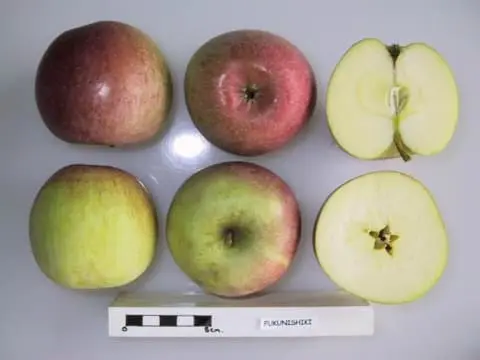
Fukunishiki
-
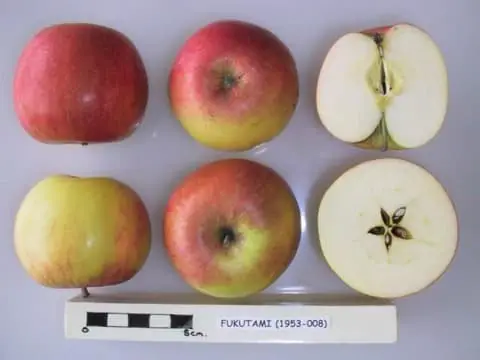
Fukutami
-
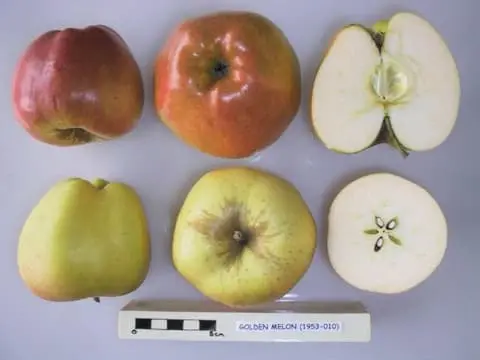
Golden Melon