Toki
A yellow Aomori apple named after its raiser; registered as Ōrin × Kogetsu, its father is now given as Fuji
History
Toki (トキ) was raised at Goshogawara, in Aomori Prefecture, by the late 土岐傳四郎, who spent about twenty years on it and whose surname, Toki, it bears1,2,3. A Hirosaki nursery company applied to register it in October 2001, naming him as the breeder, and it was registered on 8 November 20041. According to Igarashi and colleagues, it had been released several years before registration6.
The registration gives its parents as Ōrin and Kogetsu (紅月)1. In 2015 Aomori Prefecture’s tourism blog reported that later genetic analysis had shown it to be a cross of Ōrin and Fuji2, and Aomori’s industry council gives that parentage3. The raiser received the Kimura Jin’ya Prize, an annual Aomori award for service to the apple industry, for 2010; the citation credits him with crossing and raising Toki and gives its parents as Ōrin and Fuji4.
Its production grew quickly, and Igarashi and colleagues described it in 2016 as rapidly increasing6. After the 2012 crop was poorly received, Aomori’s apple industry began a joint effort in July 2013 to improve the quality of its yellow varieties, and the 2013 Toki crop was well received4. In Aomori, Toki covered 347 hectares in 2021 and 352 hectares in 2025, 2 per cent of the prefecture’s apple orchards5.
The fruit
The registration describes a round, medium-sized fruit with a yellow skin, little russet and a long, thick stalk1. The yellow flesh is dense and juicy, of medium firmness, with little or no watercore, weak acidity and medium sweetness1. Aomori’s council gives a weight of about 350 grams and a yellow skin sometimes tinged with orange-red, and calls the flesh juicy and very sweet, with an aroma like Ōrin’s3; Igarashi and colleagues also call it juicy and very sweet6.
It ripens in early October at Goshogawara1. In Aomori it is picked from the end of September to early October and sold until November, a short season3. Its keeping in ordinary and cold storage is rated medium1.
Growing
The tree is spreading and of medium vigour, with many flower buds in the leaf axils; it drops little fruit before harvest and suffers little core mould1.
Where the sources disagree
- Pollen parent. The registration gives Kogetsu1. Aomori Prefecture reports a genetic analysis showing Fuji2, the parentage also given by the council and in the 2010 prize citation3,4.
- Aroma and sweetness. The registration rates the aroma slight and the sweetness medium1; the council praises its strong sweetness and Ōrin-like aroma3, and Igarashi and colleagues call it very sweet6.
Family tree
Parents, grandparents and great-grandparents, as the entries in the atlas record them.
- Toki Japan, registered 2004
- Seed parent Ōrin Japan, first fruited 1943
- Seed parent Golden Delicious United States, 1905
- Parent Grimes Golden United States, by 1804
- Pollen parent Indo Japan, by 1930
- Seed parent White Winter Pearmain
- Seed parent Golden Delicious United States, 1905
- Pollen parent Fuji Japan, 1939
- Seed parent Ralls Janet United States, about 1800
- Pollen parent Delicious United States, 1872
- Parent Winesap United States, by 1817
- Seed parent Ōrin Japan, first fruited 1943
Sources
- Registered variety database: Toki, registration no. 12306 (in Japanese), Ministry of Agriculture, Forestry and Fisheries (MAFF), plant variety registration database, 2004-11-08. Supports: トキ (Toki), applied for on 9 October 2001 and registered on 8 November 2004; registrant a nursery company of Hirosaki, breeder 土岐傳四郎; raised by crossing Ōrin with Kogetsu (紅月); a mid-season variety maturing in early October at the breeding site (Goshogawara, Aomori Prefecture); tree spreading, of medium vigour, with many axillary flower buds; fruit round, medium-sized, ground and covering colour yellow, the covering colour slight and pale, russet none to slight, long thick stalk; flesh yellow, medium firmness, dense, little or no watercore, medium sweetness, weak acidity, little aroma, juicy; little pre-harvest drop; ordinary and cold storage medium; little core mould.
- Toki, the next ace of Aomori apples (in Japanese), Aomori Prefecture, Amazing AOMORI official tourism site, Marugoto Aomori blog, 2015-09-09. Supports: raised over about twenty years by the late 土岐傳四郎 of Goshogawara and registered in 2004; the name from Mr Toki's name; originally registered as a cross of Ōrin and Kogetsu, but shown by later genetic analysis to be a cross of Ōrin and Fuji.
- Apple varieties (in Japanese), Aomori Prefecture Apple Council (Aomori-ken Ringo Taisaku Kyōgikai). Supports: Toki (トキ): (mother) Ōrin × (father) Fuji; raised by the late 土岐傳四郎 of Goshogawara and registered in 2004; picked from the end of September to early October and sold from the end of September to November, with a short season; about 350 g, yellow skin, some fruit faintly tinged orange-red; juicy, very sweet, with a good aroma inherited from Ōrin.
- Aomori apples, 2023 edition, pp. 33–34 and 46 (in Japanese), Aomori Prefecture, Department of Agriculture, Forestry and Fisheries, 2023. Supports: the Kimura Jin'ya Prize, given every year since 1970 to organisations and people who have served the apple industry; its 2010 (Heisei 22) award to 土岐傳四郎 for crossing and raising the yellow variety Toki (Ōrin × Fuji); in 2013, after the poor reception of the previous year's Toki, a meeting on 25 July began a joint effort by the apple industry to improve the quality of yellow varieties, and the 2013 Toki crop was well received.
- Aomori apple production (in Japanese), Aomori Prefecture Apple Council, from the Aomori Prefecture apple and fruit-tree division. Supports: Toki on 347 ha in Aomori Prefecture in 2021 and 352 ha in 2025 (surveys at the end of June), 2 per cent of the prefecture's apple area in 2025.
- Biotechnology and apple breeding in Japan, Megumi Igarashi, Yoshimichi Hatsuyama, Takeo Harada and Tomoko Fukasawa-Akada, Breeding Science 66(1):18–33, Japanese Society of Breeding, PubMed Central, 2016. Supports: Table 1: Toki (2004) among cultivars raised by growers and nurseries; "released several years prior to its registration in 2004", "a juicy and very sweet yellow cultivar whose production is rapidly increasing".
More from Japan
-
Akane
-
Akibae
A Nakano grower's 1981 cross of Senshu and Tsugaru; its dark fruit was ignored in Tokyo but welcomed in Kyushu
-
Amanishiki
-
Aori
-
Fuji
Bred at Fujisaki, Aomori, from a 1939 cross; by a 2025 estimate it makes up 70 per cent of China's apples
-
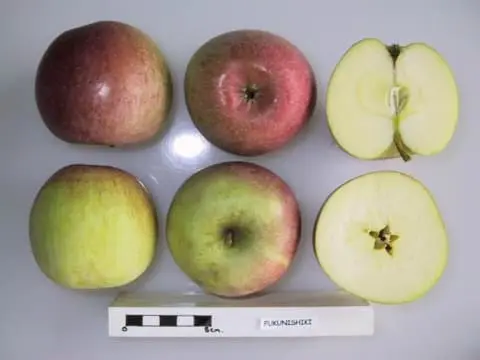
Fukunishiki
-
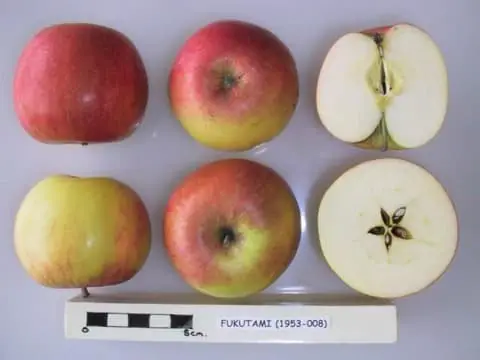
Fukutami
-
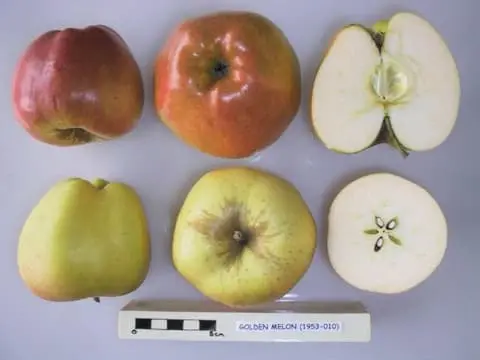
Golden Melon