Shinano Gold
A yellow Nagano apple from a 1983 cross; licensed to South Tyrol in 2016, the first Nagano variety licensed abroad
History
Shinano Gold (シナノゴールド) was bred at the Nagano Fruit Tree Experiment Station at Suzaka from a cross of Golden Delicious and Senshu made in 19831,2. The breeders were after a well-flavoured apple, and growers wanted one to pick in October, between Tsugaru in September and Fuji in November; Senshu was chosen for its balanced flavour and Golden Delicious because it was easy to grow and cropped heavily3. Of 495 seedlings raised in 1984, the one that became Shinano Gold first fruited and was selected in 1992, was selected again in 1993 for its keeping and few physiological disorders, and was finished in 1995 after trials at five growers’ orchards2. One of its breeders, Hiromitsu Komatsu, recalled that the station’s three apple breeders seldom agreed at tastings but all judged this one delicious3. It was registered on 11 August 1999, with Nagano Prefecture as holder1,2, and the prefecture made it a promoted variety in 20002.
Some tasters during selection found it a little too sharp3, but its reputation grew at an international apple meeting in Nagano in 1997, where participants comparing October varieties called it “number one”; a South Tyrolean orchard specialist took an interest, which led to trial plantings in South Tyrol3. Production and sales in Italy began in 2013, and in March 2016 Nagano signed its first licence for a variety abroad, with a South Tyrolean growers’ organisation3. South Tyrol had 64 hectares of it in 20256. An association of South Tyrolean fruit cooperatives markets it under the trade mark Yello7, which the European Union’s marketing standard for apples also lists for it8.
In Japan it covered 810.5 hectares in 2018, 2.3 per cent of the apple orchards, sixth among varieties4, and Nagano grew it on 265 hectares in 20245.
The fruit
The fruit is oblong and fairly large1; in trials in 1998–2002 it averaged 370 grams, 15.7 °Brix and 0.43 per cent malic acid2. The skin is yellow without stripes, smooth and not very glossy, with some russet in the stalk cavity1. The yellow flesh is juicy, with little or no watercore1,2; Komatsu calls it firm and crisp, with a good balance of sweetness and acidity2. Fruit grown high up keeps much of its acidity even when ripe, but mellows in store2.
It stays fresh for about three weeks at room temperature and about three months in ordinary cold storage, though the skin shrivels if the fruit loses too much water2. Treated with 1-MCP, fruit picked at the right time keeps for six to seven months, which let Nagano sell it from long storage2.
At Suzaka its main harvest originally fell in late September and early October, about 155 days after full bloom; since growers were advised to let it ripen further for sweetness, the harvest has moved to mid- and late October2. From 2006 a colour chart was developed for timing the harvest of the yellow fruit, with higher readings required at higher altitudes2.
Growing
The tree is of medium size and vigour, between upright and spreading, and its short internodes give it the growth of a spur-type variety2. It sets fruit with Fuji, Tsugaru and Ōrin. Self-pollination gave some fruit, but without seeds, which the station put down to parthenocarpy, so it is not regarded as self-compatible; its S-alleles are S1S32. Nagano plans to maintain production, as its long storage lengthens the selling season5.
Where the sources disagree
Family tree
Parents, grandparents and great-grandparents, as the entries in the atlas record them.
- Shinano Gold Japan, 1983
- Seed parent Golden Delicious United States, 1905
- Parent Grimes Golden United States, by 1804
- Pollen parent Senshu Japan, 1966
- Parent Tōkō
- Parent Fuji Japan, 1939
- Seed parent Ralls Janet United States, about 1800
- Pollen parent Delicious United States, 1872
- Seed parent Golden Delicious United States, 1905
Sources
- Registered variety database: Shinano Gold, registration no. 7328 (in Japanese), Ministry of Agriculture, Forestry and Fisheries (MAFF), plant variety registration database, 1999-08-11. Supports: シナノゴールド (Shinano Gold), registered on 11 August 1999 by Nagano Prefecture; raised by crossing Golden Delicious with Senshu; a mid-season variety maturing in early to mid October at the breeding site (Suzaka, Nagano Prefecture); fruit oblong and fairly large; ground and covering colour yellow, no stripes, russet in the stalk cavity in moderate amount, smooth skin with rather weak gloss; flesh yellow, medium firmness and texture, none to slight watercore, medium sweetness and acidity, juicy; ordinary and cold storage long.
- Breeding of 'Shinano Sweet' and 'Shinano Gold' apples and development of their management techniques to stably produce high-quality fruits (in Japanese), Hiromitsu Komatsu, Nagano Prefectural Fruit Tree Experiment Station, Horticultural Research (Japan) 17(3):269–277, Japanese Society for Horticultural Science, J-STAGE, 2018. Supports: the 1983 cross of Golden Delicious and Senshu, 495 seedlings raised the next year and planted out in 1986; first fruit and first selection 1992, second selection 1993 for storage and few physiological disorders, trials top-worked at five growers' sites, breeding completed 1995; registration on 11 August 1999; adopted as a Nagano promoted variety in 2000; tree of intermediate habit, medium size and vigour, short internodes and spur-type growth; fruit pale greenish-yellow, unstriped, flesh yellow, little or no watercore, juicy; harvest at Suzaka originally late September to early October, about 155 days after full bloom, now mid to late October since later picking of riper, sweeter fruit has been advised; 1998–2002 trials: picked 21 September to 5 October, 370 g, 15.7 °Brix, 0.43 per cent malic acid, well-balanced flavour, firm, crisp flesh; fresh for about three weeks at room temperature and three months in ordinary cold storage, with skin shrivelling as fruit loses weight; six to seven months after 1-MCP fumigation, making sales from long storage possible; fruit from high altitude keeps much malic acid when ripe but mellows in store; a colour chart for harvest timing developed from 2006, with thresholds rising with altitude; cross-compatible with Fuji, Tsugaru and Ōrin, self-pollination giving seedless parthenocarpic fruit, S-RNase genotype S1S3.
- Shinano Gold: the story of a new variety (in Japanese), Nagano Prefecture agricultural research stations, interview with Hiromitsu Komatsu, 2016-11-22. Supports: the breeders' aim from the start of a good-tasting variety with balanced sweetness and acidity; growers wanted a variety to pick in October, between Tsugaru (about September) and Fuji (about November); Senshu chosen for its balanced, good flavour and Golden Delicious for being easy to grow and heavy-cropping; the station's three apple breeders, who rarely agreed, all judged it delicious; some tasters found it a little too acid; at an international apple meeting in Nagano in 1997 participants comparing October varieties called it "number one", and a South Tyrolean orchard specialist's interest led to trial planting in South Tyrol; crossed in 1983, sown the next year, first fruit in 1991; production and sales in Italy from 2013; in March 2016 Nagano's first overseas licence for a variety, with a South Tyrolean growers' organisation.
- Apple area by variety, 2018 (in Japanese), National Agriculture and Food Research Organization (NARO), Institute of Fruit Tree and Tea Science, from the Ministry of Agriculture, Forestry and Fisheries' survey of the 2018 crop. Supports: Shinano Gold on 810.5 ha, 2.3 per cent of Japan's apple area, sixth among varieties (2018).
- Nagano Prefecture fruit-growing promotion plan, p. 5, table 2, and p. 6 (in Japanese), Nagano Prefecture, 2026-03. Supports: Shinano Gold in Nagano on 265 ha in fiscal 2024; its production to be maintained because long storage extends the selling period.
- Agrar- und Forstbericht 2025, p. 40: the main apple and pear varieties in South Tyrol (in German), Autonomous Province of Bolzano – South Tyrol, 2026. Supports: Shinano Gold on 69 ha in South Tyrol in 2024 and 64 ha in 2025.
- Products and brands: yello (in German), Verband der Südtiroler Obstgenossenschaften (VOG, Association of South Tyrolean Fruit Cooperatives), Terlan. Supports: yello given as the brand name (Markenname) of the variety Shinano Gold, which arose in 1983 at the Nagano experiment station from a cross of Golden Delicious and Senshu; yello among the brands of this association of South Tyrolean fruit cooperatives.
- Commission Delegated Regulation (EU) 2023/2429, Annex I, Part B, Part 1 (marketing standard for apples), Appendix: non-exhaustive list of apple varieties, European Commission; Official Journal of the European Union, L series, 3 November 2023, 2023-08-17. Supports: the note that some listed varieties "may be marketed under names for which trademark protection has been sought or obtained in one or more countries", with "References to known trademarks" given in the fourth column "for information only"; Shinano Gold listed with the trade mark Yello.
More from Japan
-
Akane
-
Akibae
A Nakano grower's 1981 cross of Senshu and Tsugaru; its dark fruit was ignored in Tokyo but welcomed in Kyushu
-
Amanishiki
-
Aori
-
Fuji
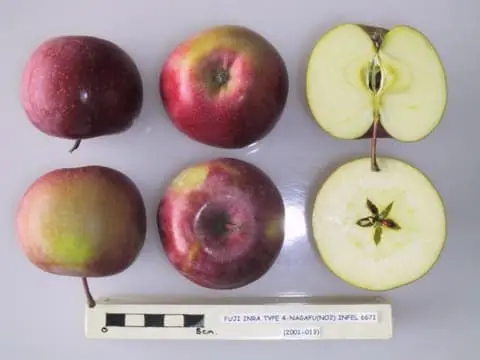
Bred at Fujisaki, Aomori, from a 1939 cross; by a 2025 estimate it makes up 70 per cent of China's apples
-
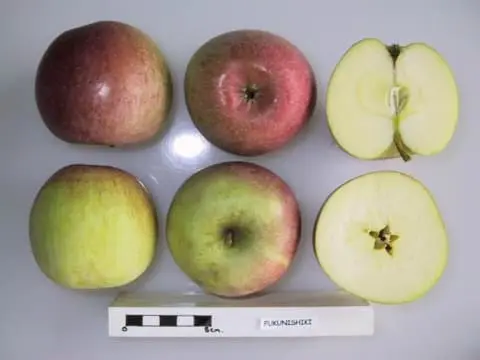
Fukunishiki
-
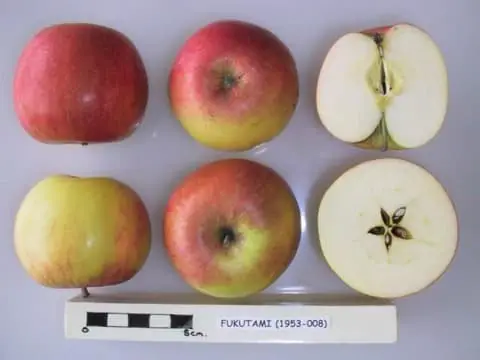
Fukutami
-
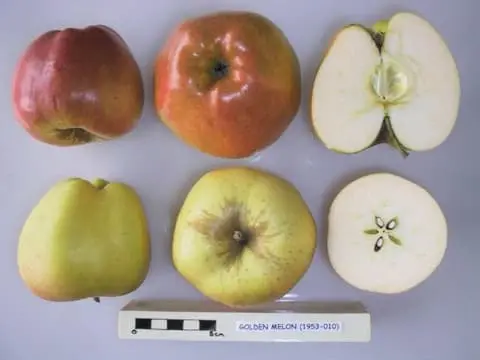
Golden Melon