Senshu
Bred in Akita from a 1966 cross of Tōkō and Fuji; a parent of Shinano Gold, Akibae and Kiō
History
Senshu (千秋) was bred by the Akita Prefectural Fruit Tree Experiment Station from a cross of Tōkō (東光) and Fuji made in 19662. Akita Prefecture applied to register it in December 1978, and it was registered on 31 March 1980 as number 42, with five breeders named: 鈴木宏, 田口辰雄, 丹野貞男, 丹波仁 and 今喜代治1. The breeder’s rights, granted for eighteen years, lapsed on 2 April 19961.
Senshu has been a parent of several later varieties. Akibae, registered in 1993, was raised at Nakano in Nagano Prefecture from a cross of Senshu and Tsugaru4. The Nagano Fruit Tree Experiment Station crossed Golden Delicious with Senshu in 1983 to raise Shinano Gold, registered in 1999, and Shinano Dolce (シナノドルチェ), registered in 2005; it crossed Senshu with Shinano Red in 2000 to raise Shinano Lip (シナノリップ), registered in 20183. In Iwate, SSR markers showed that Kiō (きおう) is a seedling of Ōrin pollinated by Senshu, not by Hatsuaki as first recorded5.
In 2023 Senshu was grown on 96.6 hectares in Japan, 71.5 of them in Aomori Prefecture, while Shinano Gold covered 903.1 hectares, Akibae 576.2 and Kiō 283.86.
The fruit
The fruit weighs about 250 grams and is nearly round1,2. Over a green-yellow ground the skin is striped and coloured brownish red, more fully than Tsugaru or Fuji, though the centre of the stalk cavity stays green1. The yellowish-white flesh is dense like Tōkō’s, crisp to the bite and juicy, and the fruit is rather heavy for its size1. Sweetness and acidity are both moderate, and watercore is usually absent1; Hirosaki City finds the flavour well balanced and more acid than Tsugaru’s2.
At Hiraka in Akita Prefecture, where it was bred, it ripens in late September, between Tsugaru and Starking Delicious, and can be picked from about 20 September; for an early apple it keeps well1. Hirosaki City gives late September to early October for its harvest2.
Growing
The tree is of medium size and vigour, with a spreading habit like both its parents1. It forms flower buds readily and has little tendency to crop in alternate years1. At Hiraka it starts to flower on 12 May on average; it is highly cross-compatible with the main commercial varieties and sets fruit well1. Its S-genotype is S1S75.
Where the sources disagree
Family tree
Parents, grandparents and great-grandparents, as the entries in the atlas record them.
- Senshu Japan, 1966
- Parent Tōkō
- Parent Fuji Japan, 1939
- Seed parent Ralls Janet United States, about 1800
- Pollen parent Delicious United States, 1872
- Parent Winesap United States, by 1817
Offspring in the atlas
- Akibae × Tsugaru; Japan, 1981
- Arisoo × Yoko; South Korea, 1994
- Shinano Gold × Golden Delicious; Japan, 1983
Sources
- Registered variety database: Senshu, registration no. 42 (in Japanese), Ministry of Agriculture, Forestry and Fisheries (MAFF), plant variety registration database, 1980-03-31. Supports: 千秋 (Senshu), applied for on 12 December 1978 and registered on 31 March 1980 as no. 42; rights granted for 18 years, extinguished on 2 April 1996; registrant Akita Prefecture; breeders 鈴木宏, 田口辰雄, 丹野貞男, 丹波仁 and 今喜代治; an early variety maturing between Tsugaru and Starking Delicious; tree of medium size and vigour, spreading like its parents Tōkō (東光) and Fuji; flower buds form readily, little biennial bearing; fruit about 250 g on average, nearly round; skin striped over a green-yellow ground and coloured brownish red, more than Tsugaru and Fuji, the centre of the stalk cavity remaining green; flesh yellowish white, dense like Tōkō, crisp to the bite and juicy, rather heavy for its apparent size; an eating apple described by its texture, juiciness and sweetness; sweetness and acidity both medium, watercore usually absent; at the breeding site (Hiraka, Akita Prefecture) first bloom on average on 12 May, high cross-compatibility with the main commercial varieties and good fruit set; matures in late September, harvest possible from about 20 September; keeps well for an early variety.
- Apple varieties (in Japanese), Hirosaki City Apple Park. Supports: 千秋: 東光 × ふじ, crossed in 1966 (Shōwa 41) by the Akita Prefectural Fruit Tree Experiment Station; harvest late September to early October; fruit about 250 g, round, brownish red with stripes; flesh dense and juicy, sweetness and acidity well balanced, good to eat (味がよい), more acid than Tsugaru.
- Apple breeding (in Japanese), Nagano Prefecture Fruit Tree Experiment Station, 2023-11-06. Supports: Shinano Gold (シナノゴールド) raised from a cross of Golden Delicious with Senshu made in 1983 and registered in 1999 (no. 7328); Shinano Dolce (シナノドルチェ) from the same 1983 cross, registered in 2005 (no. 12732); Shinano Lip (シナノリップ) from a cross of Senshu with Shinano Red (シナノレッド) made in 2000, registered in 2018 (no. 26584).
- Registered variety database: Akibae, registration no. 3411 (in Japanese), Ministry of Agriculture, Forestry and Fisheries (MAFF), plant variety registration database, 1993-03-10. Supports: 秋映 (Akibae), registered on 10 March 1993; bred at Nakano, Nagano Prefecture, by selection from seedlings of a cross of Senshu with Tsugaru.
- Parentage testing and cross-compatibility of Iwate apple lines (in Japanese), Iwate Agricultural Research Center, research results for fiscal 2009, National Diet Library Digital Collections, 2010. Supports: SSR markers showing that the seed parent of Kiō (きおう), bred at the centre, is Ōrin (王林) and its pollen parent Senshu, which differs from the pollen parent at its registration, Hatsuaki (はつあき) being the pollen parent originally recorded; the S-genotype of Senshu, S1S7 (Table 3).
- Survey of specialty fruit production, 2023 crop: apples, area by variety (in Japanese), Ministry of Agriculture, Forestry and Fisheries (MAFF), via e-Stat, 2026-03-18. Supports: Senshu classed as a registered mid-season variety, grown on 96.6 ha in Japan in 2023, 71.5 ha of them in Aomori Prefecture; Shinano Gold on 903.1 ha, Akibae on 576.2 ha and Kiō on 283.8 ha.
More from Japan
-
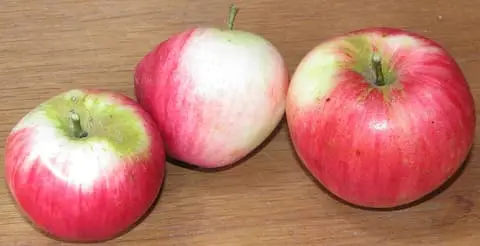
Akane
-
Akibae
A Nakano grower's 1981 cross of Senshu and Tsugaru; its dark fruit was ignored in Tokyo but welcomed in Kyushu
-
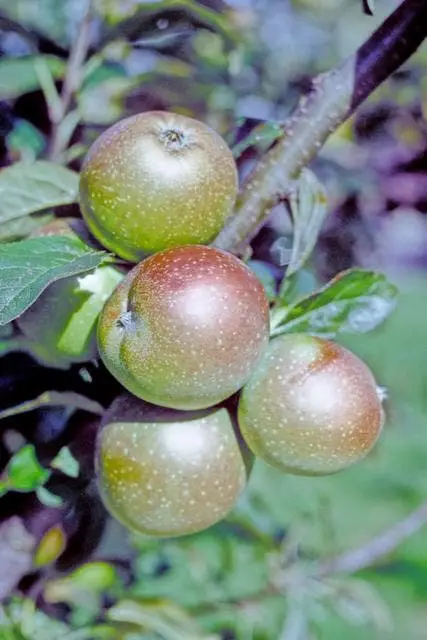
Amanishiki
-
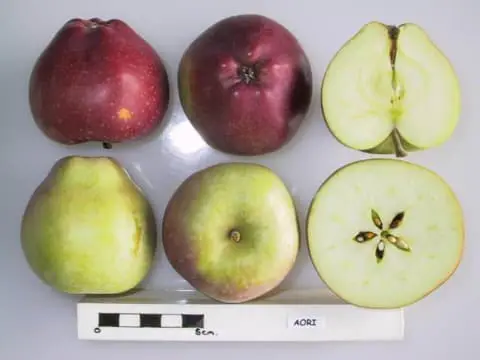
Aori
-
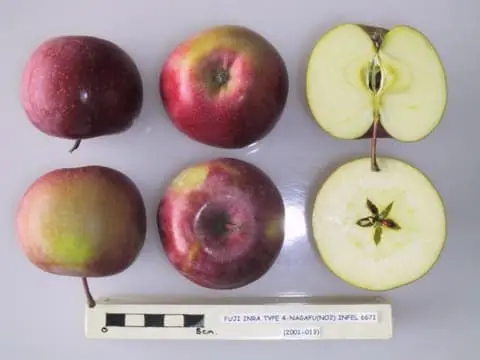
Fuji
Bred at Fujisaki, Aomori, from a 1939 cross; by a 2025 estimate it makes up 70 per cent of China's apples
-
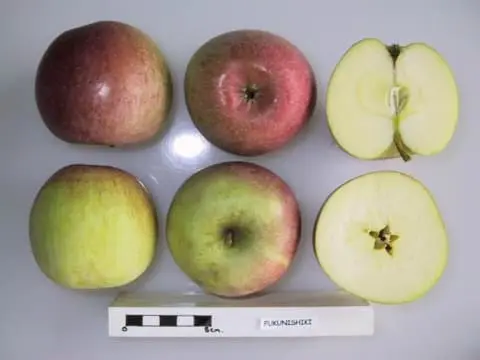
Fukunishiki
-
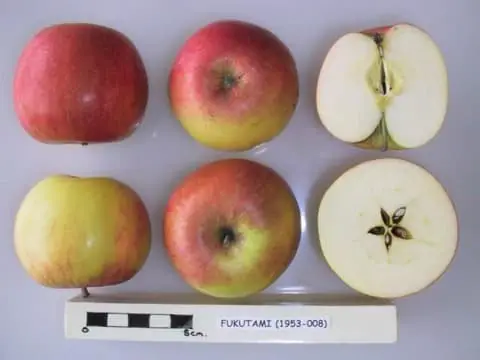
Fukutami
-
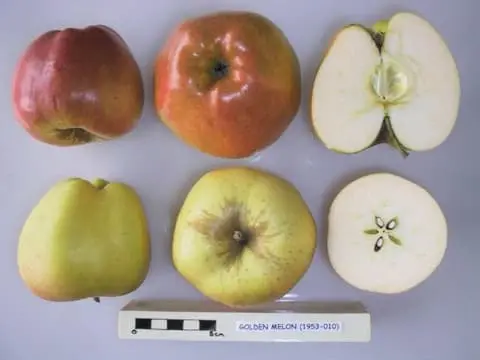
Golden Melon