Mutsu
Raised at Aomori in 1930, a big triploid that turns pink when grown in paper bags; renamed Crispin in Britain in 1968
History
Mutsu (陸奥) was raised in 1930 at the Aomori Apple Experiment Station1,2, at Kuroishi in Aomori Prefecture3, where apple breeding had begun in 19284. Its parents are Golden Delicious and Indo1,2,3, a parentage that SNP data confirm5. The tree first fruited in 1939; it was named Mutsu in 19481 and registered in 19492,4.
In 1966 Mutsu made up 1 per cent of Japan’s apple plantings, and in 1974 Yoshida and Mink named it and Fuji as the Japanese-bred apples then most popular with growers3. It also spread abroad. In 1987 Norton and colleagues found it “by far the most common outside of Japan” of the many apples the Aomori station had released, and noted that it was often called Crispin in European and New York markets4. The name Crispin had been given to it in Britain “for commercial reasons” in 19681. In Japan it covered 457.9 hectares in 2018, 1.3 per cent of the country’s apple orchards and ninth among its varieties6.
The fruit
The fruit is large and conical1,3,4: about 430 grams by the Aomori council’s account2, 400 to 600 grams by Japanese nursery catalogues4, and about 70 millimetres high and wide in the United Kingdom’s National Apple Register of 19711. Grown in the open, the skin is green to golden yellow and free of russet2,3,4. In Japan the fruit is commonly grown in paper bags4, from petal fall until 45 to 50 days before harvest, and once uncovered the skin turns bright pink3; such fruit fetched high prices in Tokyo4. The flesh is white to yellowish white, firm and juicy1,3,4, and the flavour refreshing, a little sweet, somewhat acid and aromatic1,2.
In Aomori it is picked from mid-October to early November2, and at Brogdale, Kent, in mid-October1. Norton and colleagues rated it an excellent keeper4. United States guidance gives three to four months in cold air storage and six to eight in a controlled atmosphere, with little risk of superficial scald, and warns that “green apples have low eating quality”7.
Growing
Mutsu is triploid1,3,5. The tree is very vigorous, and its pollen is sterile3.
Uses
It is used both for eating and for cooking1. Aomori’s apple council notes that it suits processing and that it is one of the varieties used for picture apples (絵文字りんご), an art made with apples2.
Where the sources disagree
Family tree
Parents, grandparents and great-grandparents, as the entries in the atlas record them.
- Mutsu Japan, 1930
- Seed parent Golden Delicious United States, 1905
- Parent Grimes Golden United States, by 1804
- Pollen parent Indo Japan, by 1930
- Seed parent White Winter Pearmain
- Seed parent Golden Delicious United States, 1905
Sources
- Mutsu (accession 1977-140), National Fruit Collection, Brogdale, Kent (Defra). Supports: "Triploid. Raised in Japan in 1930 and first fruited in 1939"; named Mutsu in 1948 and "renamed 'Crispin' in the UK for commercial reasons in 1968"; synonym Crispin; parentage Golden Delicious × Indo; a culinary and dessert apple; large and truncate-conical, 70 mm high and 70 mm wide (Smith's National Apple Register, 1971); flesh described as "firm, fine-textured, juicy", a little sweet, somewhat acid, refreshing, but characterised as coarse, after Smith's National Apple Register (1971); picked in mid-October at Brogdale.
- Apple varieties (in Japanese), Aomori Prefecture Apple Council (Aomori-ken Ringo Taisaku Kyōgikai). Supports: Mutsu (陸奥): (mother) Golden Delicious × (father) Indo; bred by the Aomori Apple Experiment Station and registered in 1949; picked from mid-October to early November; about 430 g; greenish yellow when grown without bags, pink when bagged; fairly firm, aromatic flesh, also suited to processing; one of the varieties used for picture apples (絵文字りんご), an art made with apples.
- Japanese apple varieties, Y. Yoshida and G. I. Mink, Fruit Varieties and Horticultural Digest 28(1):7–8, American Pomological Society, 1974. Supports: the Aomori Apple Experiment Station "located at Kuroishi City in Aomori Prefecture"; Fuji and Mutsu the Japanese-bred varieties "currently the most popular with growers"; Table 1 (Ministry of Agriculture and Forestry data): Mutsu 1 per cent of Japan's apple varieties in 1966; Mutsu: Golden Delicious × Indo, triploid, late, green to golden, russet-free, large, yellowish-white juicy flesh; "bright pink" when covered with paper bags "from petal fall to 45-50 days prior to harvest"; "Tree very vigorous. Pollen sterile.".
- Current status of several Japanese apple cultivars, R. A. Norton, R. L. Stebbins and Y. Yoshida, Fruit Varieties Journal 41(1):22–28, American Pomological Society, 1987. Supports: apple breeding at Aomori begun in 1928; Mutsu, "often called 'Crispin' in European and New York markets, is by far the most common outside of Japan" of the Aomori station's apples; bagged fruit turning pink when the bag is removed and commanding a high price in Tokyo; Table 1: registered 1949, Golden Delicious × Indo, 400–600 g by Japanese nursery catalogues, conic, yellow unless bagged, firm, coarse, juicy flesh, good sugar–acid balance, excellent storage; planting stable to slightly decreasing.
- Cultivar fingerprinting and SNP-based pedigree reconstruction in Danish heritage apple cultivars utilizing genotypic data from multiple germplasm collections in the world, B. Larsen and others, Genetic Resources and Crop Evolution 72:2397, supplementary Table S5, 2025. Supports: Table S5: Mutsu triploid, with Golden Delicious and Indo as its SNP-confirmed parents.
- Apple area by variety, 2018 (in Japanese), National Agriculture and Food Research Organization (NARO), Institute of Fruit Tree and Tea Science, from the Ministry of Agriculture, Forestry and Fisheries' survey of the 2018 crop. Supports: Mutsu on 457.9 ha, 1.3 per cent of Japan's apple area, ninth among varieties (2018).
- Apple, in The Commercial Storage of Fruits, Vegetables, and Florist and Nursery Stocks (Agriculture Handbook 66), Chris B. Watkins, Eugene Kupferman and David A. Rosenberger, USDA Agricultural Research Service, 2016. Supports: Table 2 (p. 182): Mutsu "3-4" months at 0 °C in air and "6-8" in controlled atmosphere; slight susceptibility to superficial scald; "Green apples have low eating quality.".
More from Japan
-
Akane
-
Akibae
A Nakano grower's 1981 cross of Senshu and Tsugaru; its dark fruit was ignored in Tokyo but welcomed in Kyushu
-
Amanishiki
-
Aori
-
Fuji
Bred at Fujisaki, Aomori, from a 1939 cross; by a 2025 estimate it makes up 70 per cent of China's apples
-
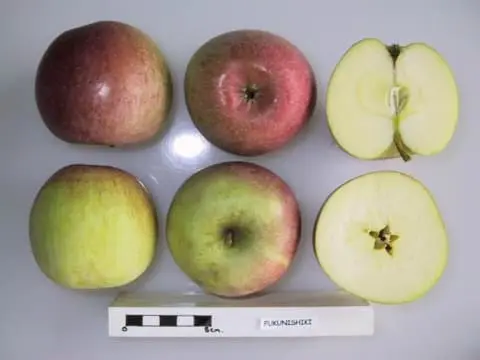
Fukunishiki
-
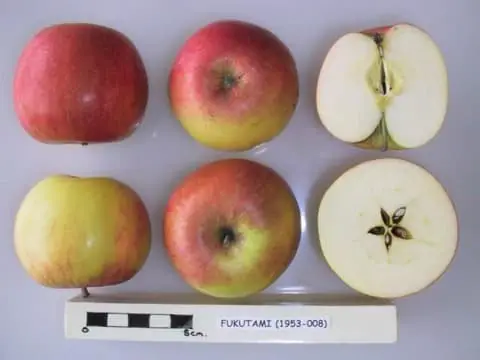
Fukutami
-
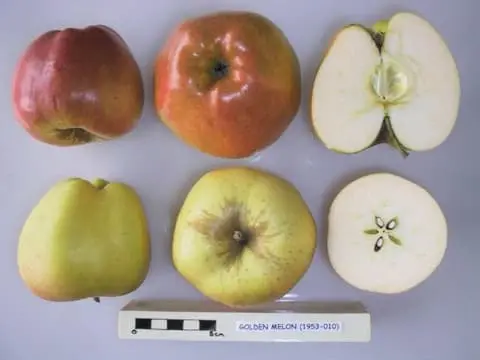
Golden Melon