Pinova
Crossed at Dresden-Pillnitz in 1965 from Clivia and Golden Delicious; released in 1986, it crops early and heavily
History
Pinova was raised at the Institute of Fruit Research at Dresden-Pillnitz, in Saxony1,2,3. Its breeders, J. Schmadlak, H. Murawski, C. Fischer and M. Fischer, crossed Clivia with Golden Delicious in 19651,2, and SNP data confirm Golden Delicious as a parent4. Clivia, the mother, is a child of Cox’s Orange Pippin6,7.
The new apple went into commerce in 19862,3. Community plant variety rights were applied for in August 1995, giving 1 December 1992 as the date of its first sale in the European Union, in Germany; the right, held by the State of Saxony, was granted on 15 October 19965,1 and ended on 1 October 20225. A US plant patent followed in October 20006.
The Julius Kühn-Institut, of which Pillnitz fruit breeding is now part, describes Pinova as a productive and reliable winter apple for commercial orchards, able to complement or replace Golden Delicious, and marketed worldwide1. In Germany’s 2022 orchard survey it covered 402 hectares in Baden-Württemberg, 168 in Saxony and 127 in North Rhine-Westphalia8.
Its fruit is also sold under trade marks. The European Union’s marketing standard for apples lists the trade mark Corail for it9. In the United States a Washington State fruit company bought the exclusive rights to grow and market it in 2004 and gave it the trade mark Piñata, under which it was sold across the United States and Canada in 201210.
The fruit
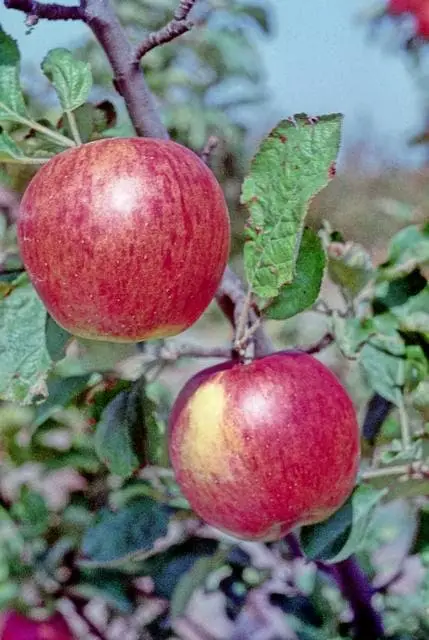
The fruit is medium-sized, about 150 grams, oblong-round and broadest near the stalk, with a narrow eye basin, and very uniform1. Its smooth golden-yellow skin is marbled with vermilion over as much as 70 per cent of the surface1; the US patent adds dark red stripes, and notes that the fruit colours more orange in hot conditions and redder in cool ones6. The yellowish flesh is firm, crisp, pleasantly sweet-sharp and aromatic, with about 14 per cent soluble solids1,6.
At Pillnitz it is picked in the second and third weeks of October1,6, in at least two passes to get an even colour grade1. It is ready to eat from November until February or March, and keeps until May in controlled-atmosphere stores1. At Brogdale, Kent, it reaches 10 per cent flowering on 27 April and is picked in early October3.
Growing
The tree is small to medium-sized and weak to moderately vigorous, and is well suited to the slender spindle; it needs little pruning, but its fruiting wood ages in the lower crown and should be renewed regularly1,6. It flowers in mid-season with Golden Delicious, heavily and every year, and tends to put out late secondary blossom1,6; it is a good pollinator6. It bears very early, heavily and regularly1, about 120 per cent as heavily as Golden Delicious according to the patent, without alternate bearing6, and must be thinned for good fruit size1. It suffers little from frost1,6 and suits all apple-growing sites1,2. In store the fruit is prone to lenticel rot caused by Gloeosporium fungi1. Pinova is diploid4,6.
Uses
Pinova is a dessert apple1,6; the German fruit genebank also lists it as a culinary apple2.
Where the sources disagree
- Clivia’s parents. The US patent gives them as Duchess of Oldenburg and Cox’s Orange Pippin6; SNP data identify Geheimrat Doktor Oldenburg and Cox’s Orange Pippin7.
- Disease. The patent calls Pinova only weakly susceptible to scab and fireblight6. The Julius Kühn-Institut rates it moderately susceptible to scab and powdery mildew1, and the German genebank lists it as susceptible to fireblight2.
Family tree
Parents, grandparents and great-grandparents, as the entries in the atlas record them.
- Pinova Germany, 1965
- Seed parent Clivia Germany, by 1961
- Seed parent Geheimrat Doktor Oldenburg Germany, 1897
- Parent Aport Russia, late 18th century
- Parent Ananas Reinette Netherlands, by 1821
- Pollen parent Cox's Orange Pippin United Kingdom, about 1825
- Parent Margil France, probably by 1608
- Parent Rosemary Russet United Kingdom, by 1831
- Seed parent Geheimrat Doktor Oldenburg Germany, 1897
- Pollen parent Golden Delicious United States, 1905
- Parent Grimes Golden United States, by 1804
- Seed parent Clivia Germany, by 1961
Sources
- Pillnitz fruit varieties and rootstocks, p. 47: Pinova (in German), Julius Kühn-Institut, Institute for Breeding Research on Fruit Crops, Dresden-Pillnitz (DOI 10.5073/jki.2017.014), 2017-11. Supports: parentage "'Clivia' x 'Golden Delicious'"; breeders J. Schmadlack, H. Murawski, C. Fischer and M. Fischer; EU plant variety protection "seit 1996", held by the Free State of Saxony (Saxon State Office for Environment, Agriculture and Geology); origin the Institut für Obstforschung, Dresden-Pillnitz; an attractive, productive and reliable winter apple for commercial growing that can complement or replace Golden Delicious; weak to moderate growth, fruiting wood ageing in the lower crown, well suited to the slender spindle, little pruning, regular renewal of fruiting branches; mid-early flowering like Golden Delicious, very regular and heavy, with a tendency to late secondary blossom; cropping very early, very high and regular; thinning needed for fruit size; picking from mid-October over a period, in at least two passes for a good colour grade; eating from November to February or March, in CA storage until May; fruit medium, about 150 g, oblong-round, broadest at the stalk end, narrow eye basin, very uniform; skin smooth, golden yellow with vermilion marbled over-colour on up to 70%; flesh yellowish, firm, crisp, pleasantly sweet-sharp and aromatic, "ca. 14 % Brix"; low to very low frost sensitivity; moderately susceptible to scab and mildew, susceptible to lenticel rot caused by Gloeosporium species; suited to all apple-growing sites; marketed worldwide. Introduction: Pillnitz fruit breeding is today part of the Julius Kühn-Institut.
- Passport data: Pinova (in German), Deutsche Genbank Obst (German Fruit Genebank). Supports: mother Clivia, father Golden Delicious; bred at Pillnitz by Schmadlak, J., Murawski, H., Fischer, C. and Fischer, M.; year of the cross 1965; in commerce from 1986; plant variety protection in Germany until 2022 and in the EU from 1996; origin Dresden-Pillnitz, Saxony; a dessert and culinary apple (Tafelapfel, Wirtschaftsapfel); suited to all apple sites and to light soils; a very good keeper, high-yielding, susceptible to fireblight; picked in October.
- Pinova (accession 1994-015), National Fruit Collection, Brogdale, Kent (Defra). Supports: "Raised at the Institute of Fruit Research, Dresden-Pillnitz, Germany. Introduced in 1986. Fruits are crisp and juicy."; 10% flowering on 27 April and picking in early October at Brogdale.
- Using whole-genome SNP data to reconstruct a large multi-generation pedigree in apple germplasm, H. Muranty and others, BMC Plant Biology 20: 2, with Additional files 1 and 6, 2020. Supports: Additional file 6 (Table S5): Pinova and Golden Delicious a parent–offspring pair with no Mendelian errors, oriented by the documented parentage Clivia × Golden Delicious; Additional file 1 (Table S1): Pinova diploid (2n).
- Community plant variety rights register, public search: Pinova, Community Plant Variety Office (CPVO). Supports: denomination Pinova (Malus domestica); application 19951072 of 30 August 1995, the applicant shown as the Sächsisches Landesamt für Umwelt, Landwirtschaft und Geologie; first sale inside the EU on 1 December 1992, in Germany; grant 1298 of 15 October 1996; status "Terminated Right", protection ending on 01/10/2022.
- Apple tree named Pinova (US Plant Patent 11,601), Hermann Manfred Fischer and Johann Schmadlak; Google Patents, 2000-10-24. Supports: filed 6 January 1998; the original tree from a cross of Clivia and Golden Delicious at Dresden-Pillnitz; parentage given as "'Clivia' ('Duchess of Oldenburg'×'Cox's Orange Pippin')×'Golden Delicious'"; ready for harvest "in the second and third weeks of October in Dresden-Pillnitz"; a small to medium, dwarf tree with vigour comparable to Braeburn, very precocious, needing regular renewal of fruiting branches, good as a slender spindle; flowering mid-season with Golden Delicious and Gloster; an excellent pollinator; three fruit at Wenatchee averaging 175 g; flesh firm, 14–15 Brix; over colour red to vermilion with dark red stripes, more orange in hotter conditions and redder in cooler ones; about 120 percent of the yield of Golden Delicious, no alternate bearing; diploid; withstands winter and spring frosts; "Only weakly susceptible to scab and fireblight"; a dessert apple.
- Cultivar fingerprinting and SNP-based pedigree reconstruction in Danish heritage apple cultivars utilizing genotypic data from multiple germplasm collections in the world, B. Larsen and others, Genetic Resources and Crop Evolution 72: 2397–2411, with supplementary file 2, 2025. Supports: Table S5: Clivia with SNP-confirmed parents Geheimrat Doktor Oldenburg and Cox's Orange Pippin.
- Growth and harvest: tree fruit 2022 (Fachserie 3, Reihe 3.2.1), table 3 (in German), Statistisches Bundesamt (Destatis), 2023-01-09. Supports: table 3, the 2022 apple harvest by variety in the main growing states, with planted areas from the 2022 orchard survey: Pinova on 402 ha in Baden-Württemberg, 168 ha in Saxony and 127 ha in North Rhine-Westphalia.
- Commission Delegated Regulation (EU) 2023/2429, Annex I, Part B, Part 1 (marketing standard for apples), Appendix: non-exhaustive list of apple varieties, European Commission; Official Journal of the European Union, L series, 3 November 2023, 2023-08-17. Supports: the note that some listed varieties "may be marketed under names for which trademark protection has been sought or obtained in one or more countries", with "References to known trademarks" given in the fourth column "for information only"; Pinova listed with the trade mark Corail.
- Stemilt's Piñata Apple Hits Stores, Stemilt Growers, Wenatchee, Washington (press release), 2012-01-04. Supports: Piñata apples in grocery stores "throughout the U.S. and Canada" in January 2012; Stemilt Growers a fruit growing, packing and shipping company based in Wenatchee, Washington; the apple bred at Dresden-Pillnitz, which made a name in Europe as Pinova and Sonata; Stemilt's purchase in 2004 of "the exclusive rights to grow and market this apple in the United States", after which it "trademarked it Piñata".