Apples of Germany
96 varieties in the atlas came from Germany. The oldest is Roter Stettiner, dated by 1598.
Harvest
Germany grew 871,990 tonnes of apples in 2024, 0.89% of the world's harvest; it ranked 16th among the world's producers.1
The figures
| Year | Tonnes |
|---|---|
| 2024 | 871,990 |
| 2023 | 941,210 |
| 2022 | 1,070,980 |
| 2021 | 1,004,630 |
| 2020 | 1,023,320 |
| 2019 | 991,450 |
| 2018 | 1,198,520 |
| 2017 | 596,666 |
| 2016 | 1,032,913 |
| 2015 | 973,462 |
| 2014 | 1,115,900 |
| 2013 | 803,784 |
| 2012 | 972,405 |
| 2011 | 898,448 |
| 2010 | 834,960 |
| 2009 | 1,070,678 |
| 2008 | 1,046,995 |
| 2007 | 1,070,036 |
| 2006 | 947,611 |
| 2005 | 891,402 |
| 2004 | 979,730 |
| 2003 | 818,032 |
| 2002 | 1,471,100 |
| 2001 | 1,779,000 |
| 2000 | 3,136,800 |
| 1999 | 1,036,100 |
| 1998 | 977,200 |
| 1997 | 764,600 |
| 1996 | 878,100 |
| 1995 | 573,300 |
| 1994 | 879,500 |
| 1993 | 882,400 |
| 1992 | 1,377,800 |
| 1991 | 780,800 |
| 1990 | 2,222,019 |
| 1989 | 2,483,089 |
| 1988 | 3,164,425 |
| 1987 | 1,592,954 |
| 1986 | 2,902,106 |
| 1985 | 2,206,203 |
| 1984 | 2,347,783 |
| 1983 | 2,097,458 |
| 1982 | 3,417,125 |
| 1981 | 1,285,644 |
| 1980 | 2,395,094 |
| 1979 | 2,713,069 |
| 1978 | 2,109,260 |
| 1977 | 1,473,564 |
| 1976 | 1,806,949 |
| 1975 | 2,488,968 |
| 1974 | 1,499,477 |
| 1973 | 2,320,000 |
| 1972 | 1,500,000 |
| 1971 | 2,309,000 |
| 1970 | 1,975,000 |
| 1969 | 2,913,000 |
| 1968 | 1,748,000 |
| 1967 | 2,732,000 |
| 1966 | 1,702,000 |
| 1965 | 1,424,000 |
| 1964 | 1,346,000 |
| 1963 | 2,216,000 |
| 1962 | 2,059,000 |
| 1961 | 851,000 |
Varieties from Germany, oldest first
-
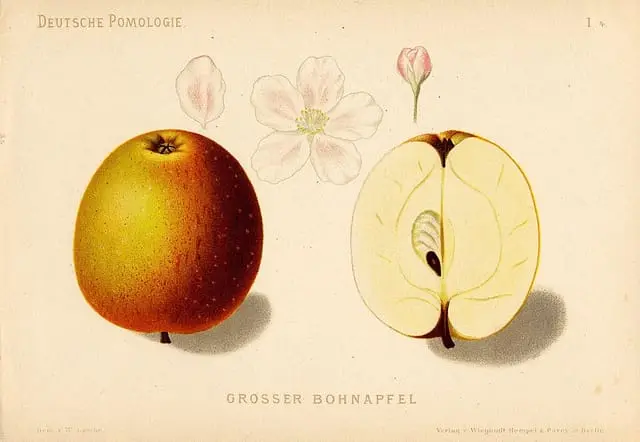
Rheinischer Bohnapfel
A triploid Rhineland apple described by Diel in 1797; hard and sour when picked, it was said to keep over a year
-
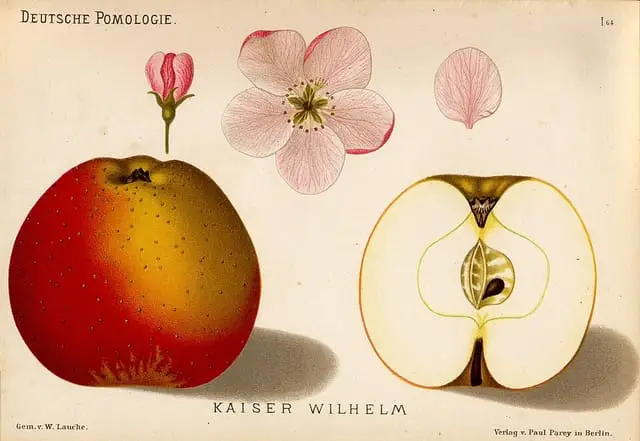
Kaiser Wilhelm
Named in 1875 with Emperor Wilhelm I's consent; DNA shows it is the Rhineland apple Peter Broich
-
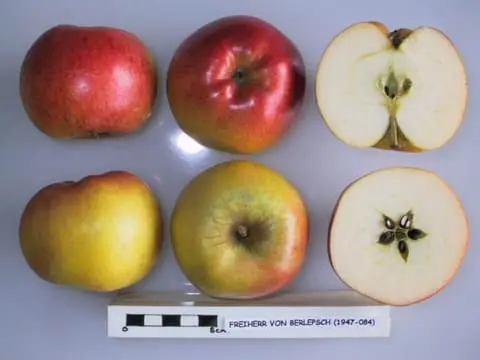
Freiherr von Berlepsch
Raised about 1880 at Grevenbroich; DNA shows its parents are Ananas Reinette and Danziger Kantapfel, not Ribston Pippin
-
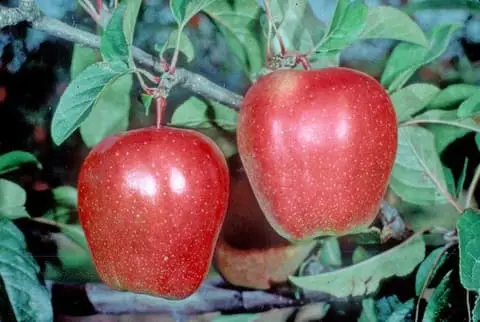
Gloster
Bred at Jork in the Altes Land from a 1951 cross of Glockenapfel and Richared Delicious; dark red and long-keeping
-
Pinova
Crossed at Dresden-Pillnitz in 1965 from Clivia and Golden Delicious; released in 1986, it crops early and heavily
-
Weirouge
An acid, astringent red-fleshed apple for processing; Germany's fruit genebank files it as Michurin's Roter Mond
-
Bay 3484
Bred from Weirouge at the Bavarian Centre of Pomology, Hallbergmoos; its fruit is sold under the trade mark Baya Marisa
And 89 more in the catalogue, A to Z
- Adamsapfel Ostpreussischer by 1951
- Adersleber Calville about 1870
- Alkmene 1930
- Altlander Fettapfel by 1958
- Altlander Pfannkuchenapfel 1840
- Altlander Rosenapfel by about 1850
- Astillisch 1929
- Astramel 1993
- Auralia by 1967
- Biesterfelder Renette by 1905
- Bietigheimer by about 1870
- Bodikers Gold-Reinette by 1875
- Boiken by 1828
- Breitling by about 1879
- Brettacher Samling 1900
- Calville d'Ulzen by 1947
- Clivia by 1961
- Cludius Herbstapfel 1850s
- Dulmener Rosenapfel about 1870
- Edelborsdorfer by the 1500s
- Elektra
- Erich Neumanns Roter James Grieve 1953
- Ernst Bosch by 1908
- Etlins Reinette by 1866
- Fiessers Erstling before 1904
- Finkenwerder Prinz about 1860
- Florianer Rosenapfel by 1776
- Fraise de Buhler by 1947
- Friedrich der Grosse by 1947
- Geheimrat Breuhahn 1895
- Geheimrat Doktor Oldenburg 1897
- Gelber Munsterlander Borsdorfer by 1951
- Gewurzluiken by about 1885
- Golden Delicious Russet by 1968
- Halberstadter Jungfernapfel by 1885
- Harberts Reinette before 1828
- Helios by 1969
- Herma 1930s
- Heusgen's Golden Reinette (Bultitude) by about 1877
- Hohenzollern by 1947
- Holstein about 1918
- Horneburger Pfannkuchen by 1951
- Ingol 1954
- Jamba 69 1954
- Jansen von Welten by 1823
- Jonica
- Juno by 1971
- Kaiser Franz Joseph before 1876
- Kalco by 1967
- Krugers Dickstiel before 1850
- Margol
- Marienwerder Gulderling by 1876
- Martini 1875
- Mauss Reinette by 1874
- Minister von Hammerstein 1882
- Morgenrot
- Neue Goldparmane 1905
- Oberlausitzer Muskatrenette by 1850
- Ohm Paul 1890s
- Orangenburg by 1973
- Osnabrucker Reinette by 1802
- Pfirsichroter Sommerapfel by the early 1800s
- Pikkolo
- Pilot by 1988
- Piros by 1985
- Prinz Albrecht von Preussen 1865
- Prinzen Apfel 1700s
- Red Martini by about 1938
- Renora by 1996
- Retina by 1991
- Rewena by 1991
- Rheinischer Krummstiel by 1821
- Roter Ananas by 1854
- Roter Eiserapfel early 1700s
- Roter Munsterlander Borsdorfer by 1948
- Roter Stettiner by 1598
- Rubinstar 1980
- Schoner aus Herrnhut between 1880 and 1885
- Schoner von Nordhausen early 1800s
- Spatbluhender Taffetapfel by 1872
- Stina Lohmann about 1800
- Ulmer Reinette 1920
- Undine by 1977
- Von Zuccalmaglios Renette 1878
- Weidners Goldreinette 1844
- Weisser Winter Taffetapfel by 1800
- Welschisner by 1889
- Wilhelm Ley
- Zabergau Renette 1885
Sources
- FAOSTAT: Production: Crops and livestock products, Food and Agriculture Organization of the United Nations (FAO), Updated 31 December 2025. Supports: each country's apple harvest by year (item 515, apples, in tonnes, 1961 to 2024), the shares of the world's harvest and the ranks worked out from them, and which figures FAOSTAT estimated or imputed.