Bay 3484
Bred from Weirouge at the Bavarian Centre of Pomology, Hallbergmoos; its fruit is sold under the trade mark Baya Marisa
History
The Bavarian Centre of Pomology and Fruit Breeding at Hallbergmoos began breeding red-fleshed apples in 1999, aiming to combine red flesh with good fruit quality, tolerance of the main apple diseases and value to growers4. The apple’s breeder, Michael Neumüller, writes that red-fleshed apples had been known for centuries, but that every variety available had been so sour that it was fit only for juice or jelly1. He crossed the old, sour, red-fleshed Weirouge with a well-flavoured dessert apple and, from many seedlings, selected this one as the first of a new generation of red-fleshed varieties1.
Neumüller applied for a Community plant variety right in June 2009; after examination by Germany’s Federal Plant Variety Office it was granted on 24 March 2014, and it runs until the end of 20442. Germany’s list of fruit varieties enters it as Bay 3484, with Baya Marisa as a further name, and records that it was on the market before 30 September 20123. The breeder marks Baya as a registered trade mark, and the fruit is sold under the trade mark Baya Marisa1,6.
Bay 3484 has since served as both seed and pollen parent in many crosses; crossed at the centre with the scab-resistant Rebella, it gave another red-fleshed apple1. Neumüller and Dittrich reported in 2017 that among seedlings from more than 40 cross combinations made between 2000 and 2014, red-leafed ones, which in type 1 red-fleshed apples signal red flesh, were commoner when the red-fleshed variety was the seed parent4.
The fruit
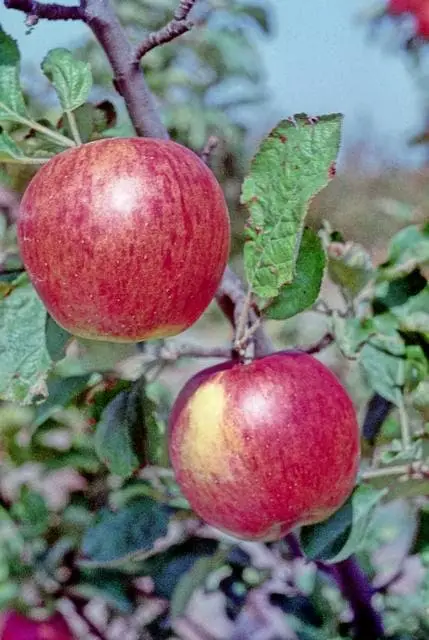
The breeder describes medium-sized fruit coloured red all over, with prominent lenticels; the firm, medium-coarse flesh is red right through to the core, with 16 per cent Brix, and its taste is pleasant, tart and aromatic1. It is picked at the end of September and eaten from September to December1. Neumüller calls it the first red-fleshed apple of dessert quality1. Flachowsky and colleagues at the Julius Kühn-Institut judged that newer red-fleshed varieties, this one among them, taste better than older ones such as Weirouge, but thought it too early to say whether they would succeed in the market5.
Growing
The breeder reports that it crops early, heavily and regularly1. It is diploid6.
Uses
The breeder suggests eating it fresh, baking it in cakes mixed with white-fleshed apples, making red jelly and juice from it and drying it as rings or chips; the red colour survives processing1.
Where the sources disagree
Family tree
Parents, grandparents and great-grandparents, as the entries in the atlas record them.
- Bay 3484 Germany, by 2009
- Parent Weirouge Germany, by 1997
Sources
- Fruit for every garden, 20th edition, pp. 7 and 16–17: Baya Marisa (in German), Michael Neumüller, Bayerisches Obstzentrum (Bavarian Centre of Pomology), Hallbergmoos, 2026. Supports: bred by Dr M. Neumüller at the Bayerisches Obstzentrum; red-fleshed apples known for centuries, but all varieties so far so sour that they could only be made into juice or jelly; a sour red-fleshed variety crossed with a well-flavoured dessert apple, and Baya Marisa selected from many seedlings as the first of a new generation of red-fleshed varieties; "Aus der alten rotfleischigen Sorte Weirouge entstand durch Kreuzung die Sorte Baya Marisa", since used as both father and mother in many crosses, among them one with the scab-resistant Rebella that gave a red-fleshed apple; the name written "Baya® Marisa"; variety protection granted under the denomination Bay 3484; picked at the end of September, eaten from September to December; medium-sized fruit coloured red all over with prominent lenticels; firm, medium-coarse flesh red throughout from skin to core; 16% Brix; pleasant taste, tart, aromatic; cropping early, high and regular; "erste rotfleischige Apfelsorte mit Tafelfruchtqualität"; uses fresh, in cakes mixed with white-fleshed apples, as red jelly and juice, and dried as rings or chips; the red colour kept after processing.
- Community plant variety rights register, public search: BAY 3484, Community Plant Variety Office (CPVO). Supports: denomination BAY 3484 (Malus domestica); applicant Michael Neumüller; application 20091111 of 22 June 2009; examination office the Bundessortenamt (Germany); grant 37194 of 24 March 2014; expiry date 31/12/2044.
- Complete list of fruit varieties: apple, as of October 2020, p. 9 (in German), Bundessortenamt (Federal Plant Variety Office), 2020-10. Supports: Bay 3484 entered with the further variety name Baya Marisa and an official description, marketable in the EU, a commonly known variety "bereits vor dem 30.09.2012 in Verkehr gebracht" (already on the market before 30 September 2012).
- Breeding for type 1 red-fleshed apple varieties: using the red-fleshed apple variety as female parent yields a higher percentage of red-leafed seedlings, M. Neumüller and F. Dittrich, Acta Horticulturae 1172: 241–244 (abstract), 2017. Supports: a breeding programme for red-fleshed apple cultivars established in 1999 at the Bavarian Centre of Pomology and Fruit Breeding, Hallbergmoos, aiming to combine red flesh with high fruit quality, tolerance to important apple diseases and high agronomic value; red leaf colour a marker for early selection of red flesh in type 1 cultivars; seedlings from more than 40 cross combinations made between 2000 and 2014, with a higher share of red-leafed seedlings when the red-fleshed variety was the female parent.
- The impact of Mendelian genetics on the breeding of apple and sweet cherry (in German), H. Flachowsky, O. F. Emeriewen, M. Schuster, A. Peil, J. Lempe and T. Wöhner, Julius Kühn-Institut; Journal für Kulturpflanzen 74 (11–12): 242–256, 2022. Supports: most red-fleshed varieties, such as Weirouge, insufficient in taste for marketing; in newer varieties such as Baya Marisa the taste already better; whether and how they succeed in the market "wird die Zukunft zeigen" (the future will show).
- Molecular genetic identification of apple cultivars based on microsatellite DNA analysis. I. The database of 600 validated profiles, S. Baric, A. Storti, M. Hofer, W. Guerra and J. Dalla Via, Erwerbs-Obstbau 62: 117–154, 2020. Supports: Table 2: BAY 3484 with the trade mark name Baya Marisa, diploid (2n), Germany, 2009, its profile from accessions at the Fondazione Edmund Mach and Laimburg.