Kaiser Wilhelm
Named in 1875 with Emperor Wilhelm I's consent; DNA shows it is the Rhineland apple Peter Broich
History
Carl Hesselmann, head teacher at Witzhelden (now part of Leichlingen) and director of the Bergisch fruit-growing association, found this apple in 1864 on an already mature tree in the estate garden of Haus Bürgel, between Düsseldorf and Monheim am Rhein2,3,4. At Christmas 1875 he sent about 30 of the apples to Emperor Wilhelm I, who replied before Christmas that he had no objection to their bearing his name4. Hesselmann first showed the fruit at the meeting of German pomologists at Potsdam in 18772, and under the emperor’s name it spread through Germany and abroad3. In the German Democratic Republic, whose government disliked the name, it was known as Wilhelmsapfel4.
In a project of the Landschaftsverband Rheinland on local fruit varieties, run from 2008 to 2016, pomologists identified the Rhineland apple Peter Broich as Kaiser Wilhelm, and a DNA comparison showed the two to be identical3,4. Peter Broich is said to have been raised from seed by Johann Wilhelm Schumacher, a vicar who ran a fruit nursery at Ramrath, now part of Rommerskirchen and about 15 km from Haus Bürgel, from 1830 until his death in 18643. Nurseries west of the Rhine went on selling it as Peter Broich, and the project’s handbook concludes that by rights that should be its name3. Kaiser Wilhelm is triploid3,5.
The fruit
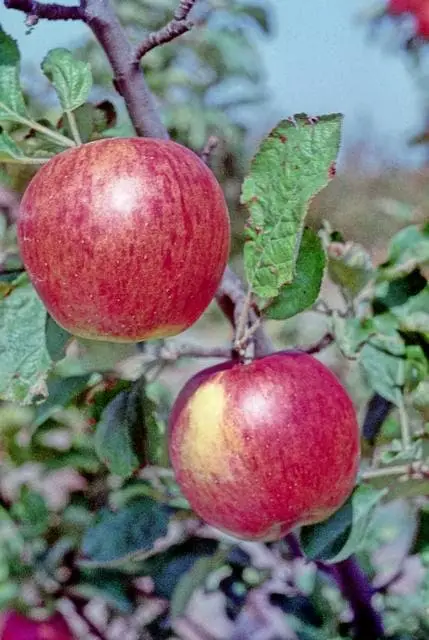
The fruit is large and flat-round1,2. Lauche described a smooth, shiny skin, yellowish green when picked and golden yellow in store, flushed lacquer-red and striped crimson on the sunny side or all over, with star-shaped light-brown dots2; the Rhineland handbook gives a dark, dull blood-red flush and cinnamon-brown russet radiating from the stalk cavity3. The flesh is whitish to yellowish white and fine1,2, and the National Apple Register of 1971 calls it subacid, sweet and spicy1.
It is picked in early to mid-October in the Rhineland3, and in early October at Brogdale, Kent, where it reaches 10 per cent flowering on 9 May1. Lauche said that it kept until April2; the Rhineland handbook says that it keeps well into winter but loses juice within a few weeks of picking3.
Growing
It makes a vigorous, large and long-lived tree with a tall, pyramidal crown2,3. Lauche found it exceedingly fertile2, but the Rhineland handbook says that it starts to bear moderately late and then gives medium crops that may alternate with poor years3. It is fairly resistant to scab and mildew, but suffers canker on heavy or wet soils, needs loose, well-aired soil, and is prone to bitter pit, especially on young trees and in years of light crops3. Being triploid, it is a poor pollinator3.
Uses
Once grown mainly for dessert, it is also good for processing at home3, and the LWL account describes it as an apple for the table, baking, cooking and pressing4.
Where the sources disagree
- Date. The National Fruit Collection says that Hesselman discovered it in about 1800 and that it was introduced by the mid-1800s1, and a 2018 study dates it “pre 1800”5. Lauche and the Rhineland sources have it found in 1864 on a mature tree2,3,4, and the Rhineland handbook traces it to Schumacher’s nursery of 1830–18643.
- Parents. Lauche thought it probably a seedling of Harberts Reinette2, and the National Fruit Collection records Harberts Reinette as its parent1. A 2018 DNA study instead identified Golden Reinette as a possible parent, contributing a diploid gamete, and placed Harberts Reinette beside Kaiser Wilhelm among its probable offspring5; the Rhineland handbook lists Harberts Reinette among the apples with which Kaiser Wilhelm is confused3.
- Size. The National Fruit Collection’s own measurements give 74.05 mm high and 83.25 mm wide, but the 1971 National Apple Register gives 50–65 mm by 61–76 mm1.
- Flavour. Lauche found it winy and spicy2, and the National Apple Register spicy1; the Rhineland handbook finds its firm, sweetish-sour flesh without a pronounced aroma and soon mealy in store, and the apple less well flavoured than more aromatic varieties3.
Sources
- Kaiser Wilhelm (accession 1958-062), National Fruit Collection, Brogdale, Kent (Defra). Supports: "Discovered in about 1800 by Head Teacher Hesselman in Witzhelden, Kreis Solingen, Germany. Introduced by the mid 1800s"; crisp, fine flesh with a subacid, sweet and spicy flavour; synonyms including Wilhelmapfel, Empereur Guillaume, Cesarz Wilhelm and Imperator Vilgelm; parentage "Harberts Reinette x Unknown"; the collection's characterisation (a): large to very large, 74.05 mm high and 83.25 mm wide, green-yellow with an orange over colour, striped or flushed, crisp, juiciness dry to medium; Smith's National Apple Register of 1971 (b): medium to large, 50–65 mm high and 61–76 mm wide, often much flushed crimson with darker stripes, yellowish-white, fine, crisp to tender flesh, "subacid, sweet, spicy"; 10% flowering on 9 May and picking in early October at Brogdale.
- First supplement to Lucas and Oberdieck's Illustrated Handbook of Pomology, pp. 103–104: No. 741, Kaiser Wilhelm (in German), Wilhelm Lauche, for the Deutscher Pomologen-Verein; Paul Parey, Berlin; Internet Archive, 1883. Supports: found in 1864 at Haus Bürgel, in the district of Solingen, by head teacher Hesselmann of Witzhelden, director of the Bergisch fruit-growing association; the mother tree in the estate garden there, cropping heavily every year; the fruit first shown by Hesselmann at the eighth meeting of German pomologists at Potsdam in 1877; "wahrscheinlich" (probably) from a seed of Harberts Reinette, from which it differs in its lacquer-red colour, many star-shaped russet dots and finer flesh; a large, flat-round apple about 80 mm wide and 70 mm high; smooth, shiny skin, yellowish green from the tree and golden yellow in store, lacquer-red with crimson stripes on the sunny side or all over, with star-shaped light-brown russet dots; the fruit does not shrivel; whitish-yellow, very fine, tender, juicy flesh with a winy, spicy taste; ready for storing at the end of October and keeping until April; a vigorous, exceedingly fertile tree with a tall, broadly pyramidal crown.
- Peter Broich (in German), Hans-Joachim Bannier, Erhalternetzwerk Obstsortenvielfalt, from the Landschaftsverband Rheinland handbook Lokale und regionale Obstsorten im Rheinland – vom Aussterben bedroht! (2010), 2014-04-16. Supports: Peter Broich said to have been raised from seed by Johann Wilhelm Schumacher of Rommerskirchen-Ramrath, vicar, who founded a fruit nursery at Ramrath in 1830 and ran it until his death in 1864; the Pomologen-Verein experts in the Landschaftsverband Rheinland project unanimously judging Peter Broich to be Kaiser Wilhelm, and a molecular-genetic test showing the two identical; Hesselmann finding Kaiser Wilhelm in 1864 on an already mature tree in the estate garden of Haus Bürgel, between Düsseldorf and Monheim am Rhein, about 15 km from Schumacher's place of work; spread under that name through Germany and abroad, while nurseries west of the Rhine sold it as Peter Broich; "by rights" (von Rechts wegen) it should be called Peter Broich; dark, dull blood-red over colour, with cinnamon-brown radiating russet in the stalk cavity; yellowish-white, firm, sweetish-sour flesh without pronounced aroma, juicy at first, soon mealy in store; picked early to mid-October, keeping well into winter but losing juice within a few weeks; vigorous, large, long-lived trees with a pyramidal crown; bearing moderately late, then medium crops that may alternate; fairly resistant to scab and mildew; canker on heavy or wet soils, and a need for loose, well-aired soil; prone to bitter pit, especially on young trees and in light-crop years; triploid and a poor pollinator; Harberts Renette among the varieties it is confused with; once grown mainly for dessert and also good for home processing; less well flavoured than more aromatic varieties.
- An apple tree for an emperor (in German), Sebastian Schröder, LWL Alltagskultur blog, Landschaftsverband Westfalen-Lippe, 2021-01-08. Supports: Carl Hesselmann, head teacher at Witzhelden, now part of Leichlingen; his find in 1864 in the garden of Gut Bürgel near Monheim; keeping until spring; about 30 apples sent to Emperor Wilhelm I in Berlin at Christmas 1875, and the emperor's reply before Christmas that he had no objection to the name Kaiser-Wilhelm-Apfel; a popular winter apple throughout the German Empire, used for the table, baking, cooking and pressing; called Wilhelmsapfel in the German Democratic Republic because of the name; the Landschaftsverband Rheinland project of 2008–2016 finding it, by molecular analysis, identical to Peter Broich, said to have been raised by the vicar Johann Wilhelm Schumacher, whose host was Peter Broich at the Ramrather Hof near Grevenbroich.
- Genetic analysis of a major international collection of cultivated apple varieties reveals previously unknown historic heteroploid and inbred relationships, M. Ordidge and others, PLOS ONE 13 (9): e0202405, 2018. Supports: Table 4: Kaiser Wilhelm (accession 1958-062) triploid, dated "pre 1800", Germany, one of eight triploids, with Harberts Reinette and Blenheim Orange, for which Golden Reinette was identified as a potential parent contributing a polyploid (diploid) gamete.