Rheinischer Bohnapfel
A triploid Rhineland apple described by Diel in 1797; hard and sour when picked, it was said to keep over a year
History
The Rheinischer Bohnapfel was made known by A. F. A. Diel, who described it in 1797 in Sickler’s Der teutsche Obstgärtner3,4. Finding it in no pomology he knew, Diel supposed it native to the banks of the Rhine, where the grafts offered to him came from3. In the Illustrirtes Handbuch der Obstkunde of 1859, Ed. Lucas also thought it probably a Rhine apple, by then grown throughout Germany2. The Bavarian horticultural association adds that it probably arose in the volcanic part of the Rhine Province and was a main variety of the Neuwied Basin4.
Diel called it Großer Rheinischer Bohnapfel; it was usually known simply as Bohnapfel, and on the Rhine also as Weißer Bohnapfel2. The first assembly of German pomologists, at Naumburg in 1853, recommended it for general planting2,4. It was once a popular roadside tree4, and it was one of the three Reichsobstsorten, or “Reich fruit varieties”, with Jakob Lebel and Ontario4. It is still grown in Germany and some neighbouring countries4.
The fruit
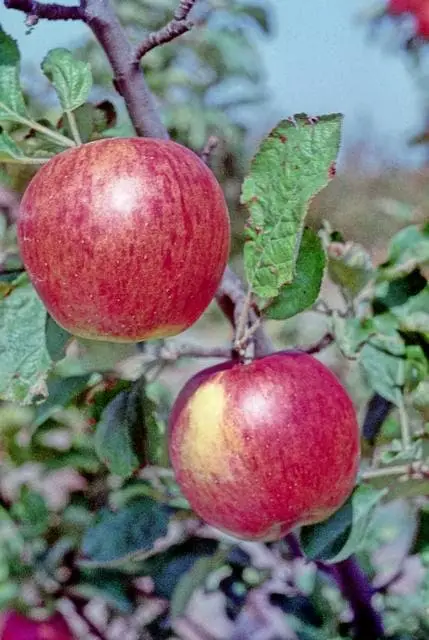
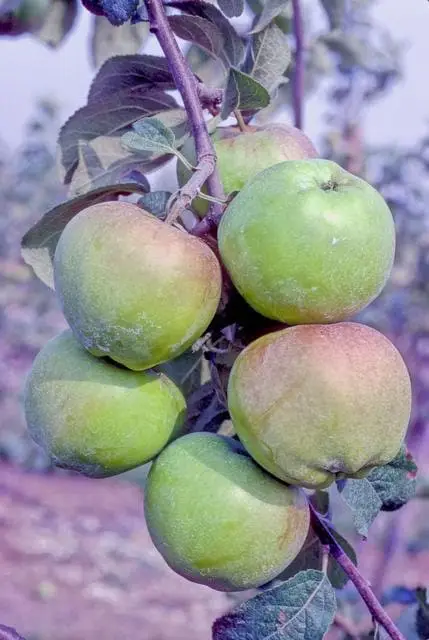
Lucas described a large apple, often a third larger and sometimes twice as large on young trees, varying from round to ovoid or even cylindrical2. The skin is smooth, glossy and tough, grass green on the tree and turning pale yellow only in winter and spring2,4; the sunny side is covered with dull red stripes2, and is dotted and marbled brownish red4. The flesh is yellowish white, very firm and coarse-grained2,4. Harsh and sour at first, it becomes pleasant, juicy and sweet at full ripeness, from March to July, in Lucas’s account2; the Bavarian association calls it slightly tart, with a faint spiciness4, and the National Fruit Collection subacid to slightly sweet1.
It is picked from mid-October, as late as possible4, and at Brogdale, Kent, in mid-October1. The fruit hangs firmly in storms2,4. Lucas wrote that it kept for over a year without shrivelling, even in earth pits2; Leroy gave its season as January to May3, and the Bavarian guidance is until May or June in a cellar4.
Growing
The tree is tall-crowned, vigorous, healthy and long-lived, forms much short fruiting wood and bears even in poorer sites2. It is late to start bearing and tends to alternate heavy and light crops, but is still counted a very good cropper4,5. It is undemanding of soil and climate and hardy in the wood, though at high altitudes its fruit does not ripen fully4. It is only slightly susceptible to scab and mildew and, being triploid, is a poor pollinator4.
Uses
Lucas counted it among the best apples for cider, cooking and drying; at table it was only third-rate, though country people liked it raw2. The Bavarian association calls it an excellent culinary and processing apple that makes a very good, long-keeping cider, and notes that its flesh stays white when baked4. Leroy rated it second-quality3.
Where the sources disagree
- Date and place. The late 1700s in the Rhineland for the National Fruit Collection1; the second half of the 18th century, in Germany, for Leroy3; about 1750, near Neuwied, for a nature conservation foundation in the district of Diepholz5.
- Size and identity. Large in 1859 and 18732,3; medium-large in the UK’s National Apple Register of 19711; small to medium, about 110 grams, today4. The 1859 handbook also described a Kleiner (small) Bohnapfel, though several authorities thought it the same apple, and of four fruits sent from the Rhine under that name, three were small examples of the large one2; Deutschlands Obstsorten (1905–1935) declared the two identical4.
- Ploidy. Triploid for the National Fruit Collection and the Bavarian association1,4. In the USDA’s Geneva collection, flow cytometry found an accession named Bohn triploid but one named Bohnapfel diploid6, and an accession labelled Bohnapfel in the University of Copenhagen’s collection proved by DNA to be Northern Spy7.
Sources
- Bohnapfel (accession 1948-679), National Fruit Collection, Brogdale, Kent (Defra). Supports: "Triploid. Originated in the late 1700s in the Rhineland, Germany"; "firm, coarse flesh with a subacid to slightly sweet flavour"; a culinary and dessert apple; medium-large, 67.5 mm high and 67 mm wide (Smith, 1971); picked in mid-October at Brogdale; the other names listed as synonyms.
- Illustrated Handbook of Pomology, vol. 1, pp. 359–361: No. 164, Großer Bohnapfel, and No. 165, Kleiner Bohnapfel (in German), Eduard Lucas, in F. Jahn, E. Lucas and J. G. C. Oberdieck (eds); Ebner & Seubert, Stuttgart; Internet Archive, 1859. Supports: No. 164, signed Ed. Lucas: "wahrscheinlich am Rhein heimisch" (probably native to the Rhine) and spread through all Germany; called by Diel Großer rheinischer Bohnapfel, usually known as Bohnapfel, on the Rhine also Weißer Bohnapfel; a large apple of variable shape, round, round-ovoid or even cylindrical, often a third larger and even twice as large on young trees; smooth, glossy skin, grass green on the tree and pale yellow only in winter and spring, the sunny side covered with dull red stripes; flesh harsh and sour at first, at full ripeness (March to July) pleasant, juicy and sweet, but always somewhat coarse-grained; "hält über ein Jahr" (keeps over a year), does not shrivel and keeps well in earth pits; among the best apples for cider, cooking and drying, "für die Tafel vom 3ten Rang" (third-rate for the table) but much liked raw by country people; a tall-crowned, vigorous tree, very healthy and long-lived, excellent along roads and on farmland, with much short fruiting wood, bearing even in less favourable sites; fruit not easily torn off by storms; included at Naumburg among the economically most useful varieties. No. 165: the Kleiner Bohnapfel held by several to be identical with the large, because the large one is often only as big as the small; of four fruits received from the Rhine as Kleiner Bohnapfel, three were small examples of the large.
- Dictionnaire de pomologie, vol. III, pp. 346–347: Gros-Bohn (in French), André Leroy, Paris and Angers; Internet Archive, 1873. Supports: the synonym Grosser Rheinischer Bohn (Diel, Teutscher Obstgärtner, 1797, vol. VII, p. 229); it seems to belong to Germany and to date from the second half of the 18th century; made known by Diel in 1797, who found it described in no pomology he knew and supposed it native to the banks of the Rhine, where the grafts offered to him came from; size "considérable"; season January to May; quality "Deuxième" (second).
- Rheinischer Bohnapfel (in German), Streuobst in Bayern, Bayerischer Landesverband für Gartenbau und Landespflege. Supports: origin uncertain, probably in the 18th century in the volcanic part of the Rhine Province; a main variety of the Neuwied Basin; described by Diel in Sickler's Der teutsche Obstgärtner in 1797; recommended for general planting at the first assembly of German pomologists, at Naumburg, in 1853; still grown in Germany and some neighbouring countries; a Kleiner and a Großer Rheinischer Bohnapfel known until the late 19th century, declared identical in Deutschlands Obstsorten (1905–1935); one of the three "Reichsobstsorten" with Jakob Lebel and Ontario; formerly a favourite roadside tree; triploid and a poor pollinator; fruit small to medium, about 110 g, round to egg- or barrel-shaped; skin tough, smooth and dry, yellowish green with brownish-red dots and marbling and darker short stripes; flesh yellowish white, coarse-grained, very firm, slightly tart with a faint spiciness; picked from mid-October, as late as possible, the fruit hanging very firmly and storm-proof; keeps until May or June in a cellar; late to bear and strongly alternate, but a very good cropper; undemanding as to soil and climate, hardy in the wood, suited to rough sites, but not ripening fully at high altitudes; only slightly susceptible to scab and mildew; an excellent culinary and processing variety making a very good, long-keeping cider, with flesh that stays white when baked.
- Rheinischer Bohnapfel (in German), Stiftung Naturschutz im Landkreis Diepholz. Supports: "Um 1750 im Raum Neuwied entdeckt" (discovered near Neuwied about 1750); a strong tree with a large crown, triploid, late to bear and often alternate.
- Ploidy determination, Malus (study MALUS.PLOIDYDETERMINATION.2008), USDA Agricultural Research Service, GRIN-Global, 2008. Supports: ploidy determined from nuclear DNA content by flow cytometry at the National Germplasm Repository, Geneva: PI 644154, named Bohn, triploid (3x); PI 644150, named Bohnapfel, diploid (2x).
- Cultivar fingerprinting and SNP-based pedigree reconstruction in Danish heritage apple cultivars utilizing genotypic data from multiple germplasm collections in the world, B. Larsen and others, Genetic Resources and Crop Evolution 72: 2397, with supplementary tables, 2025. Supports: Table S1: the accession named Bohnapfel (DNK1042) in the University of Copenhagen's Pometum has the genotype of Northern Spy (MUNQ 23).