Gloster
Bred at Jork in the Altes Land from a 1951 cross of Glockenapfel and Richared Delicious; dark red and long-keeping
History
Gloster was raised from a cross made in 1951 at the fruit research station at Jork, in the Altes Land1,2,6. The German fruit genebank records its mother as Weißer Winterglockenapfel and its father as Richared Delicious2, a redder sport of Delicious found in Washington State about 19155. A study of SNP data identified the parents as Glockenapfel and Delicious, consistent with that record4.
It went on sale in the late 1960s2,6. Germany’s official list of fruit varieties registers it as Gloster, with Gloster 69 as a second name3, the name under which the National Fruit Collection in Kent holds it1.
It came to be grown throughout central Europe2, but its plantings have fallen steeply, as demand fell and newer, better-tasting varieties competed with it6. A more compact mutant, Piglos, was produced at Dresden-Pillnitz by treating buds with cobalt, and has been sold since 19906.
The fruit
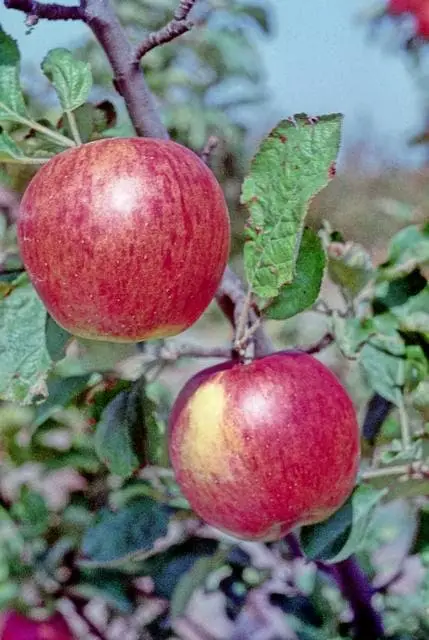
The fruit is medium to large, 160–200 grams, tall and irregular, with flat bosses, a deep eye and a long stalk6. Its tough, smooth skin has a bluish waxy bloom; at maturity it is greenish yellow6, almost wholly covered with purple-red2 that is usually paler near the eye6. The flesh is greenish white, firm and juicy, with a light aroma2,6 and only 5 grams of acid per litre6; the National Fruit Collection describes it as sweet, with a briskly pleasant flavour1. Poorly coloured fruit tastes flat6.
It is picked in October2: early in the month according to the Bavarian guide6, and in mid-October at Brogdale, Kent1. Picked too late, the flesh can turn glassy, but the fruit hangs firm in wind until it is ripe2,6. It keeps about five months in a cool natural store and until April at 2 °C6.
Growing
The tree grows strongly to very strongly, with an upright, narrow crown of long, little-branched limbs, and needs skilled pruning, in summer as well, so that the fruit colours; its wood is not fully hardy6. It flowers mid-early and briefly, is a good pollinator, and crops early, heavily and regularly6. At Brogdale it reaches 10 per cent flowering on 12 May1. It needs fertile soil that is not too dry2,6, in a sheltered site free of late frosts6. It is highly susceptible to fireblight and to proliferation disease, and also to scab and canker, and its fruit is prone to glassiness, bitter pit and, often, mouldy core6. Gloster is diploid4.
Uses
Gloster is mainly a dessert apple2,6. The German genebank lists it as a culinary apple as well2, but the Bavarian guide finds it of little use for processing6.
Where the sources disagree
- Release. The genebank gives 1967 as the year it was first mentioned and went into commerce2; a Bavarian guide says it has been on sale since 19696.
- Mildew. The genebank rates its leaves as strongly affected by powdery mildew, as well as by scab2; the Bavarian guide rates its susceptibility to mildew as low6.
- Texture. The flesh is fine-textured according to the National Fruit Collection1, but coarse-celled according to the Bavarian guide6.
- The pollen parent. The Bavarian guide calls Richared Delicious a mutant of Golden Delicious6. The National Fruit Collection records it as a sport of Delicious5, and the SNP study found Delicious among Gloster’s parents4.
Family tree
Parents, grandparents and great-grandparents, as the entries in the atlas record them.
- Gloster Germany, 1951
- Seed parent Glockenapfel Switzerland, by 1948
- Parent Prinzen Apfel Germany, 1700s
- Parent Prinzen Apfel Germany, 1700s
- Parent Boiken Germany, by 1828
- Parent Boiken Germany, by 1828
- Parent Prinzen Apfel Germany, 1700s
- Pollen parent Richared Delicious United States, about 1915
- Seed parent Glockenapfel Switzerland, by 1948
Sources
- Gloster 69 (accession 1968-067), National Fruit Collection, Brogdale, Kent (Defra). Supports: "Raised in 1951 at the Fruit Research Station, Jork, Hamburg, Germany. Fruits have fine-textured, juicy, sweet flesh with a briskly pleasant flavour."; held under the name Gloster 69; 10% flowering on 12 May and picking in mid-October at Brogdale.
- Passport data: Gloster (in German), Deutsche Genbank Obst (German Fruit Genebank). Supports: other name Gloster 69; mother Weißer Winterglockenapfel, father Richared Delicious; bred at the OVA Jork; year of the cross 1951; first mention and year of commerce both 1967; origin Jork, Germany; grown throughout central Europe; fruit medium to large, ground colour whitish green, over colour purple-red, almost solid, flesh greenish, firm, sweet-sharp with a light aroma; picked in October, eaten from October to April; a dessert and culinary apple (Tafelapfel, Wirtschaftsapfel); nutrient-rich soils that are not too dry; firm in wind, the fruit liable to turn glassy if picked too late; leaf scab strong, fruit scab very strong, leaf mildew strong.
- Complete list of fruit varieties: apple, as of October 2020 (in German), Bundessortenamt (Federal Plant Variety Office), 2020-10. Supports: Gloster registered with the further denomination Gloster 69, with an officially recognised description, marketable in the EU, as a commonly known variety "bereits vor dem 30.09.2012 in Verkehr gebracht" (already on the market before 30 September 2012).
- Using whole-genome SNP data to reconstruct a large multi-generation pedigree in apple germplasm, H. Muranty and others, BMC Plant Biology 20: 2, with Additional files 1 and 3, 2020. Supports: Additional file 3 (Table S3): Gloster 69 (MUNQ 625) with inferred parents Glockenapfel and Delicious, 28 Mendelian errors; parents from the literature Weisser Winter Glockenapfel and Richared Delicious, both marked "~yes" as confirmed; Additional file 1 (Table S1): Gloster 69 diploid (2n).
- Richared Delicious (accession 1979-184), National Fruit Collection, Brogdale, Kent (Defra). Supports: "A more highly coloured sport of Delicious. Discovered in about 1915 by J.L. Richardson, in Monitor, Washington, USA.".
- Gloster (in German), Streuobst in Bayern, Bayerischer Landesverband für Gartenbau und Landespflege (funded by the Bavarian State Ministry for Food, Agriculture and Forestry). Supports: raised in 1951 at the Obstbauversuchsanstalt Jork (Altes Land); Richared Delicious described as "eine Mutante von 'Golden Delicious'"; "Seit 1969 im Handel"; Piglos a cobalt-treated bud mutant of Gloster from Dresden-Pillnitz, more compact, on sale since 1990; flowering mid-early and brief, a good pollen donor, thinning after flowering for even fruit size; fruit medium to large, 160–200 g, tall, irregular with flat bosses, deep eye basin, long stalk; skin tough, smooth, bluish waxy; greenish yellow with a solid red flush, usually paler near the eye; flesh greenish white, coarse-celled, firm, juicy, light aroma, only 5 g/l acid; poorly coloured fruit tasting flat; ripe in early October, glassy if picked too late, firm in wind until ripe; about five months in a cool natural store, until April at 2 °C, mealy sooner if stored dry; mainly a dessert apple, hardly usable for processing; early, high and regular cropping; tree upright and narrow with long, little-branched limbs, strong to very strong growth, needing skilled pruning including summer pruning, wood not fully frost-hardy; nutrient-rich soils in sheltered sites, not dry soils or late-frost sites; highly susceptible to fireblight and proliferation, also to scab and canker, less to mildew (rated low); prone to glassiness, bitter pit and often mouldy core; plantings strongly declining because of lower demand and competition from newer, better-tasting varieties.