Freiherr von Berlepsch
Raised about 1880 at Grevenbroich; DNA shows its parents are Ananas Reinette and Danziger Kantapfel, not Ribston Pippin
History
Freiherr von Berlepsch was raised at Grevenbroich, in the Rhineland, by Diedrich Uhlhorn junior1,2. The National Fruit Collection dates it to about 18801; a record of the Kulturzentrum Sinsteden, a museum of the Rhein-Kreis Neuss, gives 1880 and Uhlhorn’s dates as 1843–1915, and says it is regarded as his best apple2. It was named after Hans Hermann Freiherr von Berlepsch, then district president at Düsseldorf2.
The National Fruit Collection and German sources record it as a cross of Ananas Reinette and Ribston Pippin1,2,3. Two studies of SNP data confirm Ananas Reinette as a parent but identify the other as Danziger Kantapfel, an apple dated to 17604,5; the literature that Muranty and colleagues consulted had already offered Danziger Kantapfel as an alternative to Ribston Pippin4.
In 2022 it was grown as a table apple on 15 hectares in North Rhine-Westphalia, the only German state for which the federal harvest report lists it6. Of its sports, the Bavarian horticultural association prefers the redder Roter Berlepsch2,3; another, Berlepsch Typ Bonn, has somewhat larger fruit3.
The fruit
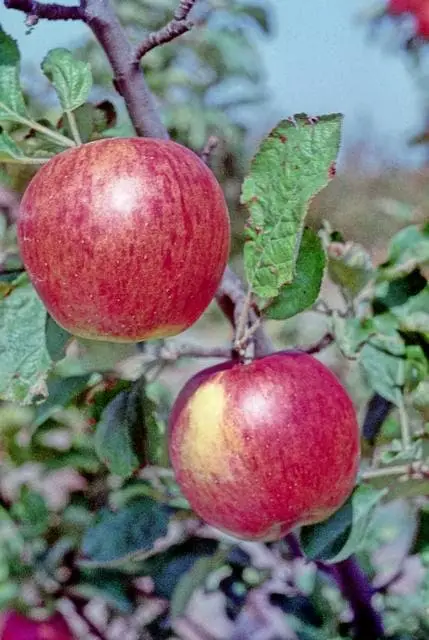
The fruit is medium-sized, about 110 grams, and mostly flat-round, with five ribs typically running from the eye3; the UK’s National Apple Register of 1971 gives it as 54 mm high and 63 mm wide, strongly ribbed1. The skin is yellow to reddish yellow, striped red or washed dark red on the sunny side, with very little russet; dry and sometimes a little rough, it becomes somewhat greasy when fully ripe and in store1,3. The yellowish-white flesh is fine-celled, firm, crisp and very juicy1,2,3, and highly aromatic, with 18.8 per cent sugar and a fine acidity3; the Sinsteden record calls its flavour spicy and sweet-sour2. The Bavarian profile rates its vitamin C content very high, and the Sinsteden record gives 23.5 mg per 100 g2,3.
In Germany it is picked from late September to mid-October2,3, and at Brogdale, Kent, in early October1. It reaches its full aroma about four weeks after picking and is at its best from January to March2. It keeps about six months in a cool store, losing no aroma even as the fruit shrivels, and about seven months at 1 °C3.
Growing
The tree flowers late and over a long period, and its blossom is sensitive to the weather2,3; at Brogdale it reaches 10 per cent flowering on 5 May1. It is a good pollinator3. It starts to bear early but then alternates between heavy crops and failures, which careful thinning after the June drop, summer pruning and leaf feeding after harvest can lessen3. On dry soils the fruit drops early, and several pickings are advised3. Growth is strong at first, later moderate, and in gardens it suits only weak rootstocks3. It is especially at risk from fire blight, susceptible to canker, collar rot, apple proliferation and aphids, and sensitive to copper and sulphur sprays3. It is diploid4,5.
Uses
The Bavarian profile counts it a first-rate variety for every use3. It is eaten fresh and made into apple cake, compote, purée and juice2.
Where the sources disagree
Family tree
Parents, grandparents and great-grandparents, as the entries in the atlas record them.
- Freiherr von Berlepsch Germany, about 1880
- Parent Ananas Reinette Netherlands, by 1821
- Parent Golden Harvey United Kingdom, 1600s
- Parent Danziger Kantapfel Poland, by 1760
- Parent Ananas Reinette Netherlands, by 1821
Sources
- Freiherr von Berlepsch (accession 1947-084), National Fruit Collection, Brogdale, Kent (Defra). Supports: "Raised in about 1880 in Grevenbroich, Rheinland, Germany by Diedrich Uhlhorn junior"; "crisp flesh with a subacid flavour"; synonyms including Berlepsch, Goldrenette Freiherr von Berlepsch, Berlepschs Goldrenette, Reinette Freiherr von Berlepsch and Baron de Berlepsch; parentage "Ananas Reinette x Ribston Pippin"; Smith's National Apple Register of 1971 (b): medium, flat, strongly ribbed, 54 mm high and 63 mm wide, yellow with red stripes over a medium to high share, very little russet, crisp, cream flesh; 10% flowering on 5 May and picking in early October at Brogdale.
- Berlepsch (in German), Kulturzentrum Sinsteden des Rhein-Kreises Neuss, museum-digital:rheinland, 2025-02-06. Supports: raised in 1880 at Grevenbroich by Diedrich Uhlhorn junior (1843–1915) and regarded as his best apple; named after the then district president (Regierungspräsident) at Düsseldorf, "Han[s] Hermann Freiherr von Berlepsch"; recorded as bred from Ananas Reinette and Ribston Pippin; late, long flowering, from the end of April to mid-May; firm, very juicy flesh with a spicy, sweet-sour flavour; harvest from the end of September to mid-October, full aroma four weeks after picking, best from early January to the end of March; the red sport Roter Berlepsch; vitamin C "23,5 mg pro 100 g"; eaten fresh or made into apple cake, compote, purée and juice.
- Freiherr von Berlepsch (in German), Streuobst in Bayern, Bayerischer Landesverband für Gartenbau und Landespflege. Supports: a late variety; the sports Roter Berlepsch ("bevorzugt") and Berlepsch Typ Bonn (somewhat larger fruit); "Um 1880, aus Ananasrenette x Ribston Pepping", raised by D. Uhlhorn, Grevenbroich; late, long, weather-sensitive flowering; a good pollen donor; fruit about 110 g, mostly flat-round with five typical ribs from the eye; dry, sometimes rough skin, somewhat greasy when fully ripe and in store; reddish-yellow ground with red stripes or a washed dark red on the sunny side; yellowish-white, fine-celled, highly aromatic flesh with 18.8 per cent sugar and a fine acidity, very juicy; ripe at the end of September, with early drop on dry soils and several pickings advised; about six months in a cool store without loss of aroma as the fruit shrivels, about seven at 1 °C; early bearing, then alternate; thinning after the June drop, summer pruning and leaf feeding after harvest to reduce alternation; strong growth, later moderate; in gardens only on weak rootstocks; "Besonders gefährdet durch Feuerbrand"; susceptible to canker, collar rot, apple proliferation, aphids and woolly aphids; sensitive to copper and sulphur sprays; "Spitzensorte für alle Verwertungsarten"; "Sehr hoher Anteil an Vitamin C".
- Using whole-genome SNP data to reconstruct a large multi-generation pedigree in apple germplasm, H. Muranty and others, BMC Plant Biology 20: 2, with Additional files 1 and 3, 2020. Supports: Table S3: SNP-inferred parents Ananas Reinette and Danziger Kantapfel (9 Mendelian errors), Ananas Reinette confirmed and Ribston Pippin not, against the literature's "Ananas Reinette (or Zuccalmaglios Renette)" and "Ribston Pippin (or Danziger Kantapfel)"; Table S1: Freiherr von Berlepsch diploid, dated 1880, and Danziger Kantapfel dated 1760.
- Cultivar fingerprinting and SNP-based pedigree reconstruction in Danish heritage apple cultivars utilizing genotypic data from multiple germplasm collections in the world, B. Larsen and others, Genetic Resources and Crop Evolution 72: 2397, with supplementary tables, 2025. Supports: Table S5: Freiherr von Berlepsch diploid, with Ananas Reinette and Danziger Kantapfel as SNP-confirmed parents.
- Tree fruit 2022 (Fachserie 3, Reihe 3.2.1), table 3: final estimate of the apple harvest by variety in the main growing states (in German), Statistisches Bundesamt (Destatis), 2023-01-09. Supports: Berlepsch planted on 15 ha among table apples in North Rhine-Westphalia in 2022, the only state in the table that lists it.