Ananas Reinette
Long thought Dutch, first described in Germany in 1826; DNA names Golden Harvey as one of its parents
History
The Ananas Reinette was first described by A. F. A. Diel in 18262,3,4. He had it from Friedrich Commans of Deutz, who had received the tree from a friend near Zülpich, a small town whose convent had ties with Brabant3,4,5.
Where it arose is not known. In 1859 the pomologist Ed. Lucas found it in most collections under the same name and thought it probably came from Holland2,3; Leroy took his view as all but settling the question3, and the National Fruit Collection still records it as thought to be Dutch1. The Pomologen-Verein’s network of variety keepers calls its origin completely unclear, some later authors having inferred a Dutch origin from the convent’s links with Brabant5.
Recommended by the assembly of pomologists at Gotha in 1857, it spread so fast that by 1873 it was among the most widely grown apples in Germany4. It remained a standard variety, chiefly in German-speaking countries, into the 20th century; old trees are still often found, but the Pomologen-Verein counts it as endangered5.
A 2025 study of SNP data identifies Golden Harvey as one parent; the other is an unidentified cultivar whose genotype has been reconstructed from its other offspring6. Ananas Reinette is itself a parent, with Danziger Kantapfel, of Freiherr von Berlepsch, and, with Alexander, of Geheimrat Doktor Oldenburg6,7. It is also a parent of Von Zuccalmaglios Renette, which resembles it but lacks its star-shaped russet dots, and of the triploid Holsteiner Cox5,6,7.
The fruit
Lucas described a medium-sized, often large, regular apple of tall appearance2; modern accounts call it small to medium, about 110 grams4,5. The smooth skin turns from dark lemon yellow to deep golden yellow, without red, and is marked by many conspicuous russet dots and small russet stars2,5; when ripe it becomes greasy and fragrant, and it bruises easily4. The flesh is yellowish white to almost white, fine-grained and very juicy, firm at first and mellowing in store2,4. Lucas found it spicy, winy and sweet2, and Leroy sweet, deliciously acidulous and perfumed3. The National Fruit Collection notes a perfumed pineapple flavour1, the Bavarian horticultural association a winy acidity recalling blackcurrants4, and the Pomologen-Verein an aroma only in large fruit5.
In Germany it is picked in October, or from late September in warm places, and has the best aroma when picked late4,5; at Brogdale, Kent, it is picked in early October1. It keeps about five months in a cool store without shrivelling4; Leroy gave its season as January to March3.
Growing
The tree is weak to moderately vigorous, with a dense, upright crown and thick shoots on which the buds sit unusually close2,4,5. It bears early and heavily, and the fruit must be thinned or it stays small2,4,5. It flowers mid-early and over a long period, and is a good pollinator4. For good fruit it needs good, moist soil and a sheltered site; it is prone to canker on heavy or wet soils and to fire blight, but little to scab, and its late-ripening shoots are open to frost4,5. It does not suit weak rootstocks4, and the Pomologen-Verein recommends it for gardens and espaliers rather than meadow orchards5. It is diploid5,6,7.
Uses
Lucas counted it among the best dessert apples and excellent for cider2. The Bavarian association rates it for every use, baking included, and notes that it was once dried4.
Where the sources disagree
- Origin. Probably Dutch for Lucas and the National Fruit Collection1,2; completely unclear for the Pomologen-Verein5.
- First record. The National Fruit Collection gives 18211; Lucas, Leroy and the Bavarian association date Diel’s first description to 18262,3,4.
- Size. Medium and often large in 18592; small to medium today4,5.
Family tree
Parents, grandparents and great-grandparents, as the entries in the atlas record them.
- Ananas Reinette Netherlands, by 1821
- Parent Golden Harvey United Kingdom, 1600s
Offspring in the atlas
- Ernst Bosch × Manks Codlin; Germany, by 1908
- Freiherr von Berlepsch × Danziger Kantapfel; Germany, about 1880
- Geheimrat Doktor Oldenburg × Aport; Germany, 1897
- Slavyanka × Antonovka; Russia, 1899
- Von Zuccalmaglios Renette × Purpurroter Agatapfel; Germany, 1878
11 varieties in the atlas descend from Ananas Reinette.
Sources
- Ananas Reinette (accession 1947-074), National Fruit Collection, Brogdale, Kent (Defra). Supports: "Thought to have originated in The Netherlands. Recorded in 1821"; "crisp and juicy with a perfumed pineapple flavour"; a dessert apple; picked in early October at Brogdale; the other names listed as synonyms.
- Illustrated Handbook of Pomology, vol. 1, pp. 131–132: No. 50, Ananas-Reinette (in German), Ed. Lucas, in F. Jahn, E. Lucas and J. G. C. Oberdieck (eds); Ebner & Seubert, Stuttgart; Internet Archive, 1859. Supports: signed by Ed. Lucas; found in most pomological collections, everywhere under this name, and "wahrscheinlich" (probably) from Holland; described by Diel in vol. IV of his systematic description (1826); a medium-sized, often large, very regular, tall-looking apple; smooth skin, dark lemon yellow on the tree and deep golden yellow when ripe, "ohne Spur von Röthe" (without a trace of red), with reddish dots on strongly sunned fruit; the numerous, regular russet dots and russet stars "ein ganz charakteristisches Merkmal"; yellowish-white, very juicy, fine-grained flesh with a spicy, winy, sweet taste like Goldpepping's; ripe in November and keeping without shrivelling until mid-February and often longer; "einer der besten Tafeläpfel, aber auch zu Obstwein vortrefflich" (one of the best dessert apples, and excellent for cider); thick, compact shoots, with buds closer together on young wood than in any apple Lucas knew; "außerordentlich tragbar" (extraordinarily fruitful), pyramids on seedling stocks often bearing in their second year, and fruit even in the nursery.
- Dictionnaire de pomologie, vol. IV, pp. 615–616: Reinette Ananas (in French), André Leroy, Paris and Angers; Internet Archive, 1873. Supports: Lucas "le savant pomologue"; Diel apparently its first describer, in 1826 (Vorz. Kernobstsorten, vol. IV, p. 55, note): he had it from Friedrich Commans of Deutz, who received the tree, labelled Reinette Ananas, from a friend near Zülpich, "petite ville où se trouve un couvent en relations avec le Brabant"; no serious conjecture on its nationality to be drawn from this, but Lucas's view of 1859 that it was probably from Holland "presque tranché la question"; flesh "sucrée, délicieusement acidulée et parfumée"; season January to March.
- Ananasrenette (in German), Streuobst in Bayern, Bayerischer Landesverband für Gartenbau und Landespflege. Supports: the name Ananasrenette; first described by Diel in 1826, who had it from Friedrich R. Commans of Deutz, who had it from a friend in Zülpich; recommended at the second assembly of pomologists at Gotha in 1857 and by 1873 among the most widely grown varieties in Germany; small to medium fruit, about 110 g; skin golden yellow when ripe, smooth, greasy, with distinct russet dots, fragrant, bruising easily; flesh almost white, fine-celled, juicy, firm at first and somewhat mellow in store, pleasantly winy and acid, "etwas an Schwarze Johannisbeeren erinnernd" (somewhat recalling blackcurrants); picked from late September in warm sites, otherwise early to mid-October, with the best aroma when picked late; about five months in a cool store without shrivelling; mid-season, long flowering and a good pollinator; heavy setting, so thinning soon after flowering is needed, or the fruit stays small and tasteless; dense, compact, upright crown, thick shoots with short internodes, weak growth; late end to shoot growth and so frost-prone wood; needs good, moist soil in a sheltered site; strongly susceptible to fire blight, hardly to scab, strongly to canker on heavy or wet soils; not for weak rootstocks; all uses, including baking and cider, and formerly dried.
- Ananasrenette (in German), Jens Meyer, Erhalternetzwerk Obstsortenvielfalt, Pomologen-Verein, 2026-01-14. Supports: the name Ananasrenette; first described by Diel; the scions came from Zülpich, where a convent had links with Brabant, so that later authors supposed it Dutch, but "die Herkunft ist aber völlig unklar" (its origin is completely unclear); widespread chiefly in German-speaking countries and a standard variety into the 20th century, with old trees still often found; endangered (gefährdet); picked from mid to late October; small to medium, conical fruit, warm yellow, with very conspicuous russet-star lenticels; flesh juicy and sharp, aromatic in large fruit; weak to moderate growth with short internodes; thinning essential, as it tends to small fruit; canker on heavy soils, and frost-prone because the shoots ripen poorly; suited to espaliers; for gardens rather than meadow orchards; diploid; Zuccalmaglios Renette descended from it.
- Cultivar fingerprinting and SNP-based pedigree reconstruction in Danish heritage apple cultivars utilizing genotypic data from multiple germplasm collections in the world, B. Larsen and others, Genetic Resources and Crop Evolution 72: 2397, with supplementary tables, 2025. Supports: Table S5: Ananas Reinette diploid, with Golden Harvey and the imputed "Unknown Founder 1" as its SNP-confirmed parents, and a parent of Freiherr von Berlepsch (with Danziger Kantapfel), Geheimrat Doktor Oldenburg (with Alexander), Zuccalmaglios Renette and the triploid Holsteiner Cox (with Cox's Orange Pippin); the text: the "Unknown Founder" genotypes imputed from groups of half-sibs sharing an unknown parent.
- Using whole-genome SNP data to reconstruct a large multi-generation pedigree in apple germplasm, H. Muranty and others, BMC Plant Biology 20: 2, with Additional files 1, 3 and 6, 2020. Supports: Table S1: Ananas Reinette diploid (2n); Table S3: Ananas Reinette and Danziger Kantapfel the SNP-inferred parents of Freiherr von Berlepsch, and Alexander and Ananas Reinette of Geheimrat Doktor Oldenburg; Table S5 (Additional file 6): Zuccalmaglios Renette an offspring of Ananas Reinette.
More from Netherlands
-
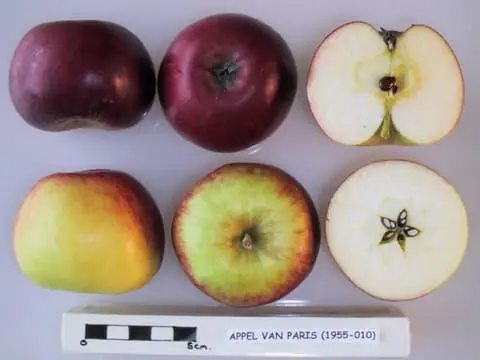
Appel van Paris
-
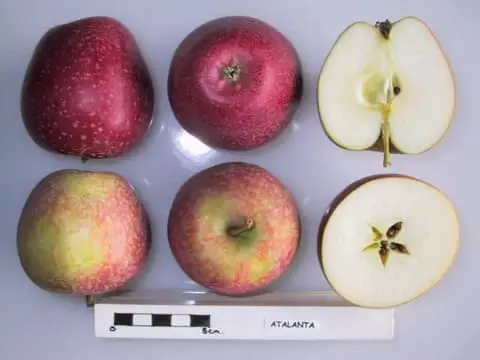
Atalanta (Netherlands)
-
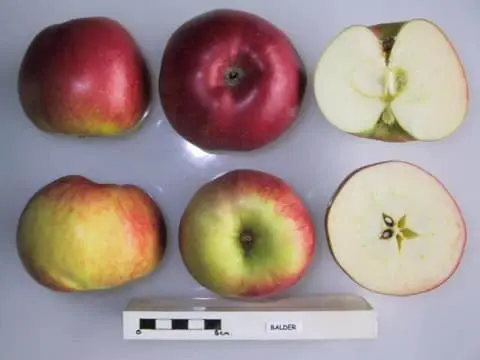
Balder
-
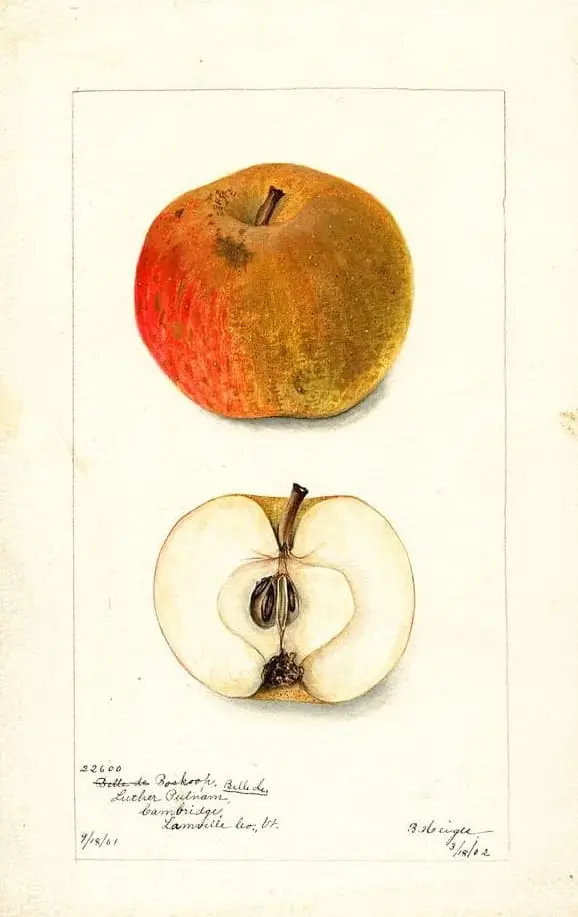
Belle de Boskoop
Found at Boskoop in 1856 and much grown in the Netherlands and Germany; DNA shows Kasseler Renette is one parent
-
Bellida
-
Directeur van de Plassche
-
Dutch Codlin
-
Dutch Mignonne