Elstar
Dutch cross of 1955 named from Elst and the assistant breeder Arie Schaap; Germany's leading table apple in 2022
History
Elstar was raised by the IVT of Wageningen1. From about 1948 the institute’s tree-fruit department made systematic crosses at Elst, the centre of fruit growing in the Betuwe, in an orchard on heavy clay called the Santacker, where the assistant breeder Arie Schaap carried out the crossing and grafting2. Elstar comes from a cross of 1955, the year encoded in its early number, 550454-2402. Its mother is Golden Delicious and its father Ingrid Marie, an apple from the Danish island of Funen3, and SNP data confirm both parents4.
When Tijs Visser, who had come to the Santacker in the 1960s, held taste tests of 120 promising seedlings in 1965, Elstar did well, but its tree was the kind growers dislike: all leaf, with a greenish-yellow apple here and there2. Visser praised the fruit while Schaap took the growers’ objections seriously; the tree was kept, and Elstar was moved from a strong rootstock, probably M 2, onto the weaker M 9, in the hope of less leaf and more fruit2. When the orchard was cleared, only about twelve trees that Visser and Schaap thought promising were spared2. Schaap died in 1968, and when the apple began to succeed it was named Elstar, from Elst and Arie, although many take the name to mean “star of Elst”2.
The grower Hans Smits planted about 600 trees in 19732. By the early 1980s growers and traders were enthusiastic, although the fruit was often picked too late; then the winter of 1984/85 killed many trees, and growers replanted on a large scale with Elstar, which had fetched good prices2. It became the most important apple variety in the Netherlands2. Dutch orchards held 5,126 hectares of it in 1997, out of 15,191 hectares of apples, and 2,208 hectares out of 5,061 in 20256. In Germany it was the leading table apple in 2022, on 6,600 hectares, ahead of Gala on 2,600 and Braeburn on 2,5005.
The fruit
The fruit is medium-sized and round-conical, its yellow skin carrying a moderate red flush, striped and mottled, with little russet1. The original Elstar was not red enough, and shops usually sell redder sports2. The first, Red Elstar, appeared in 1981 on a shoot of a tree belonging to Louis Miechielsens, a grower at Woensdrecht; others followed, among them Elshof in 1983, Elstar van der Grift in 1985 and Red Elswout in 19862. The National Fruit Collection lists Bel-El, Daliest, Elnica, Elshof, Reinstar and Red Elstar among its sports1.
The flesh is cream-coloured, crisp and juicy to very juicy, and the fruit is sweet1. At Brogdale, Kent, the tree reaches 10 per cent flowering on 14 May and the fruit is picked in early October1. It keeps for a long time2.
Growing
The tree grows too strongly and needs much pruning and thinning, tends to crop in alternate years, and is susceptible to almost every disease of apple orchards; it does well on both sand and clay, and also in Germany, Poland and France2. It is diploid4.
Uses
Elstar is a dessert apple1.
Where the sources disagree
Family tree
Parents, grandparents and great-grandparents, as the entries in the atlas record them.
- Elstar Netherlands, 1955
- Seed parent Golden Delicious United States, 1905
- Parent Grimes Golden United States, by 1804
- Pollen parent Ingrid Marie Denmark, about 1910
- Parent Cox's Orange Pippin United Kingdom, about 1825
- Parent Margil France, probably by 1608
- Parent Rosemary Russet United Kingdom, by 1831
- Parent Cox's Pomona United Kingdom, about 1825
- Seed parent Ribston Pippin United Kingdom, about 1707
- Parent Cox's Orange Pippin United Kingdom, about 1825
- Seed parent Golden Delicious United States, 1905
Offspring in the atlas
- Civni × Gala; Italy, 1988
- Elshof Netherlands
- Red Elstar Netherlands
Sources
- Elstar (accession 1974-005), National Fruit Collection, Brogdale, Kent (Defra). Supports: "Raised in 1955 by Dr T. Visser at IVT,Wageningen, The Netherlands"; "Fruits are sweet, crisp and juicy"; a dessert apple; parentage "Golden Delicious x Ingrid Marie"; sports Bel-El, Daliest, Elnica, Elshof, Reinstar and Red Elstar; the collection's characterisation (a): medium, globose-conical, yellow ground with a medium amount of red over colour, striped or mottled, low russet, crisp, juicy to very juicy, cream flesh; 10% flowering on 14 May and picking in early October at Brogdale.
- A short history of Elstar (in Dutch), Pomospost, spring 2010, pp. 20–21, abridged from Hans Schiere in De Fruitteelt 99 (4), 23 January 2009; Wageningen University and Research eDepot, 2010. Supports: the most important Dutch apple variety and the most successful Dutch apple ever, widely grown elsewhere in Europe; systematic crosses from about 1948 by the IVT's tree-fruit department at Elst, the centre of fruit growing in the Betuwe, in an orchard on heavy clay called the Santacker; the assistant breeder Arie Schaap in charge of crosses and grafting; Tijs Visser at the Santacker from the 1960s and his 1965 taste tests of 120 selected seedlings, in which Elstar, from Ingrid Marie and Golden Delicious, did well; the tree all leaf with here and there a greenish-yellow apple; Visser praising its taste and Schaap weighing growers' objections; the tree kept and moved from a strong rootstock, probably M 2, to the weaker M 9, which would give less leaf and more apples; about twelve trees spared when the orchard was cleared; Schaap's death in 1968; the number 550454-240 from the crossing year 1955; the name from Elst and Arie, though many take it as "star of Elst"; Hans Smits planting about 600 trees in 1973; enthusiasm from the early 1980s and fruit often picked too late; the winter of 1984/85 killing many trees and mass replanting with Elstar, which fetched good prices; colour originally not red enough; Red Elstar found in 1981 by the Woensdrecht grower Louis Miechielsens on a top shoot of one of his trees; Elshof (1983), Elstar van der Grift (1985) and Red Elswout (1986); redder mutants usual in shops; growth too strong, needing much pruning and thinning; prone to alternate bearing and to almost all apple diseases; good on sand and clay; long-keeping fruit; successful in Germany, Poland and France.
- Ingrid Marie and Karin Schneider (in Dutch), Jan Veel, Pomospost, summer 2014, pp. 15–16; Wageningen University and Research eDepot, 2014. Supports: Ingrid Marie the father of Elstar, whose mother tree is Golden Delicious; Ingrid Marie a seedling that came up in the garden of the village school at Høed, near Flemløse, on the Danish island of Funen.
- Cultivar fingerprinting and SNP-based pedigree reconstruction in Danish heritage apple cultivars utilizing genotypic data from multiple germplasm collections in the world, B. Larsen and others, Genetic Resources and Crop Evolution 72: 2397, with supplementary tables, 2025. Supports: Table S5: Elstar diploid, with Golden Delicious and Ingrid Marie as SNP-confirmed parents.
- Tree fruit growing 2022: number of farms down 9% on 2017 (in German), Statistisches Bundesamt (Destatis), press release 394, 2022-09-16. Supports: table apples on 27,400 ha in 2022, 82.8% of the apple area; "Die bedeutendsten Sorten sind dabei Elstar mit 6 600 Hektar (-1,3 %), Gala mit 2 600 Hektar (+10,9 %) und Braeburn mit 2 500 Hektar (-9,8 %)".
- Fruit growing: harvest and growing area of apples and pears (in Dutch), Centraal Bureau voor de Statistiek (CBS), StatLine table 84499NED, 2026-08-14. Supports: Elstar on 5,126 ha in 1997 and 2,208 ha in 2025 (final figures); all apple varieties 15,191 ha in 1997 and 5,061 ha in 2025.
More from Netherlands
-
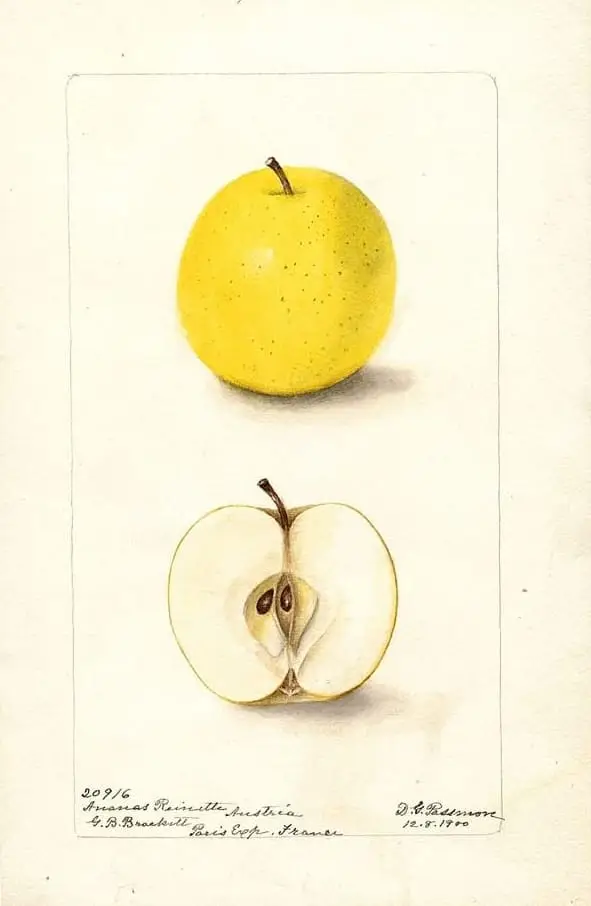
Ananas Reinette
Long thought Dutch, first described in Germany in 1826; DNA names Golden Harvey as one of its parents
-
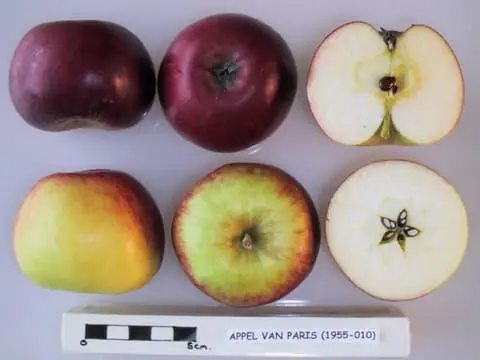
Appel van Paris
-
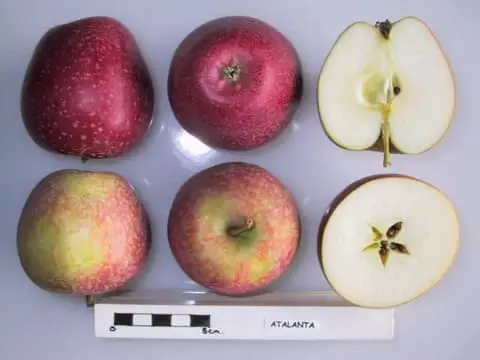
Atalanta (Netherlands)
-
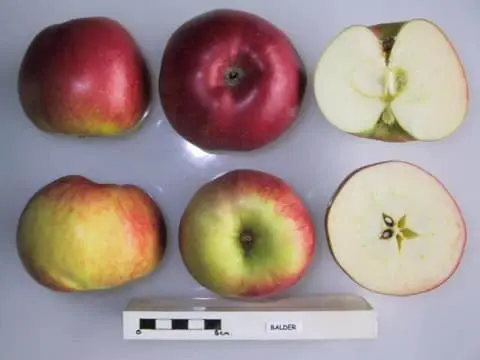
Balder
-
Belle de Boskoop
Found at Boskoop in 1856 and much grown in the Netherlands and Germany; DNA shows Kasseler Renette is one parent
-
Bellida
-
Directeur van de Plassche
-
Dutch Codlin