Ingrid Marie
Found in a Fyn school garden about 1910; Denmark's most widespread apple until 1997 and still Sweden's in 2023
History
Ingrid Marie arose about 1910 at the school at Høed, near Flemløse on the Danish island of Fyn1,3,4. The mother tree was found in the school garden by the teacher, Madsen, and the apple was named after his daughter1,3. It first fruited in 1915 and soon spread across Denmark, partly under the name Høed Orange1. The tree was protected in 1958, and Norway’s Institute of Bioeconomy Research (NIBIO) reported in 2020 that it still stood1.
Because it closely resembles Cox’s Orange Pippin, Cox was thought likely to be one parent1, and the National Fruit Collection records it as a seedling of Cox’s Orange Pippin with the other parent unknown4. Guldborg was once proposed, with a question mark, as that parent5. SNP data from two studies show it to be a seedling of Cox’s Orange Pippin and Cox’s Pomona5,6, in agreement with an earlier marker study of the Danish genebank5.
Ingrid Marie became Denmark’s leading apple. It was the most widespread variety in the country until 19977 and has been among the three most planted for more than 40 years6. In 2023 it covered 139 of Denmark’s 1,285 hectares of apple orchards, second only to Elstar, itself a child of Golden Delicious and Ingrid Marie; 59 per cent of the Ingrid Marie area lay in the Region of Southern Denmark7. It reached Norway and Sweden around 19351. Sweden’s commercial orchards have long held more Ingrid Marie than any other apple, about 780,000 trees in 2023, and more new trees of it were planted between 2019 and 2023 than of any other variety, some 130,0008.
The National Fruit Collection lists it as the mother of Alice, Aroma and Ingol and the father of Odin, Elstar and Kim4. It has also produced colour sports. The best known, Karin Schneider, very dark red all over, was found at H. Schneider’s on Falster around 19401; the Pometum, the University of Copenhagen’s fruit genebank, keeps it beside Ingrid Marie, whose genotype it shares6.
The fruit
The fruit is medium-sized to large, flat-round and regular1,2,4; the Pometum gives 73 mm across and 55 mm high2. Its greenish-yellow skin is largely covered with red to dark red1: deep crimson in the National Apple Register4, dark purple over about three-quarters of the surface to the Pometum2. The skin is slightly greasy, with pale-ringed dots1,2, and in some seasons the fruit cracks around the eye4. The flesh is yellowish to greenish white1,2, sweet, with moderate to weak acidity and little aroma1,2,4; the Pometum gives 12.6 per cent sugar and 0.68 per cent acid for its juice2. It bruises easily and browns quickly when cut2.
In Denmark it is picked in the second half of September2, at Brogdale, in Kent, in late September4, and in Norway in early to mid-October, to be eaten from mid-November to January1. The Pometum rates it a long keeper2.
Growing
The tree is of medium vigour, with a broad, flattish or drooping crown1,2, narrow branch angles and bare stretches of branch inside the crown; its leaves hang on late into autumn1. It bears early, and later heavily and regularly1,2, mostly on older wood2, and it flowers late2. Canker and powdery mildew can attack the tree, and scab and Gloeosporium rot the fruit1. In unsprayed trials in southern Germany in 1997 and 1999 the fruit stayed free of scab and only a few leaves were infected, but mildew affected just under half the shoots2. Ingrid Marie is diploid2,5.
Uses
It is mainly a dessert apple1,4 and is also used for cooking2.
Where the sources disagree
- The second parent. The National Fruit Collection still records it as unknown4, and Guldborg was once proposed with a question mark5; SNP data identify Cox’s Pomona5,6.
- Texture. The National Fruit Collection describes the flesh as firm, crisp and fine-textured4; NIBIO finds it fairly loose and a little coarse1, and the Pometum soft and medium-fine2.
Family tree
Parents, grandparents and great-grandparents, as the entries in the atlas record them.
- Ingrid Marie Denmark, about 1910
- Parent Cox's Orange Pippin United Kingdom, about 1825
- Parent Margil France, probably by 1608
- Parent Rosemary Russet United Kingdom, by 1831
- Parent Nonpareil France, by the mid 1500s
- Parent Cox's Pomona United Kingdom, about 1825
- Seed parent Ribston Pippin United Kingdom, about 1707
- Parent Margil France, probably by 1608
- Parent Nonsuch Park United Kingdom, by 1831
- Seed parent Ribston Pippin United Kingdom, about 1707
- Parent Cox's Orange Pippin United Kingdom, about 1825
Offspring in the atlas
- Alice × Gyllenkroks Astrakan; Sweden, 1943
- Aroma × Filippa; Sweden, 1947
- Elstar × Golden Delicious; Netherlands, 1955
- Ingol × Golden Delicious; Germany, 1954
- Kim × Cortland; Sweden, 1946
- Odin × Golden Delicious; Netherlands, 1953
10 varieties in the atlas descend from Ingrid Marie.
Sources
- Apple varieties: Ingrid Marie (in Norwegian), NIBIO (Norwegian Institute of Bioeconomy Research), plant genetic resources: fruit varieties, 2020-03-30. Supports: a Danish variety of uncertain origin, so like Cox's Orange that Cox's Orange is probably a parent; named after the daughter of the teacher Madsen, who found the mother tree in the Høed school garden on Fyn about 1910; first fruit in 1915; soon spread across Denmark, partly as Høed Orange; to Norway and Sweden about 1935; mother tree protected in 1958 and still standing; colour mutants, the best known Karin Schneider, found at H. Schneider's on Falster about 1940, very dark red all over; tree of medium vigour, medium-sized, with a flat-round crown, narrow and weak branch angles, bare branch sections inside the crown, and leaves that hang on late in autumn; bearing early, later heavily and regularly; canker and powdery mildew on the tree, scab and Gloeosporium rot on the fruit; fruit medium-sized, flat-round to round and regular, greenish yellow, red to dark red over much of the surface, with light-ringed dots; skin slightly greasy; flesh yellowish white or slightly greenish, fairly loose, a little coarse and medium juicy, weakly acid, mild aroma; picked early to mid-October, eating ripe from mid-November to January; mostly a dessert apple.
- The Pometum's apple key: Ingrid Marie (in Danish), University of Copenhagen, the Pometum (Pometets æblenøgle); Internet Archive copy of 3 August 2025, 2025. Supports: origin Flemløse near Assens, Fyn, 1910; synonyms Høed Orange and Ingrid Maries æble; a seedling of Cox Orange × Cox Pomona; widely grown; used for dessert and cooking; tree of medium vigour, broad-crowned or drooping, with a large yield and flower buds mainly on older wood; very late or late flowering; in unsprayed trials in southern Germany in 1997 and 1999 no scab on the fruit, scab on a few leaves and mildew on just under half the shoots; diploid; picked in the second half of September; flesh medium juicy, very sweet, medium acidity, no or weak aroma; juice with 0.68 per cent acid and 12.6 per cent sugar; bruising easily; a long keeper; medium to large, 55 mm high and 73 mm across, flat and symmetrical, with cracks; green-yellow with dark purple over about 75 per cent; greasy skin with light-ringed lenticels; flesh soft and medium-fine, browning strongly when cut.
- Ingrid Marie (in Danish), Ole Callesen, Den Store Danske, Lex.dk, 2009-01-31. Supports: a Danish apple that "arose at Høed school near Flemløse about 1910", named after the schoolteacher's daughter.
- Ingrid Marie (accession 1968-017), National Fruit Collection, Brogdale, Kent (Defra). Supports: "Raised on the island of Fyn, Denmark in about 1910. Fruits have firm, crisp, fine-textured, juicy flesh with a fair flavour. Cracks around the eye in some seasons."; synonyms Hoed Orange and Ingrid Maries Aeble; parentage "Cox's Orange Pippin x Unknown"; mother to Alice, Aroma and Ingol and father to Odin, Elstar and Kim; National Apple Register (Smith, 1971): medium to large, flat, 51–64 mm high and 70–73 mm wide, greenish yellow almost entirely flushed deep crimson, subacid and sweet; a dessert apple; picked in late September at Brogdale.
- Using whole-genome SNP data to reconstruct a large multi-generation pedigree in apple germplasm, H. Muranty and others, BMC Plant Biology 20: 2, with Additional files 1 and 3, 2020. Supports: Table S3: Ingrid Marie inferred from Cox's Orange Pippin and Cox's Pomona, where the documented parents were Cox's Orange Pippin and "Guldborg? (or Cox's Pomona)"; the trio consistent with an earlier marker-based study of the Danish genebank (Larsen and others, 2017); Table S1: diploid.
- Cultivar fingerprinting and SNP-based pedigree reconstruction in Danish heritage apple cultivars utilizing genotypic data from multiple germplasm collections in the world, B. Larsen and others, Genetic Resources and Crop Evolution 72: 2397–2411, with supplementary file 2, 2025. Supports: Ingrid Marie (Cox's Orange Pippin × Cox's Pomona), among the three most planted apples in Denmark "for more than 40 years" and a parent of Aroma and Elstar; colour sports such as Rød Ingrid Marie kept at the Pometum; Table S1: the accession Karin Schneider (Rød Ingrid Marie) with the same genotype (MUNQ 32) as Ingrid Marie.
- Orchards 2023: Elstar is the largest apple variety in Denmark (in Danish), Danmarks Statistik (Statistics Denmark), Nyt fra Danmarks Statistik no. 202, 2024-07-01. Supports: Ingrid Marie the most widespread apple in Denmark "until 1997", now second; Elstar, the largest, bred from Golden Delicious and Ingrid Marie; in 2023 Ingrid Marie on 139 of 1,285 hectares of apples, 59.0 per cent of its area in the Region of Southern Denmark (agricultural and horticultural census 2023).
- Fruit trees in horticulture 2023 (in Swedish), Jordbruksverket (Swedish Board of Agriculture), official statistics JO0119, 2024-11-07. Supports: Ingrid Marie long the most common variety in Swedish commercial apple orchards and still so in 2023, with 780,000 trees, 15,000 fewer than in 2017; the most planted variety in 2019–2023, with 130,000 new trees.
More from Denmark
-
Bodil Neergaard
-
Cherry Cox
-
Filippa
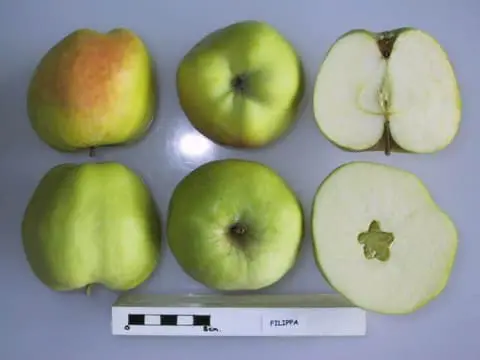
Grown from pips sown in a pot by Filippa Johannsen at Hundstrup, Fyn, about 1880; a parent of Aroma
-
Gravenstein
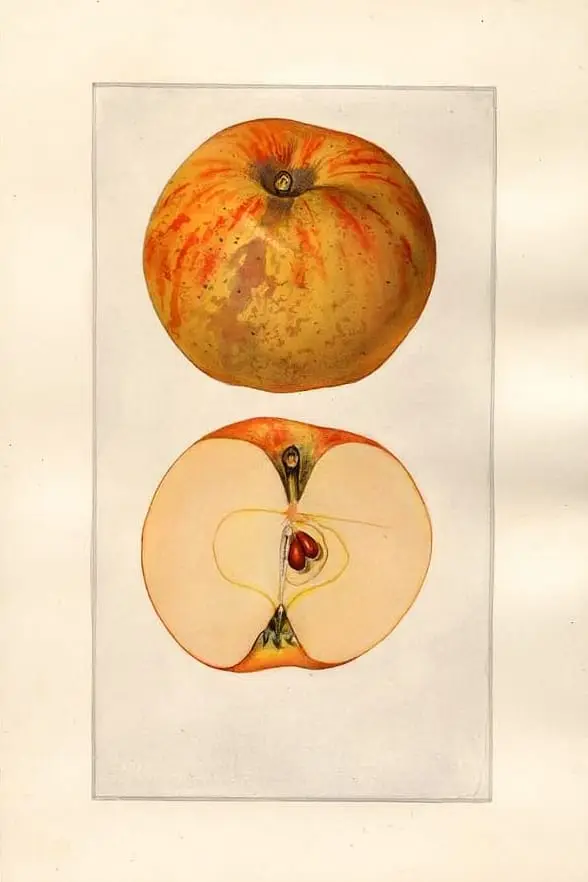
A triploid of disputed origin, linked to Gråsten Castle and to Italy; Danish growers named it the national apple in 2005
-
Guldborg
-
Ildrod Pigeon
-
Josefine Kallehave
-
Kortegaard Cox