Apple varieties, United States
MAIA-1
A Honeycrisp × Fuji seedling bred by a growers' association; only Honeycrisp was planted more in Michigan in 2020–22
History
MAIA-1 was bred by MAIA, an association that commercial growers founded in the mid-1990s to raise apples suited to the American Midwest2. Any grower may join for a yearly fee and royalties on the trees; the members make the crosses, plant and assess the seedlings and report on them, and varieties are released by consensus2.
Honeycrisp, the seed parent, was crossed with Fuji at Pataskala, Ohio, in 19991. The seedling was planted at Wabash, Indiana, in 2001 among several hundred siblings; assessment began in 2005, and over several years it stood out for its growth, early cropping, fruit quality and keeping1. Tested as MDD5-443, it was propagated by grafting at Wabash in 20081. A plant patent applied for in August 2012 was granted on 1 July 2014 under the denomination MAIA1, naming William Dodd, David Doud, John Mitchell Lynd and Gregory Miller as inventors1. It is sold under the trade mark EverCrisp2,3, and Penn State Extension calls it the association’s most popular variety2.
By the autumn of 2020 MAIA reported that 1.8 million trees had been planted in the United States since its release3. Under an international testing agreement, members of the International Pome Association in Chile and New Zealand had begun commercial plantings, and partners in South Africa, Australia and Italy were testing it3. Michigan’s fruit inventory counted 580,000 trees under its trade mark in 2022, out of 17.6 million apple trees in the state; 350,000 of them had been planted in 2020–22, more than of any other listed variety except Honeycrisp4.
The fruit
The patent describes a medium-sized, roundish-oblate fruit of 180–220 grams and 75–80 mm across, with orange-red skin lightly striped over an orange-white ground and little given to cracking1. The yellowish-white flesh is firm, very crisp, breaking and juicy, sweet and aromatic1. In a comparison in November 2010 it was firmer than either parent and had red over 90 per cent of its skin, more than either, with 15.6 per cent soluble solids against 14.3 for Honeycrisp and 17.2 for Fuji1.
It ripens in mid-October, six to eight weeks after Honeycrisp; between 2008 and 2011 it was picked from 17 to 25 October1. It keeps long, both in cold storage and at room temperature1.
Growing
The tree is less vigorous than Fuji’s, with a more open canopy and many more fruiting spurs on two-year-old wood1. It flowers about a week after Fuji, with Golden Delicious, and needs a diploid pollinator in flower at the same time1; its S-alleles are S1 and S24, so Golden Delicious can pollinate it3. It is susceptible to scab, powdery mildew and other fungal diseases, has slight resistance to fire blight, and its fruit is prone to soft rot caused by Penicillium expansum1. An extension educator in Massachusetts found that it “appears particularly susceptible” to Marssonina blotch, as are both its parents3. MAIA advises against chemical thinning, preferring pruning and hand thinning, and warns that fruit borne at the tips of long, limber branches colours poorly3.
Where the sources disagree
- Bearing. The patent records annual cropping1; an extension educator in Massachusetts warns that over-cropped trees can become somewhat biennial3.
- Tree numbers. MAIA’s 2020 report says both that its millionth tree was planted that spring and that 1.8 million had been planted in the United States since its release3.
Family tree
Parents, grandparents and great-grandparents, as the entries in the atlas record them.
- MAIA-1 United States, 1999
- Seed parent Honeycrisp United States, about 1960
- Parent Keepsake United States, 1936
- Parent MN 447
- Parent Northern Spy United States, about 1800
- Parent MN1627
- Parent Keepsake United States, 1936
- Pollen parent Fuji Japan, 1939
- Seed parent Ralls Janet United States, about 1800
- Pollen parent Delicious United States, 1872
- Parent Winesap United States, by 1817
- Seed parent Honeycrisp United States, about 1960
Sources
- Apple tree named 'MAIA1' (US Plant Patent PP24,579), William Dodd, David Doud, John Mitchell Lynd and Gregory Miller (inventors), US Patent and Trademark Office, via Google Patents, 2014-07-01. Supports: Honeycrisp (female parent) × Fuji (male parent), a controlled cross made at Pataskala, Ohio, in 1999 as part of an apple breeding project; the seedling planted as a one-year tree at Wabash, Indiana, in 2001 among several hundred siblings, evaluated from 2005 and identified over several years as superior for growth habit, precocity, fruit quality and storability; propagated by grafting on Malling 7 rootstock by David Doud at Wabash in 2008; variety denomination MAIA1; application filed on 15 August 2012, patent granted on 1 July 2014, inventors William Dodd, David Doud, John Mitchell Lynd and Gregory Miller, assigned to the association; ripening in mid-October, 6–8 weeks after Honeycrisp, with harvests between 17 and 25 October in 2008–2011 (Table 1), the original tree and photographs at Wabash; less vigorous than Fuji, with a more open canopy and more fruiting spurs on two-year-old wood (Table 2); bloom about one week after Fuji, with Golden Delicious; needs cross-pollination from diploid varieties with overlapping bloom; bearing annual; fruit medium-sized, 180–220 g, 75–80 mm across, roundish oblate; skin orange-red with light striping over an orange-white ground, little tendency to crack; flesh yellow-white, firm, crisp, breaking, juicy and sweet, aroma sweet and aromatic; in November 2010 (Table 3) firmer than Honeycrisp and Fuji (7.9 against 7.2 and 7.5 kg/cm²), with 90.3% cover colour against 75.3% and 81.7%, and 15.6% soluble solids against 14.3% and 17.2%; keeping quality excellent, long keeping in refrigerated storage and at room temperature; use fresh market, dessert; susceptible to apple scab, powdery mildew and other fungal diseases, slight resistance to fire blight, fruit susceptible to soft rot (Penicillium expansum).
- Why All the New Apple Varieties?, Rob Crassweller and Robert Pollock, Penn State Extension, 2023-11-25. Supports: MAIA founded in the mid-1990s by commercial apple growers, and maintained by them, to produce cultivars for the Midwestern United States that are available to all US and Canadian growers; any grower may join for an annual fee and royalties on trees; the grower-members make the crosses, plant and evaluate the seedlings and report their findings, and cultivars are released by consensus; the association's most popular cultivar, EverCrisp; Table 1, whose first column gives the "trademark or brand name" seen on the box or bag of apples and whose second gives the patented cultivar name: EverCrisp for MAIA1, from Honeycrisp × Fuji, Wabash, Indiana.
- MAIA News, Autumn 2020, Midwest Apple Improvement Association (MAIA), 2020. Supports: MAIA1: trade mark EverCrisp, test name MDD5-44, Honeycrisp × Fuji, patent PP24,579 (table of trade mark and cultivar names, p. 2); president's update (p. 4): 1.8 million MAIA1 trees planted in the US since its release by 674 MAIA members, and "The millionth MAIA1 tree was planted in the spring of 2020"; under an international testing agreement with the International Pome Association, its members in Chile and New Zealand had begun commercial plantings, and partners in South Africa, Australia and Italy were testing it; S-alleles S1 S24, determined at Washington State University, with Golden Delicious a good pollenizer for it (pp. 7–8); MAIA's recommendation of no chemical thinning, using pruning and hand thinning, and its warning that tip-borne fruit on long, limber branches colours poorly (p. 8); Jon Clements, UMass Amherst Extension (pp. 9–10): over-cropped MAIA1 trees "can go somewhat biennial", and MAIA1 "appears particularly susceptible" to Marssonina blotch, both its parents being susceptible.
- Michigan Fruit Inventory 2022: Apples, USDA National Agricultural Statistics Service, 2024. Supports: the variety listed as Evercrisp: 580,000 trees on 800 acres in Michigan in 2022, of 17.6 million apple trees on 38,000 acres; 350,000 trees planted in 2020–2022, of 2,496,000 apple trees planted in those years, more than any other listed variety except Honeycrisp (1,060,000).
More from United States
-
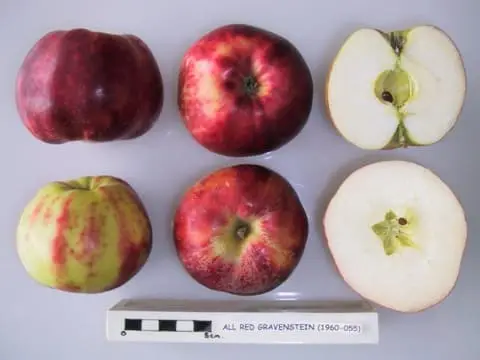
All-Red Gravenstein
-
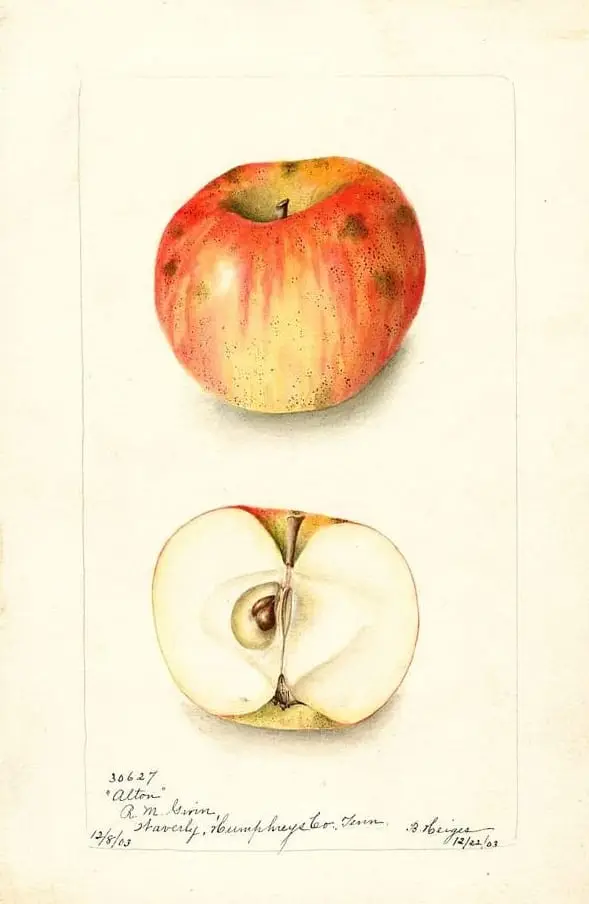
Alton
-
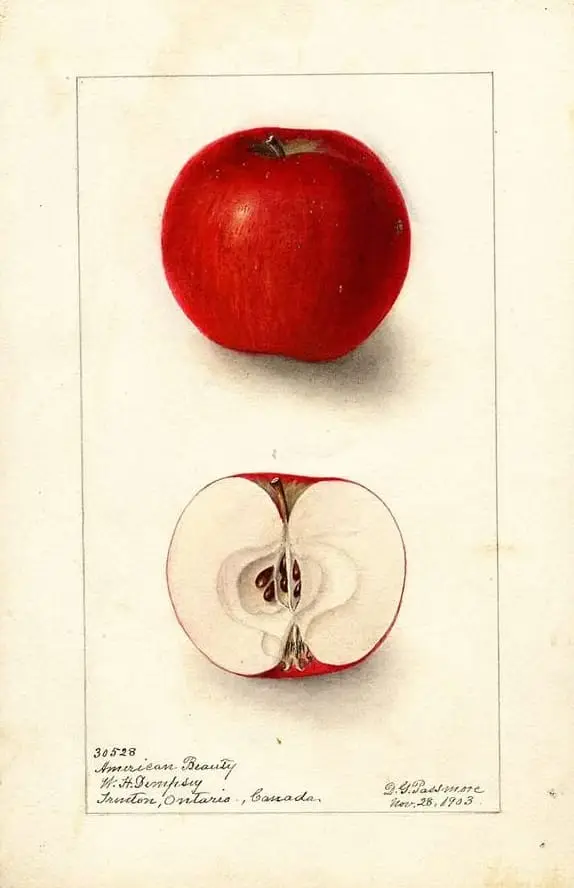
American Beauty
-
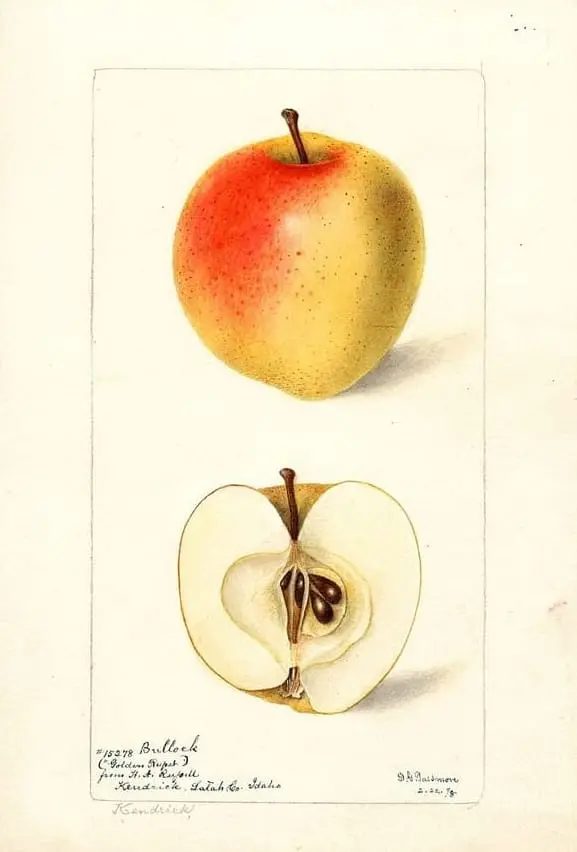
American Golden Russet
A small New Jersey russet whose flesh Downing likened to a buttery pear; Coxe knew it in 1817 as Sheep-nose
-
American Grindling
-
American Summer Pearmain
-
Ames
-
Arkansas