Apple varieties, United States
Pink Pearl
Albert Etter's best-known red-fleshed apple, a Surprise seedling from Ettersburg, California, patented in 1947
History
Pink Pearl was raised by Albert F. Etter, a private fruit breeder whose schooling ended with the ninth grade3. Etter grew up on his family’s farm at Ferndale, California, and at 21 moved to a remote homestead in the upper Mattole River valley in Humboldt County, where he set up his “Ettersburg Experiment Place”3. He began breeding apples there in the 1890s, starting from a trial of more than 600 varieties obtained through the University of California, and from the late 1920s gave most of his effort to them3.
Etter liked to use crab apples and obscure varieties as parents, and worked much with Surprise, a red-fleshed apple brought from Europe to North America in the mid-nineteenth century, whose colour probably came from Malus pumila var. niedzwetzkyana3. From this work he kept more than 30 red-fleshed selections, from light pink to deep red and mostly with a berry-like flavour, and one of them, Pink Pearl, was formally introduced3. The patent calls it “a seedling of Surprise”, and the cultivar register records it as an open-pollinated seedling selected in 19441,2.
In his last years, poor and in failing health, Etter handed his best apples to the California Nursery Company at Niles, where George C. Roeding Jr. helped him choose seven for patenting; they were introduced in 19443. Etter applied for Pink Pearl’s patent on 23 June 1944, and Plant Patent 723 was granted on 4 March 1947, assigned to Roeding1,2. The nursery lacked the means to promote the new apples, and Etter died in 19503.
Writing in 1987, Ram Fishman judged Pink Pearl probably the most widely distributed and acclaimed of Etter’s apples, with an outstanding reputation among amateur growers throughout the United States3. In the 1980s Louis Kimzey at first took the red-fleshed apple he found at Airlie, Oregon, Airlie Red Flesh, for Pink Pearl6. Breeders have used it as a parent: Irodori (Jonathan × Pink Pearl) is a parent of the red-fleshed Moon Rouge and Shinku, raised in Nagano, Japan, and a Falstaff × Pink Pearl selection is a parent of E756-36, a pink-fleshed apple bred by NIAB EMR in the United Kingdom4.
The fruit
The fruit has the shape of a Yellow Bellflower and the size of a Northfield, about 5 to 7 cm (2 to 2¾ inches) across1,2. Its translucent skin glows with the colour of the pink flesh beneath1,2,3, and the register notes an “outstanding bouquet when skin is broken”2. The flesh is pink, crisp and juicy, around a small core; the stalk is long and the eye closed, in a small, shallow basin1,2. It ripens in September and keeps tolerably well under refrigeration, and Fishman rated its dessert quality excellent2,3. Pink Pearl is diploid5.
Growing
The patent describes the tree’s foliage as strong, abundant and of medium size1.
Uses
Above all a dessert apple, it is also used in fruit salads, sauces and pies, where its colour is valued3.
Family tree
Parents, grandparents and great-grandparents, as the entries in the atlas record them.
- Pink Pearl United States, by 1944
- Seed parent Landsberger Reinette Poland, about 1840
Sources
- Apple tree (US Plant Patent 723), Albert F. Etter, inventor, assignor to George C. Roeding Jr.; Google Patents, 1947-03-04. Supports: Albert F. Etter of Ettersburg, California, assignor to George C. Roeding Jr. of Niles, California; application filed 23 June 1944 (serial no. 541,691), patented 4 March 1947; "a new variety of apple tree characterized by its fruit having a transparent skin which glows with the color of the pink flesh beneath"; the shape of a Bellflower and the size of a Northfield, 2 inches across and more; long stem, closed calyx, small and shallow basin, small calyx tube, small core, dark seeds of medium size; flesh pink, crisp and juicy; foliage "Strong, medium sized, and abundant"; "Origin: A seedling of Surprise".
- Pink Pearl, Fruit and Nut Cultivars Database (the American Pomological Society's register of fruit and nut cultivars); choose Apple, then Pink Pearl. Supports: originated at Ettersburg, California, by Albert F. Etter; "Introd. in 1944"; USPP 723 of 4 March 1947, assigned to George C. Roeding Jr., California Nursery Co.; "Surprise o.p.; selected in 1944"; fruit the size of Northfield, "varying from 2 to 2 3/4 inches in diam.", the shape of Yellow Bellflower; transparent skin glowing pink from the flesh beneath; "outstanding bouquet when skin is broken"; flesh crisp, juicy, pink; core small; "ripens in September".
- Albert Etter: Fruit Breeder, Ram Fishman, Fruit Varieties Journal 41(1): 40–46, American Pomological Society, 1987. Supports: Etter a private breeder chiefly of strawberries and apples, whose formal education ended with the ninth grade; his boyhood on the family farm at Ferndale, California; at 21 a remote homestead in the upper Mattole River valley, his "Ettersburg Experiment Place" (at Ettersburg, Humboldt County, in the works cited); apple breeding from the 1890s, beginning with a trial of over 600 cultivars obtained through the University of California; most of his energy given to apples from the late 1920s; heavy use of crab apples and obscure cultivars; much hybridisation with Surprise, introduced from Europe into North America in the mid-nineteenth century for its red flesh, "probably derived from M. pumila var. Niedzwetzkyana"; more than 30 red-fleshed selections, light pink to deepest red, most with a berry-like flavour; Pink Pearl one of them, formally introduced, and the best known of his pink- and red-fleshed cultivars; his best apples handed, when he was impoverished and in poor health, to the California Nursery Company in the Niles district, where George Roeding Jr. helped choose seven for patent applications, introduced in 1944; the nursery lacking the resources to promote them; Etter's death in 1950; Pink Pearl (patent 723, seedling of Surprise) "Probable Etter's most widely distributed and acclaimed apple cultivar", with an outstanding reputation among amateur growers throughout the United States; translucent skin revealing the pink flesh; ripens mid-season (September); keeps tolerably well under refrigeration; excellent dessert quality; used in fruit salads, sauces and pies for its colour.
- Register of New Fruit and Nut Cultivars List 50: Apple (E756-36, Moon Rouge, Shinku), Ksenija Gasic, John E. Preece and David Karp; apple section by Sarah Kostick and Kate Evans; HortScience 55(7): 1164–1201 (read in the Internet Archive's copy of the journal page), 2020. Supports: E756-36, a pink-fleshed apple from NIAB EMR in the United Kingdom, by K. M. Evans, from "Gala × SA908-12 (Falstaff × Pink Pearl)"; Moon Rouge and Shinku, red-fleshed apples from Nagano, Japan, by K. Yoshiie, both from "Irodori (Jonathan × Pink Pearl) × Fuji".
- Using whole-genome SNP data to reconstruct a large multi-generation pedigree in apple germplasm, Hélène Muranty and others, BMC Plant Biology 20: 2, Additional file 1 (Table S1), 2020. Supports: Pink Pearl (an accession of the Laimburg collection, MUNQ 5242) diploid (2n).
- The Curious Case of the Hidden Rose, Regina Winkle-Bryan, Portland Monthly, 2016-10-04. Supports: Louis Kimzey, finding the red-fleshed apple of Airlie, Oregon, known as Airlie Red Flesh, in the 1980s, and at first thinking it a Pink Pearl, "another apple with unusually ruddy flesh".
More from United States
-
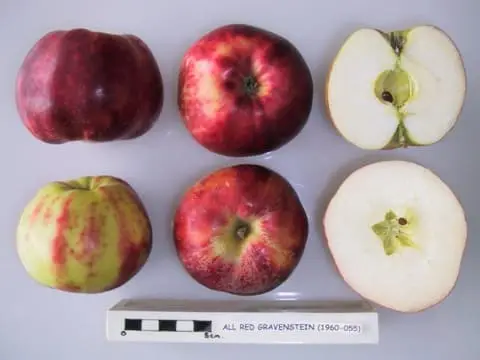
All-Red Gravenstein
-
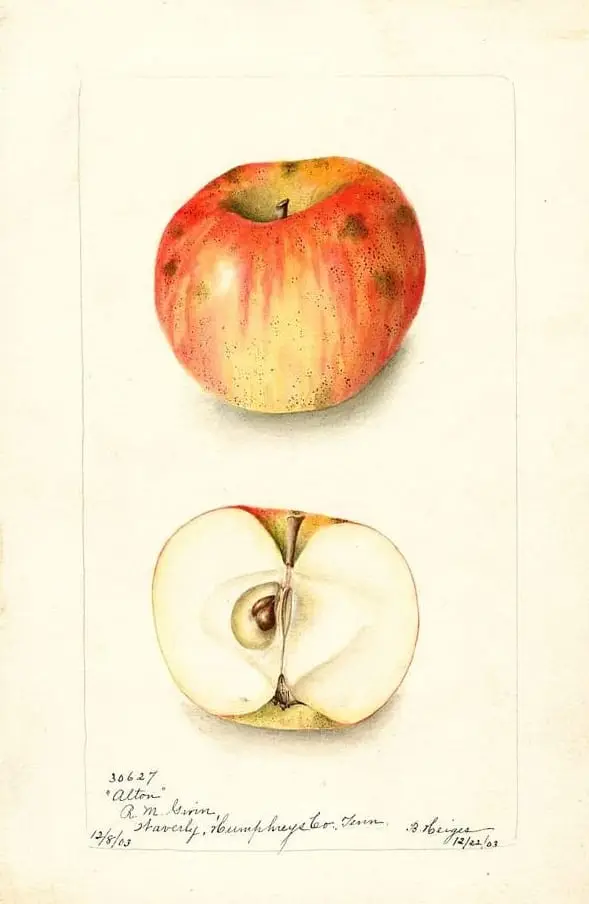
Alton
-
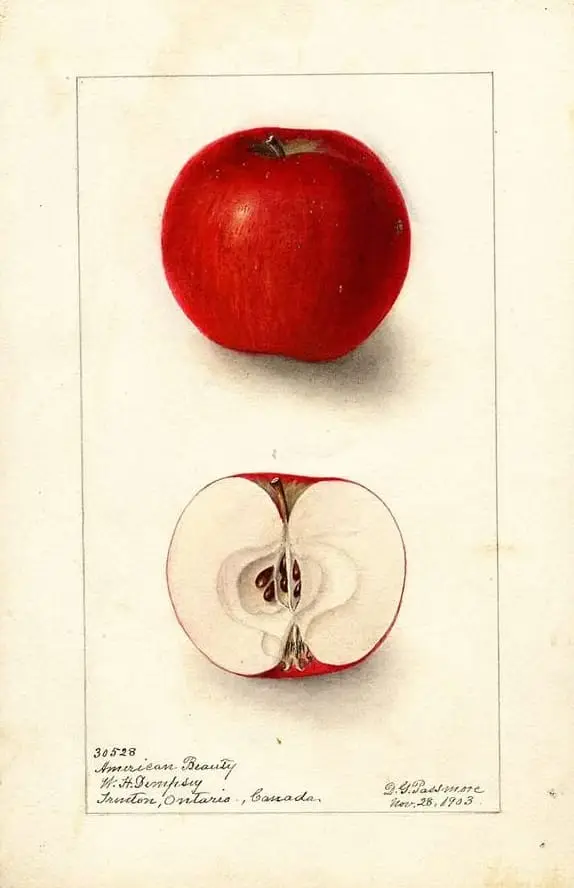
American Beauty
-
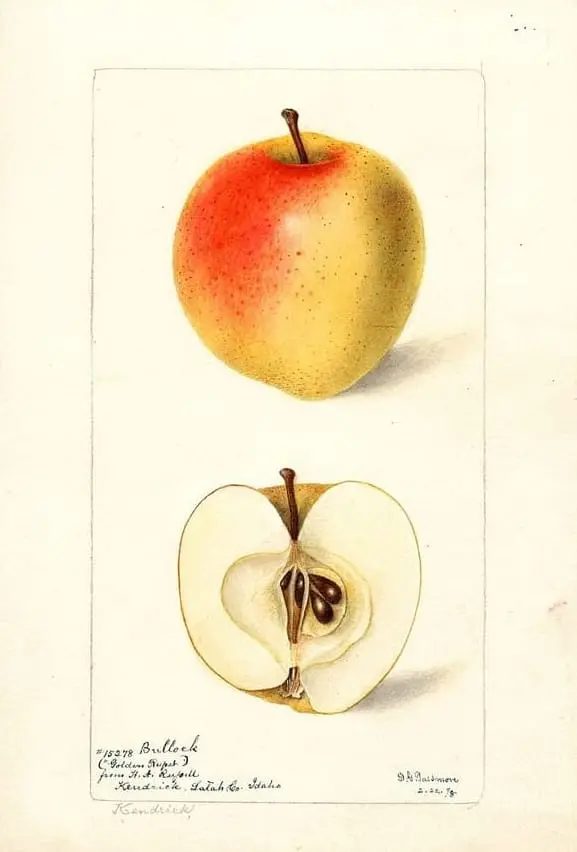
American Golden Russet
A small New Jersey russet whose flesh Downing likened to a buttery pear; Coxe knew it in 1817 as Sheep-nose
-
American Grindling
-
American Summer Pearmain
-
Ames
-
Arkansas