Binet Rouge
Red-striped Norman cider apple of unknown origin, the seventh most planted cider apple in France in 1997
History
Binet Rouge is a cider apple of unknown origin1. The variety directory of the Normandy cider appellations finds it in the Eure, Seine-Maritime, Calvados and Orne, and records the other names Nature des Fosses and Fréquin de Putanges1; the Normandie-Maine regional nature park places it also in the east of the Pays d’Auge2. In 1887 Henri Moisy’s dictionary of the dialect of central Normandy defined the Binet as a late apple taking in several varieties, of which the Binet Blanc was the most esteemed3.
In the 1980s it was planted in the Sarthe, the Manche and Brittany2, and in 1997 it was the seventh most planted cider apple in France, one of eleven varieties that together made up 75 per cent of plantings4. It is classed as a phenolic variety for Calvados, Calvados Pays d’Auge, Calvados Domfrontais, Pommeau de Normandie and Pays d’Auge cider, and a principal variety of Cotentin and Perche cider1. Analyses at the Long Ashton Research Station, near Bristol, between 1905 and 1975 classed it as a late bittersweet, with 0.15 per cent malic acid and 0.21 per cent tannin in its juice5.
The fruit
The fruit is very small to small, globular or ovoid, and flat to fairly elongated, its skin striped and strongly coloured red, with a wide area of fine red dots1. The flesh is sweet, white, firm and scented; the juice is deeply coloured, sugary and well scented1, with an acidity of 26.54 milliequivalents per litre, 2.41 grams of polyphenols per litre (as tannic acid) and a pH of 4.00, and 100 kilograms of fruit yield 60.62 kilograms of juice1. The fruit matures in November and December according to the directory1, and in early November according to the park, which puts milling in the second half of November2.
Growing
The tree is of low to medium vigour and dome-shaped, drooping at harvest1. It flowers in mid- to late May, is fairly slow to come into bearing and is hard to thin1, and crops in alternate years1,2. It is little susceptible to scab, fairly susceptible to powdery mildew, slightly to fairly susceptible to canker and susceptible to fire blight on flowers and shoots1; sawflies sometimes attack it2. The park finds it fairly hardy and easy to train as a central axis2. It is diploid6.
Uses
Binet Rouge is a cider apple1,2. Its cider is relatively low in tannin, and care is needed at milling to keep it bacteriologically stable1.
Where the sources disagree
- Sweet or bittersweet. The directory gives its flavour as sweet, and the park its cider as sweet-tasting1,2; yet the directory also lists it as a principal bittersweet for Perche cider, and Long Ashton classed it as a bittersweet1,5.
- Cropping. The directory rates its production as low1; the park calls it productive and highly fertile2.
- Biennial bearing. The directory rates the tendency as medium to strong1; the park calls it total, the tree bearing every other year2.
Sources
- Binet rouge (in French), Normandie, Terre d'Appellations Cidricoles (aocidricoles.fr), variety directory of the Normandy cider appellations. Supports: the synonyms Nature des Fosses and Fréquin de Putanges; origin "Inconnue, localisée dans l'Eure, en Seine-Maritime, dans le Calvados et dans l'Orne"; striped fruit, bicoloured with a large area of fine red dots, strongly coloured red; very small to small, globular or ovoid, flat or fairly elongated; maturity November and December; flavour ("saveur") sweet; tree dome-shaped or drooping at harvest, flowering mid- to late May, production low, biennial bearing medium to strong, vigour low to medium, hard to thin, slow to fairly slow to come into bearing; little susceptible to scab, fairly susceptible to powdery mildew, little to fairly susceptible to canker, susceptible to fire blight on flowers and shoots; classed phenolic for Calvados, Calvados Pays d'Auge, Calvados Domfrontais, Pommeau de Normandie and Pays d'Auge, principal bitter and bittersweet for Cotentin and principal bittersweet for Perche; a cider apple giving a relatively low-tannin cider, with precautions needed at milling for bacteriological stability; flesh sweet, white, firm and scented; juice very coloured, sugary and well scented; juice acidity 26.54 meq/L, polyphenols 2.41 g/L as tannic acid, extraction yield 60.62 kg/100 kg, pH 4.00.
- Binet Rouge apple (in French), Parc naturel régional et Géoparc mondial UNESCO Normandie-Maine, conservation orchards: apple and pear varieties. Supports: found in the Eure, Seine-Maritime and the east of the Pays d'Auge, and planted in the 1980s in the Sarthe, the Manche and Brittany; fairly hardy and productive but wholly biennial ("alternance totale"), bearing every other year; easy to train as a central axis; sometimes susceptible to sawfly; a sweet-tasting cider; small, ovoid, red-striped fruit; maturity early November, milling mid- to late November; keeping medium; fertility high.
- Dictionnaire de patois normand, p. 70: Binet (in French), Henri Moisy, Henri Delesques, Caen; Internet Archive, 1887. Supports: a dictionary of the dialect of central Normandy (title page); "Binet": a late kind of apple ("espèce de pomme tardive") that includes several varieties, the most esteemed being the binet blanc.
- Genetic mapping of the phenolic compounds of the apple, doctoral thesis (in French), Cindy Verdu, Université d'Angers; HAL open archive, 2013. Supports: p. 17 (PDF p. 40), on the French cider sector, citing Boré and Fleckinger (1997): the most planted varieties in 1997, in order of importance, began with Douce Moën (12%) and ended with Clos Renaux (4%), Binet Rouge being seventh of eleven; these eleven varieties made up 75% of plantings.
- Cider Apple Compositional Data, Andrew Lea, cider.org.uk, from composite data of the Long Ashton Research Station near Bristol, 2015-04-21. Supports: composite analyses of fresh juice made at Long Ashton from 1905 to 1975; Barker's classification, a bittersweet having under 0.45% acid and over 0.2% tannin; Binet Rouge "Late", "Bittersweet", malic acid 0.15%, tannin 0.21%.
- Ploidy determination, Malus (study MALUS.PLOIDYDETERMINATION.2008), USDA Agricultural Research Service, GRIN-Global, 2008. Supports: Binet Rouge (PI 158730) diploid (2x) by flow cytometry.
More from France
-
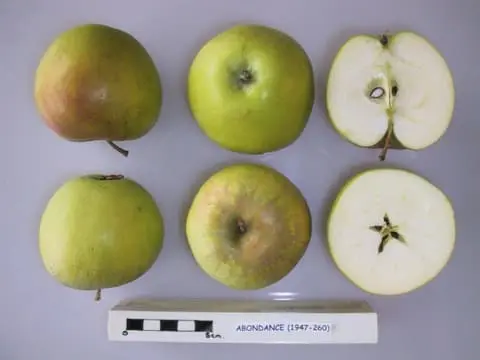
Abondance
-
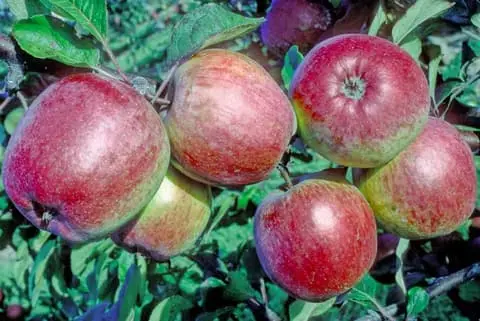
Alfred Jolibois
-
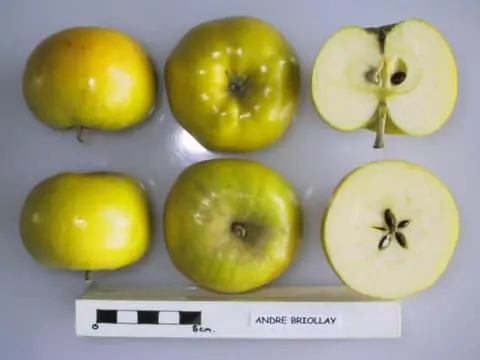
Andre Briollay
-
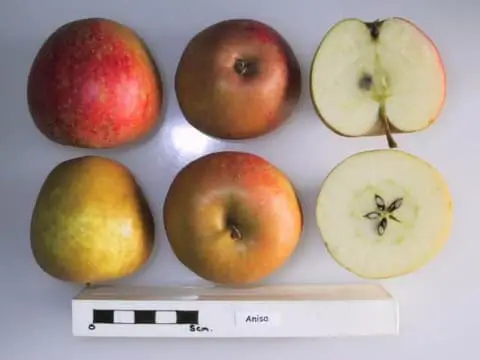
Anisa
-
Api
A tiny, glossy, red-cheeked apple recorded in 1628 and said to have been found wild in a forest in Brittany
-
Api Noir
-
Barre
-
Bassard