Regona
A very sharp, slightly bitter Asturian cider apple, the second most used in Sidra de Asturias orchards
History
Regona is one of the local cider apples of Asturias, in northern Spain1. The specification of the Sidra de Asturias protected designation explains that Asturian farmers chose their cider varieties over centuries from ungrafted seedling trees, grafting from those that cropped best, suited their surroundings and gave the best cider fruit1. Between 1986 and 2001 SERIDA, the Asturian agricultural research service, evaluated the local varieties in its collection and selected sixteen of high value, Regona among them; by 2009 these were widely grown in Asturias and elsewhere along Spain’s Cantabrian coast2.
When the regulation of the designation was ratified in January 2003, Regona was one of the 22 varieties from which its cider had to be made, and the only one in the acid-bitter group (ácido-amargo)3. It was entered definitively in Spain’s Register of Commercial Varieties in 20074. A book on Asturian cider printed in 2021 names it as the second most used variety in the orchards registered with the designation, after Raxao, a pattern very like that of Asturian orchards in general5.
The fruit
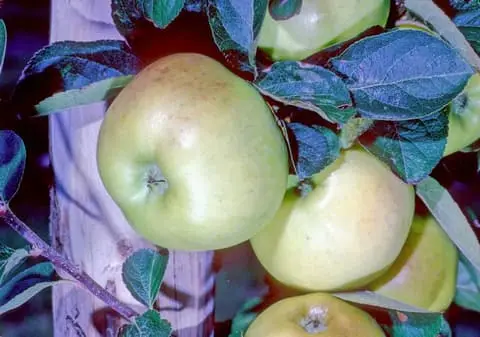
The fruit is medium-sized, or small when the tree is overloaded, and round and flattened1; SERIDA gives 58 mm for its height and 71 to 75 mm for its diameter2. The skin is green or yellowish green, tinged brown where it is most exposed to the sun and on some fruit streaked with white, with many small lenticels, some ringed with white1,2. The flesh is cream, slightly greenish2.
SERIDA’s analyses give 63.7 litres of juice per 100 kg of fruit, with 86.6 grams of sugars per litre, a total acidity of 7.1 grams per litre (as sulphuric acid), a pH of 3.2 and 1.3 grams of phenols per litre (as tannic acid), placing it among very sharp, slightly bitter apples2. The designation’s regulatory council gives the same acidity and phenol figures6.
Growing
Regona flowers very late2,6: from 2005 to 2009 its flowering began on average in early May2. It comes quickly into bearing and crops well, at more than 25 tonnes a hectare, but its cropping alternates fairly strongly from year to year2,6. Its susceptibility to scab is low to medium, and to canker, powdery mildew and brown rot (monilia) very low2. It ripens in November2,6.
Uses
Regona is a cider apple; the designation admits only cider varieties3,6.
Where the sources disagree
- Vigour. SERIDA’s 2009 description rates the tree’s vigour as medium2; the regulatory council’s page, drawing on SERIDA’s data, rates it high6.
- Ripening. SERIDA gives the middle ten days of November2; the council gives the last ten days6.
- Stalk. The specification describes a long stalk1; SERIDA found stalks from very short to long, but mostly short, 11 to 15 mm2.
Sources
- Application for registration of the protected designation of origin "Sidra de Asturias": document 2, specification (in Spanish), Ministerio de Agricultura, Pesca y Alimentación, Subdirección General de Sistemas de Calidad Diferenciada; Principado de Asturias. Supports: Asturian farmers have for centuries selected varieties from ungrafted seedling trees, grafting from the most productive, the best adapted and those giving the best cider apples; Regona among the authorised local varieties, classed "Ácido-amarga"; Regona: fruit medium-sized, or small when the tree is overloaded, round and flattened, green or yellowish green with brownish tones on the parts most exposed to the sun, many small lenticels with a white halo, shallow stalk cavity, long stalk, fairly wide eye basin and closed eye.
- Description of the apple varieties of the PDO Sidra de Asturias (in Spanish), E. Dapena de la Fuente and M. D. Blázquez Noguero, SERIDA (Servicio Regional de Investigación y Desarrollo Agroalimentario); Internet Archive copy, 2009. Supports: SERIDA's evaluation of the Asturian varieties in its collection in 1986–2001 and the 16 varieties then selected and proposed to growers, Regona among them, widely grown in Asturias and other regions of the Cantabrian coast; Regona (pp. 44–45): vigour medium; susceptibility low to medium to scab and very low to canker, powdery mildew and monilia; flowering very late, beginning on average in the middle of the first ten days of May (2005–2009); ripening in the second ten days of November; quick to bear, a reasonable yield (more than 25 t/ha), fairly strong alternate bearing; juice yield 63.7 l/100 kg, total sugars 86.6 g/l, total acidity 7.1 g/l (as H2SO4), pH 3.2, total phenols 1.3 g/l (as tannic acid), technological group "muy ácido ligeramente amargo"; fruit 58 mm high and 71–75 mm in diameter, rather flattened; ground colour whitish green or yellowish green, tan tones on the most exposed parts and whitish stripes on some fruit; lenticels small to medium, some with a white halo; flesh cream, somewhat greenish; stalk very short to long, mostly short (11–15 mm).
- Order APA/224/2003 of 28 January ratifying the regulation of the protected designation of origin "Sidra de Asturias" (in Spanish), Ministerio de Agricultura, Pesca y Alimentación; Boletín Oficial del Estado no. 36, pp. 5524–5533, 2003-02-11. Supports: article 6: the cider of the designation made exclusively from cider apples of the listed varieties, 22 in all; Regona the only variety in the acid-bitter ("Ácido-amargo") technological block.
- Order APA/3524/2007 of 15 November including various varieties in the Register of Commercial Varieties (in Spanish), Ministerio de Agricultura, Pesca y Alimentación; Boletín Oficial del Estado no. 290, pp. 50161–50162, 2007-12-04. Supports: apple (Manzano), definitive registration ("Inscripción definitiva"): 20020246 Regona.
- Asturias, the world cradle of cider (in Spanish), Lorena Alonso Pérez and Natalia Díaz González (texts); published on the website of the Consejo Regulador de la DOP Sidra de Asturias, 2021. Supports: the varieties most used in plantations registered with the DOP, from the highest percentage down: Raxao, Regona (acid-bitter), Durona de Tresali, De la Riega, Xuanina and Verdialona, "un dato muy similar al general de las pumaradas asturianas"; printed 30 April 2021.
- Varieties (in Spanish), Consejo Regulador de la DOP Sidra de Asturias, with data from the fruit-growing research programme of SERIDA. Supports: table varieties not admitted to the designation; the agronomic and technological data prepared and supplied by SERIDA's fruit research programme; Regona: technological group acid-bitter, vigour high, susceptibility to fungi medium to low, flowering very late, maturity in the last ten days of November ("3ª decena de noviembre"), a good level of production, total acidity 7.10 g/l (as H2SO4), total phenols 1.30 g/l (as tannic acid).
More from Spain
-
Raxao
Sharp, late-flowering Asturian cider apple, the variety most used in orchards of the Sidra de Asturias designation
-
Verde Doncella
An old Spanish apple from nineteenth-century nurseries: sweet, pale-skinned and able to keep through the winter