Apple varieties, United Kingdom
Redstreak
The celebrated cider apple of 17th-century Herefordshire, spread by Lord Scudamore; by 1885 it was no longer grown
History
The Redstreak was the most celebrated cider apple of seventeenth-century Herefordshire; Hogg thought that perhaps no other apple of that century had so much “said and written” about it1. He and the Herefordshire Pomona both thought it arose about the beginning of the century1,2. Evelyn, the first writer to notice it, called it “a pure Wilding”, known within living memory as Scudamore’s Crab and then little known outside its neighbourhood2.
Scudamore’s Crab was named after the first Viscount Scudamore, born in 16001. Hogg relates that after the Duke of Buckingham, whom he was attending, was stabbed at Portsmouth, Scudamore withdrew to plant orchards, chiefly of the Redstreak, before going to France as ambassador in 16341. The Pomona’s life of Scudamore gives the tradition that he came upon the seedling while improving his estate, grafted it widely himself and used his influence to spread it3. Philips’s poem Cyder later hailed “the Scudamorean plant” and bade every tree in every garden own “The Redstreak as supream”2,3.
The Redstreak displaced the Gennet Moyle as the favourite cider apple, and its cider was thought “a fitting present for princes”2. In 1714 a manuscript history of Gloucester praised the “Redstrake Sider” of Dymock and Kempley as “not much inferior to the best French wines”2.
Beale already preferred Gennet Moyle cider in 1656, and the Pomona says Herefordshire growers always thought Redstreak cider, though sweet and pleasant, weaker than many others; it also kept badly2. In 1791 Dunster found it “now seldom made pure”, in 1796 Marshall wrote that “The Redstreak Apple is given up”, and in 1811 Knight thought it had outlived its good qualities2. Hogg called it in 1884 a cider apple “which at one period was unsurpassed, but now comparatively but little cultivated”1.
Enquiries for the Pomona found one tree of the true variety at King’s Caple, blown down in the spring of 1878, and one still standing at Kempley2. The Pomona concluded that “as a distinct variety the Redstreak has now ceased to exist”2, and the second volume repeated that Lord Scudamore’s Redstreak was no longer grown4. The name stayed common, since any unnamed seedling with crimson-streaked fruit tended to be called a Redstreak, so that such apples were, in the Pomona’s word, “infinite”4. Somerset Redstreak, for example, is thought to come from the Sutton Montis area and entered commercial orchards after a trial in 19175. Neither Herefordshire Redstreak nor Scudamore’s Crab is among the National Fruit Collection’s apple names6,7.
The fruit
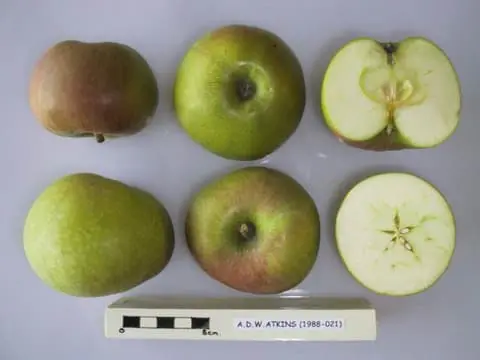
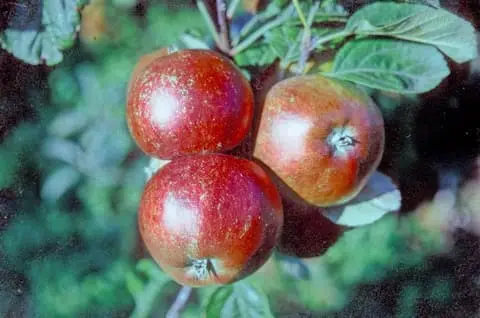
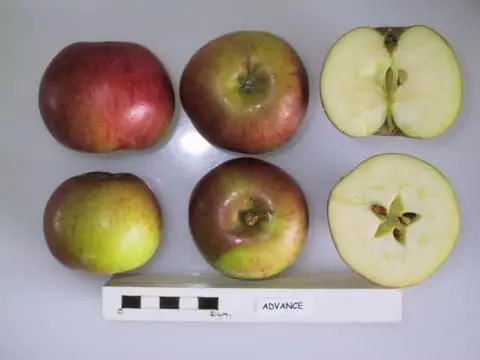
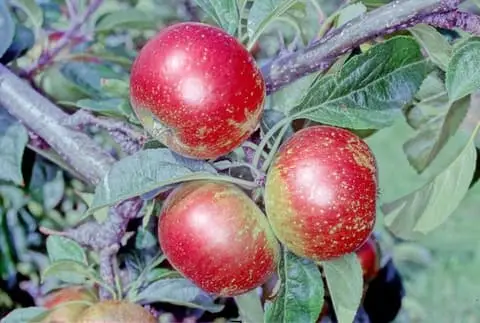
Hogg and the Pomona describe a medium-sized fruit, about 70 mm wide and 57 mm high (“two inches and three-quarters wide, and two inches and a quarter high”), roundish and narrowing towards the apex1,2. The skin was deep clear yellow streaked with red, and on the sunny side red streaked with deeper red, near mahogany, with specks of cinnamon russet1,2. The flesh was yellow, firm, crisp and rather dry, and Hogg found it briskly acid with a rough flavour; the juice had a specific gravity of 10791,2. The tree seems to have been short-lived; it was low, shrubby and rugged2.
Where the sources disagree
- How it arose. Evelyn called it “a pure Wilding”2, and Hogg has Scudamore planting it before his French embassy1. A Herefordshire Council heritage page instead makes it one of the seedlings Scudamore raised from Norman cider fruit brought back from France8; the Pomona says the tradition of his introducing Norman apples is “nowhere supported by any written authority”3.
- When it declined. Hogg dated the start of its decline to about the beginning of the eighteenth century1, the Pomona to about its middle2; the council page blames it partly on the cider tax of 17638.
Sources
- The Fruit Manual, 5th ed., pp. 188–189: Red-streak, Robert Hogg, Journal of Horticulture Office, Internet Archive, 1884. Supports: synonyms Herefordshire Red-streak and Scudamore's Crab; fruit medium sized, "two inches and three-quarters wide, and two inches and a quarter high", roundish or inclining to oblate, narrowing towards the apex; skin deep clear yellow streaked with red on the shaded side, deep red streaked with deeper red "approaching dark mahogany colour" in the sun, with cinnamon-coloured russet; flesh yellow, firm, crisp, rather dry, "briskly acid, and with a rough flavour"; specific gravity of the juice 1079; "A cider apple, which at one period was unsurpassed, but now comparatively but little cultivated"; no apple of which "so much was said and written during the 17th century"; its reputation beginning to decline "about the beginning of the last century"; "seems to have originated about the beginning of the 17th century"; called Scudamore's Crab from being extensively planted by the first Lord Scudamore, born in 1600 and created Viscount Scudamore by Charles I, who after the stabbing of the Duke of Buckingham at Portsmouth retired into private life and planted orchards "of which the Red-streak formed the principal variety", and in 1634 was sent as ambassador to France for four years.
- The Herefordshire Pomona, vol. I, plate XI: Redstreak, Robert Hogg and H. G. Bull (eds), Woolhope Naturalists' Field Club, Internet Archive, 1876–1885. Supports: synonyms Scudamore's Crab, Herefordshire Redstreak, Redstrake of King's Caple and Irchinfield Redstrake; "It seems to have originated about the beginning of the 17th century", first brought into general notice by Lord Scudamore; Evelyn the first writer to notice it: "The famous Red-strake of Herefordshire, a pure Wilding, and within the memory of some now living, surnamed the Scudamore's Crab, and then not much known, save in the neighbourhood"; Philips's Cyder: "The Redstreak as supream"; its cider deemed "a fitting present for princes"; it supplanted the Gennet Moyle as the favourite cider apple; Abel Wantner's manuscript history of Gloucester, 1714, on the "Redstrake Sider" of Dymock and Kemply, "not much inferior to the best French wines"; its reputation beginning to decline "about the middle of last century", its cider sweet and pleasant but lacking strength and keeping badly, and thought by Herefordshire growers from the first inferior to that of many other fruits; Beale (1656) preferring Gennet Moyle; Dunster (1791): "it is now seldom made pure"; Marshall (1796): "The Redstreak Apple is given up"; Knight (1811): it had survived its good qualities; fruit medium sized, two inches and three quarters wide and two inches and a quarter high, roundish, narrowing towards the apex, deep clear yellow streaked with red on the shaded side and red streaked with deeper red in the sun, flesh yellow, firm, crisp and rather dry; specific gravity of the juice 1079; the tree naturally very short-lived, low, shrubby and rugged; one tree found at King's Capel, blown down in the spring of 1878, and one tree remaining at Kemply, out of the many thousands at Dymock and Kemply in 1714; "As a distinct variety the Redstreak has now ceased to exist".
- The Herefordshire Pomona, vol. I, introduction, p. 67: Life of Lord Scudamore, Robert Hogg and H. G. Bull (eds), Woolhope Naturalists' Field Club, Internet Archive, 1876–1885. Supports: the tradition that Lord Scudamore, while improving his estate, "met with the seedling apple, which was named the Redstreak, or Red-strake", grafted it extensively himself and encouraged its propagation with all his influence; Evelyn's "a pure Wilding"; Philips's lines on "the Scudamorean plant"; the tradition that Scudamore introduced Norman cider apples, "though it is nowhere supported by any written authority".
- The Herefordshire Pomona, vol. II, plate LVII: Redstreak Apples, Robert Hogg and H. G. Bull (eds), Woolhope Naturalists' Field Club, Internet Archive, 1876–1885. Supports: "The number and variety of Redstreak Apples is infinite": a seedling or unnamed apple streaked with crimson "naturally takes the name of Redstreak"; "The renowned Redstreak of Lord Scudamore is no longer grown", having "long since been surpassed by superior varieties".
- Somerset Redstreak (accession 1989-106), National Fruit Collection, Brogdale, Kent (Defra). Supports: "Thought to have originated in the Sutton Montis area of Somerset"; propagated for many commercial cider orchards after good performance in a 1917 trial at the National Fruit & Cider Institute and in orchards at Burghill, Hereford; a mild or medium bittersweet.
- Name search: herefordshire (apple, expanded), National Fruit Collection, Brogdale, Kent (Defra). Supports: 25 apple names beginning Herefordshire, from Herefordshire Beefing to Herefordshire Underleaf, none of them Herefordshire Redstreak.
- Name search: scudamore (apple, expanded), National Fruit Collection, Brogdale, Kent (Defra). Supports: no apple name beginning Scudamore.
- Cider, Herefordshire Through Time, Herefordshire Council, 2015-03-02. Supports: Viscount Scudamore of Holme Lacy said to have returned from his embassy in France with cider fruit from Normandy and to have used it to improve English stocks "through cross-pollination and the development of seedlings", the Redstreak being among these seedlings; the apple in decline less than a century later, "In part" because of the cider tax of 1763.