Apple varieties, United Kingdom
Kingston Black
A Somerset bittersharp whose juice comes close to the ideal for cider; its origin near Taunton rests on tradition
History
Kingston Black is a cider apple of Somerset, linked by its name and by tradition with Kingston, near Taunton1,2,3. According to the National Fruit Collection, a Mr Palmer of the Bollitree estate, at Weston-under-Penyard near Ross-on-Wye, brought it into Herefordshire about 18203.
In 1884 Hogg described it as “a beautiful little apple”, grown widely in Somerset, where it was then considered “the most valuable cider apple”2. The 1900 printing of Downing’s American pomology took the opposite view, dismissing it as “a small English cider fruit of little value”4. Andrew Lea counts it among the very few cider apples whose juice approaches his ideal of 15 per cent sugar, 0.4 per cent malic acid and 0.2 per cent tannin, but notes that it is scarcely grown commercially because it is prone to canker5.
The fruit
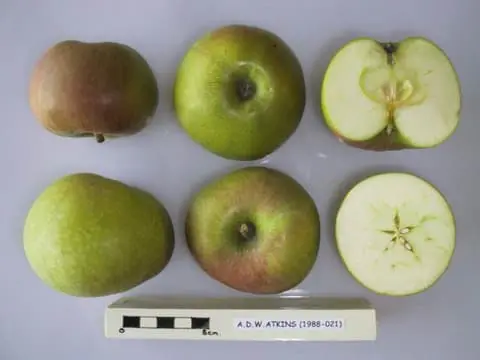
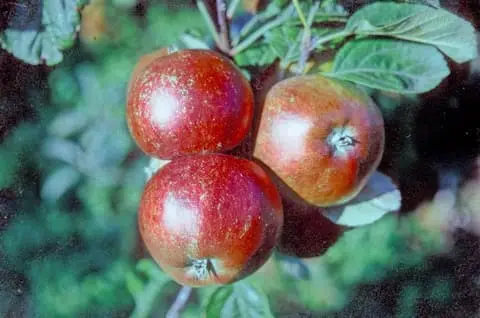
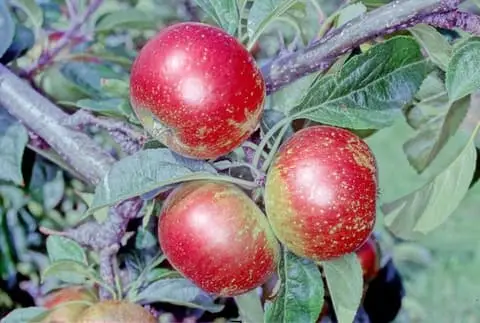
Hogg found the fruit small, “two inches and a half wide, and two inches high” (about 64 by 51 mm), roundish ovate or short conical2; the Pomona called it medium-sized, a short cone that is broad and flat at the base1. Fruit measured at the National Fruit Collection was 52.85 mm wide and 45.75 mm high3. The skin is dark red to mahogany over most of the surface, streaked with darker crimson or, in Hogg’s words, “almost black stripes”; it is yellow to orange where shaded, dotted with russet, and russeted at the base1,2. The flesh is white or yellowish, tinged red or pink under the skin, and Hogg found it tender, juicy and sweet1,2.
The Pomona described the juice as plentiful and tawny red, moderately sweet and pleasantly acid, with an astringent aftertaste; an analysis of the 1881 crop gave a density of 1.052 and 10.028 per cent sugar by weight1. In the classification that B. T. P. Barker set up at Long Ashton Research Station, founded in 1903, a bittersharp has more than 0.45 per cent acid and more than 0.2 per cent tannin6. Long Ashton’s composite juice analyses of 1905 to 1975 give Kingston Black 0.58 per cent malic acid and 0.20 per cent tannin, a late bittersharp, and Lea marks it as one of the cultivars generally regarded as having “vintage quality”6.
At Brogdale, in Kent, it reaches 10 per cent flowering around 8 May and is picked in late September3; Lea gives mid-season flowering and a mid-October harvest5. Hogg reported that it kept until Christmas2.
Growing
The National Fruit Collection describes a medium-sized, spreading tree that is susceptible to scab3. Lea found its growth and cropping moderate and the tree slow to come into bearing5. It is diploid7.
Uses
The National Fruit Collection credits Kingston Black with a full-bodied cider of excellent quality and distinctive flavour3, and Lea calls it “allegedly the ‘perfect’ cider apple”5.
Where the sources disagree
- Origin. The Pomona gave the Kingston story as tradition and found “no authentic record of its origin”1; Hogg stated it as fact2; the National Fruit Collection says the apple was “possibly” raised there3.
- Black Taunton. The Pomona gives Taunton Black and Taynton Black as other names for Kingston Black1. Hogg described Black Taunton, or Taunton Black, as a separate Somerset cider apple, roundish oblate and broader than it is high8.
- Worth. In 1884 Hogg reported it to be considered the most valuable cider apple in Somerset2; Downing’s pomology thought it of little value4.
Sources
- The Herefordshire Pomona, vol. II, plate XLV: Kingston Black, Robert Hogg and H. G. Bull (eds), Woolhope Naturalists' Field Club, Internet Archive, 1876–1885. Supports: synonyms Black Kingston, Taynton Black and Taunton Black; "believed to be a Somersetshire Apple", said by tradition to have been raised at Kingston, near Taunton, with "no authentic record of its origin"; fruit "of medium size", a short cone, broad and flat at the base; skin dark mahogany or deep crimson over nearly the whole surface, splashed with dark crimson, deep yellow approaching orange where shaded, with cinnamon russet dots and ashy grey russet at the base; flesh yellowish with a pink tint near the skin; juice plentiful, "of a rich tawny red colour", moderately sweet and pleasantly acid "with an astringent after-taste"; Mr With's analysis of the 1881 crop: density of fresh juice 1.052, sugar 10.028 parts in 100 by weight.
- The Fruit Manual, 5th ed., p. 124: Kingston Black, Robert Hogg, Journal of Horticulture Office, Internet Archive, 1884. Supports: fruit small, "two inches and a half wide, and two inches high", roundish ovate or short conical; skin pale yellow striped with red on the shaded side and very dark red "striped with dark purple, or almost black stripes" in the sun, with grey russety dots and a large russet patch at the base; flesh white, stained with red under the skin, tender, juicy and sweet; "a beautiful little apple, extensively grown in Somersetshire, where in the present day it is considered the most valuable cider apple"; "It keeps till Christmas"; "It takes its name from Kingston, near Taunton".
- Kingston Black (accessions 1999-096 and 1989-093), National Fruit Collection, Brogdale, Kent (Defra). Supports: a cider apple "Believed to be a Somerset apple and possibly raised at Kingston, near Taunton"; introduced into Herefordshire "c.1820 by Mr Palmer of Bollitree Estate, Weston-under-Penyard near Ross-on-Wye"; trees of medium size with a spreading habit, susceptible to scab; fruits medium to small, producing "a full bodied, excellent quality cider with a distinctive flavour"; 10% flowering on 8 May and picking in late September (accession 1999-096); size small, height 45.75 mm and width 52.85 mm, red over colour in a striped and solid flush (accession 1989-093).
- The Fruits and Fruit Trees of America, p. 241: Kingston Black, A. J. Downing, revised by Charles Downing, John Wiley & Sons, Internet Archive, 1900. Supports: "A small English cider fruit of little value"; fruit roundish, pale yellow, striped with red; flesh white, stained with red, tender, juicy, sweet; November and December.
- The Science of Cidermaking, Part 2: Fruit and Cultivation, Andrew Lea, cider.org.uk, 1997, lightly updated 2009. Supports: the composition of the "ideal" cider apple juice: 15 per cent sugar, 0.4 per cent malic acid and 0.2 per cent tannin by weight; "very few" true cider apples match it, Kingston Black a bittersharp that does approximate to it "but this is scarcely grown commercially nowadays on account of its susceptibility to canker"; in the table of vintage-quality cultivars a mild bittersharp, growth and cropping moderate, "Slow to start bearing", flowering mid-season, harvest mid-October, "Excellent distinctive flavour, allegedly the 'perfect' cider apple!".
- Cider Apple Compositional Data, Andrew Lea, cider.org.uk, from Long Ashton Research Station data, 2015-04-21. Supports: Long Ashton Research Station founded to work on cider in 1903, with B. T. P. Barker its first director, who established its classification: bittersharp above 0.45 per cent acid and above 0.2 per cent tannin; composite juice analyses at Long Ashton from 1905 to 1975: Kingston Black a late bittersharp with 0.58 per cent malic acid and 0.20 per cent tannin, shown among the cultivars "generally regarded as having" vintage quality.
- Ploidy determination, Malus (study MALUS.PLOIDYDETERMINATION.2008), USDA Agricultural Research Service, GRIN-Global, 2008. Supports: Kingston Black (PI 589703) diploid (2x) by flow cytometry.
- The Fruit Manual, 5th ed., p. 24: Black Taunton, Robert Hogg, Journal of Horticulture Office, Internet Archive, 1884. Supports: Black Taunton (Taunton Black) described as a separate apple, "two inches and three-quarters wide, and two inches high; roundish oblate", crimson streaked with darker crimson over a rich yellow ground; "A popular Somersetshire cider apple".