Apple varieties, United Kingdom
Yarlington Mill
A bittersweet cider apple from the Somerset village of Yarlington; it makes a light, aromatic cider
History
Yarlington Mill originated in the village of Yarlington, in the North Cadbury area of Somerset1. When a 2025 study genotyped a tree held at the University of Copenhagen’s Pometum, the SNP data identified no parent for it5.
The fruit
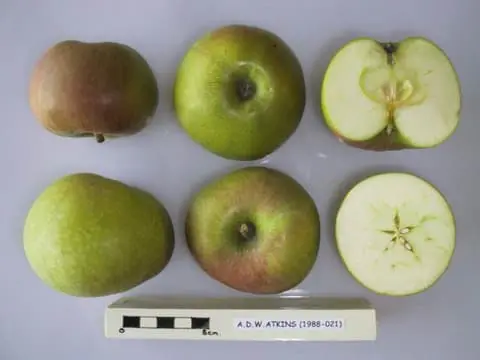
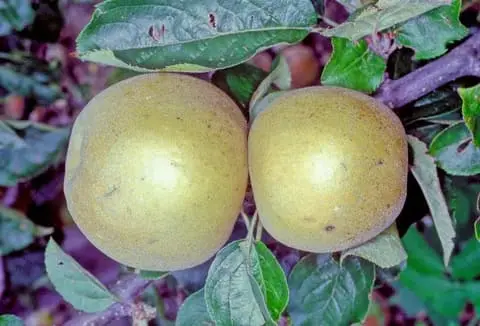
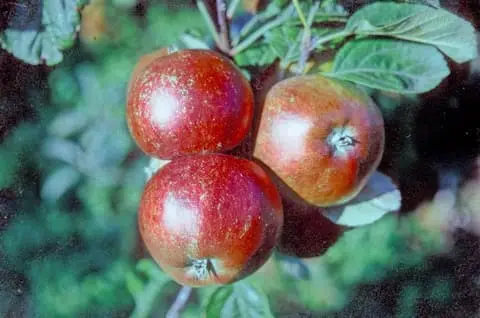
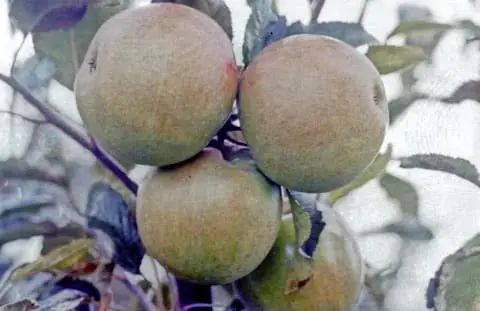
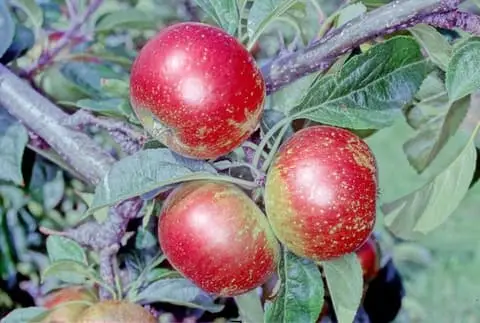
The fruit is small to medium and rounded-conical; at the National Fruit Collection it measured 63.60 mm wide and 54.70 mm high1. The green-yellow skin is mostly covered with a red flush and stripes, with little russet, and the flesh is cream-coloured1.
Long Ashton’s composite juice analyses of 1905 to 1975 give Yarlington Mill 0.22 per cent malic acid and 0.32 per cent tannin, which makes it a late bittersweet in the classification B. T. P. Barker drew up at Long Ashton Research Station: under 0.45 per cent acid and over 0.2 per cent tannin2. Andrew Lea calls it a medium bittersweet3.
At Brogdale, in Kent, it reaches 10 per cent flowering around 2 May and is picked in late October1; Lea gives mid-season flowering and a November harvest3.
Growing
The National Fruit Collection calls it “a strongly biennial cropper unless pruned regularly”1. Lea describes a tree that tends to droop and crops well in alternate years3. It is diploid4,5.
Uses
Yarlington Mill is grown for cider. The National Fruit Collection describes a medium bittersweet cider1, Lea a good, light and aromatic one, and he lists it among the cider apples generally regarded as having “vintage quality”2,3.
Sources
- Yarlington Mill (accession 1989-119), National Fruit Collection, Brogdale, Kent (Defra). Supports: a cider apple that "Originated in the village of yarlington, in the North Cadbury area of Somerset"; "A strongly biennial cropper unless pruned regularly"; "Produces a medium bittersweet cider"; 10% flowering on 2 May and picking in late October; size small to medium, globose conical, height 54.70 mm and width 63.60 mm, green-yellow ground with a high red over colour in a striped and solid flush, low russet, cream flesh.
- Cider Apple Compositional Data, Andrew Lea, cider.org.uk, from Long Ashton Research Station data, 2015-04-21. Supports: Barker's classification at Long Ashton Research Station (founded 1903): bittersweet below 0.45 per cent acid and above 0.2 per cent tannin; composite juice analyses at Long Ashton from 1905 to 1975: Yarlington Mill a late bittersweet with 0.22 per cent malic acid and 0.32 per cent tannin, shown among the cultivars "generally regarded as having" vintage quality.
- The Science of Cidermaking, Part 2: Fruit and Cultivation, Andrew Lea, cider.org.uk, 1997, lightly updated 2009. Supports: in the table of vintage-quality cultivars Yarlington Mill a medium bittersweet: "Tends to droop. Good biennial cropper"; flowering mid-season; harvest November; "Good light aromatic cider".
- Ploidy determination, Malus (study MALUS.PLOIDYDETERMINATION.2008), USDA Agricultural Research Service, GRIN-Global, 2008. Supports: Yarlington Mill (PI 588780) diploid (2x) by flow cytometry.
- Cultivar fingerprinting and SNP-based pedigree reconstruction in Danish heritage apple cultivars utilizing genotypic data from multiple germplasm collections in the world, B. Larsen and others, Genetic Resources and Crop Evolution 72: 2397, supplementary Tables S1 and S5, 2025. Supports: Yarlington Mill genotyped from accession DNK1288 in the non-heritage collection of the Pometum, University of Copenhagen (Table S1); diploid, with no SNP-confirmed parent (Table S5).