Bisquet
Old yellow-green Norman bittersweet, cited in 18th- and 19th-century monographs; its name is said to come from Biscay
History
Bisquet is a bittersweet cider apple of unknown origin1. The variety directory of the Normandy cider appellations reports that its name is said to come from Biscay, in Spain, where the variety supposedly originated1. The directory also records the names Bisquet Jaune, Bica, Biscaye, Bonne Chambrière and Belle Fille de la Saint Jean1.
The specification of the Calvados Pays d’Auge appellation gives Bisquet, with Saint Martin, Germaine and Noël des Champs, as a well-known example of the many varieties cited in eighteenth- and nineteenth-century monographs that are still grown, a constancy that it counts as a very strong link with the land of the appellation2. Bisquet is one of the phenolic (bitter and bittersweet) varieties authorised for Pays d’Auge cider3 and Calvados Pays d’Auge2, and also for Calvados, Calvados Domfrontais and Pommeau de Normandie; for Perche cider it is an accessory bittersweet1.
In the French classification of cider apples by the acidity and tannin of their juice, Bisquet is cited as an example of a bittersweet, douce-amère4. The class takes in juices with less than 60 milliequivalents of acid and 2 to 3 grams of tannin per litre4.
The fruit
The fruit is medium-sized and conical, yellow-green with practically no red and no stripes, on a short to fairly long, rather thick stalk1. It matures in November and December and keeps well1. The directory gives its juice an acidity of 31.31 milliequivalents per litre, 2.12 grams of polyphenols per litre (as tannic acid), a density of 1,045 kilograms per cubic metre and a pH of 4.00, and 100 kilograms of fruit yield 63.12 kilograms of juice1.
Growing
The tree is of medium to strong vigour and grows as a spherical sector or a dome1. It flowers from late April to mid-May, comes into bearing at a moderate pace and crops well, with little to moderate biennial bearing; it is easy to train1. It is susceptible to scab in wet years, moderately susceptible to powdery mildew and canker, and little affected by blossom wilt1.
Uses
Bisquet is used for cider and Calvados1. The fruit is relatively poor in sugar and can give a light cider with little tannin1. Because the fruit is very rich in nitrogen, the directory advises measuring it and managing the fermentation so as to deplete the nitrogen, and recommends precautions at milling, such as cooling the must and sulphiting, to keep the cider bacteriologically stable1.
Sources
- Bisquet (in French), Normandie, Terre d'Appellations Cidricoles (aocidricoles.fr), variety directory of the Normandy cider appellations. Supports: the synonyms Bisquet jaune, Bica, Biscaye, Bonne Chambrière and Belle fille de la Saint Jean; origin unknown; "Son nom viendrait de la région d'Espagne d'où elle serait originaire : La Biscaye"; fruit not striped, yellow-green, practically without red, conical, medium-sized, with a short or fairly long, fairly thick stalk; maturity November and December; keeping good; flavour bittersweet; tree shaped as a spherical sector or dome, flowering late April to mid-May, production good, susceptible to scab in wet years, moderately susceptible to powdery mildew and canker, little susceptible to blossom wilt on flowers, biennial bearing low to medium, vigour medium to strong, easy to train, medium speed into bearing; phenolic for Calvados, Calvados Pays d'Auge, Calvados Domfrontais, Pommeau de Normandie and Pays d'Auge, accessory bittersweet for Perche; uses cider and Calvados; relatively poor in sugar, giving a light cider with little tannin; precautions at milling for bacteriological stability (cooling the must, sulphiting); very rich in nitrogen (measurement recommended), the fermentation to be managed so as to deplete the nitrogen; juice acidity 31.31 meq/L, density 1045.0 kg/m³, polyphenols 2.12 g/L as tannic acid, extraction yield 63.12 kg/100 kg, pH 4.00.
- Specification of the controlled designation of origin "Calvados Pays d'Auge" (in French), Institut national de l'origine et de la qualité (INAO); approved by order of 17 December 2021, Journal officiel of 23 December 2021; copy published by Normandie, Terre d'Appellations Cidricoles, 2021-12-23. Supports: section 5.1: many varieties cited in the monographs of the eighteenth and nineteenth centuries are still grown today, "Bisquet, Saint Martin, Germaine, Noel des Champs" being a few well-known examples among dozens of others, a constancy of varieties that forms a very strong link with the land of Calvados Pays d'Auge; Bisquet among the phenolic varieties of annex 1.
- Specification of the designation of origin "Pays d'Auge" or "Pays d'Auge-Cambremer" (in French), Institut national de l'origine et de la qualité (INAO); approved by order of 17 January 2026, Journal officiel of 21 January 2026; copy published by Normandie, Terre d'Appellations Cidricoles, 2026-01-21. Supports: "Pays d'Auge" a sparkling cider made from pure juice of cider apples; section 5.1.1: Bisquet among the authorised "Variétés phénoliques (amères et douces-amères)" of the orchard.
- Genetic mapping of the phenolic compounds of the apple, doctoral thesis (in French), Cindy Verdu, Université d'Angers; HAL open archive, 2013. Supports: p. 15 (PDF p. 38): French cider apples classed by flavour, Bisquet and Douce Moën given as examples of the bittersweet (douce-amère) class; the classification table after Tavernier and Jacquin (1959): a bittersweet has acidity below 60 meq/L and tannins between 2 and 3 g/L.
More from France
-
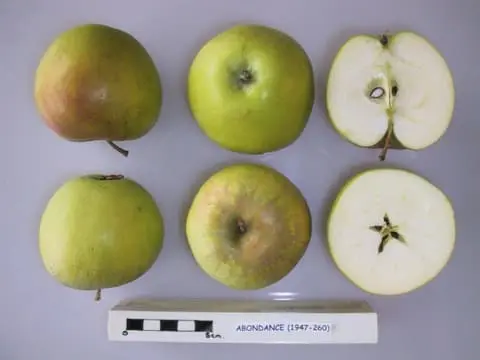
Abondance
-
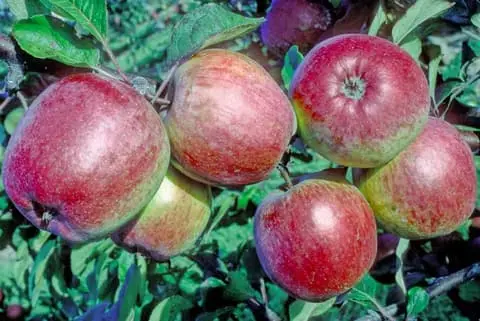
Alfred Jolibois
-
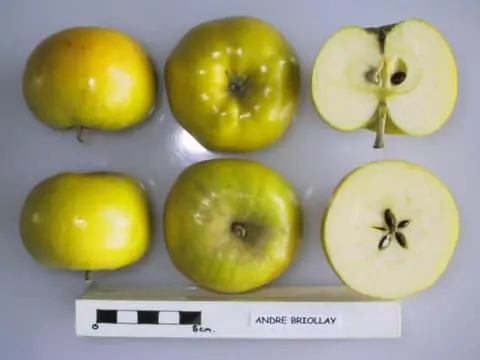
Andre Briollay
-
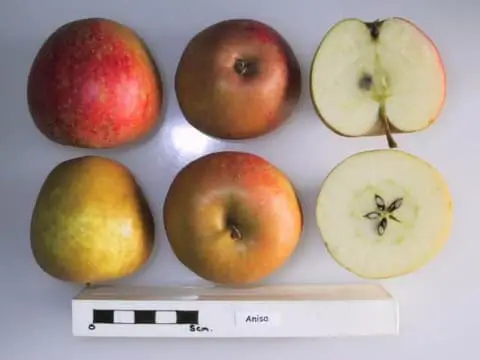
Anisa
-
Api
A tiny, glossy, red-cheeked apple recorded in 1628 and said to have been found wild in a forest in Brittany
-
Api Noir
-
Barre
-
Bassard