Douce Moën
A bittersweet despite its name, from southern Finistère; the most planted cider apple in France in 1997
History
Douce Moën is a cider apple of unknown origin from Finistère1. The Normandie-Maine regional nature park places it in southern Finistère, around Clohars-Carnoët and Quimperlé2, both communes of the Cornouaille cider appellation3. The variety directory of the Normandy cider appellations also calls it Doux Moine, and records the form Dous Mœn1.
The specification of the Cidre de Bretagne geographical indication lists Douce Moën among the varieties recommended under French orders of 1967 and 1980, and marks it as one of those dominant in new plantings4. It was planted in Brittany and, in the 1980s, throughout the cider-growing region2. In 1997 it was the most planted cider apple in France, with 12 per cent of plantings, ahead of Douce Coët Ligné5.
Although its name calls it sweet (douce), Douce Moën is a bittersweet: a 2013 thesis gives it, with Bisquet, as an example of the French bittersweet class5, and the Normandy directory rates its flavour as bittersweet1. It is one of the phenolic (bitter and bittersweet) varieties allowed for Cornouaille cider3, for Pommeau du Maine6 and for Calvados, Calvados Pays d’Auge, Calvados Domfrontais and Pommeau de Normandie; for Cotentin and Perche cider it is an accessory variety1.
The fruit
The fruit is barrel-shaped1,2 and elongated, with a short, thin stalk set in a deep, steep and heavily russeted cavity1. The Normandy directory gives the juice an acidity of 31.85 milliequivalents per litre and 2.43 grams of polyphenols per litre (as tannic acid), and 100 kilograms of fruit yield 64.36 kilograms of juice1; the park gives juice yields of 50 to 70 per cent2. The must is scented, sweet and very deeply coloured, and the cider has a bitterish taste2. The directory gives maturity in October and November1, the park early November2; the fruit keeps moderately well to well1,2.
Growing
The tree is dome-shaped and of medium to strong vigour; it flowers in mid-May and comes into bearing at a moderate pace1. It tends to bear in alternate years1,2. The park finds it fairly hardy and easy to train as a central axis2. In some microclimates it is fairly to highly susceptible to scab; it is susceptible to powdery mildew and fairly susceptible to canker1,2; it is susceptible to fire blight on its shoots and very receptive to it in flower1.
Where the sources disagree
- Size and colour. The Normandy directory describes very small to small fruit, striped and strongly coloured red1; the park describes small to medium fruit, golden washed with red and often rough2.
- Cropping. The directory rates its production as medium1; the park rates its fertility as high2.
- Spelling. The name is written Douce Moën in the Cidre de Bretagne and Pommeau du Maine specifications4,6, Douce Moen by the Normandy directory and the park1,2, and Douce Möen in the Cornouaille specification3.
Sources
- Douce Moen or Doux Moine (in French), Normandie, Terre d'Appellations Cidricoles (aocidricoles.fr), variety directory of the Normandy cider appellations. Supports: the names Douce Moen and Doux Moine and the synonym Dous mœn; origin "Inconnue, localisée dans le Finistère"; fruit striped, red, strongly coloured red, barrel-shaped ("tonnelé"), elongated or very elongated, very small or small, with a short, thin stalk in a deep or very deep, steep, heavily russeted cavity; maturity October and November; keeping medium to good; flavour bittersweet; tree dome-shaped, flowering mid-May, production medium, biennial bearing medium to strong, vigour medium to strong, medium speed into bearing; fairly susceptible to susceptible to scab in some microclimates, susceptible to powdery mildew, fairly susceptible to canker, susceptible to fire blight on shoots and very receptive to it on flowers; phenolic for Calvados, Calvados Pays d'Auge, Calvados Domfrontais and Pommeau de Normandie, an accessory variety for Cotentin (bitter and bittersweet) and Perche (bittersweet); a cider apple; juice acidity 31.85 meq/L, density 1061.1 kg/m³, polyphenols 2.43 g/L as tannic acid, extraction yield 64.36 kg/100 kg.
- Douce Moen apple (in French), Parc naturel régional et Géoparc mondial UNESCO Normandie-Maine, conservation orchards: apple and pear varieties. Supports: found in southern Finistère, around "Cloars-Carnoët" and Quimperlé; planted in Brittany and, in the 1980s, throughout the cider region; fairly hardy, easy to train as a central axis; susceptibility to scab medium to high in some microclimates, to powdery mildew medium to high, to canker medium; juice yield 50 to 70%; a cider of bitterish ("amertumée") flavour and a scented must, sweet and very deeply coloured; small to medium, barrel-shaped fruit, golden washed with red and often rough; maturity early November; keeping good; fertility high, bearing every other year.
- Specification of the designation of origin "Cornouaille" (in French), Institut national de l'origine et de la qualité (INAO); approved by order of 22 March 2019, Journal officiel of 29 March 2019; Bulletin officiel du Ministère de l'agriculture et de l'alimentation no. 2019-14, 2019-03-29. Supports: the area of 40 communes of Finistère, Clohars-Carnoët and Quimperlé among them; varieties classed by the flavour of the must as phenolic (bitter and bittersweet), sweet or acidic; "Douce Möen" among the authorised phenolic varieties.
- Specification for the production of "Cidre de Bretagne", with the list of recommended cider-fruit varieties (in French), Syndicat National des Industries Cidricoles and other applicants; European Commission, eAmbrosia register of geographical indications. Supports: p. 22: "Douce Moën" among the varieties recommended under the orders of 20 April 1967 and 30 May 1980, underlined as one of the "variétés dominantes dans les nouvelles plantations".
- Genetic mapping of the phenolic compounds of the apple, doctoral thesis (in French), Cindy Verdu, Université d'Angers; HAL open archive, 2013. Supports: p. 15 (PDF p. 38): Bisquet and Douce Moën given as examples of the French bittersweet (douce-amère) class; p. 17 (PDF p. 40), citing Boré and Fleckinger (1997): "Les variétés les plus plantées en 1997 étaient, par ordre d'importance, 'Douce Moën' (12%), 'Douce Coët Ligné'", the eleven most planted making up 75% of plantings.
- Specification of the controlled designation of origin "Pommeau du Maine" (in French), Institut national de l'origine et de la qualité (INAO); approved by order of 9 December 2025, Journal officiel of 18 December 2025; Bulletin officiel du Ministère de l'agriculture, 25 December 2025, 2025-12-25. Supports: annex: "Douce Moën" among the phenolic cider-apple varieties.
More from France
-
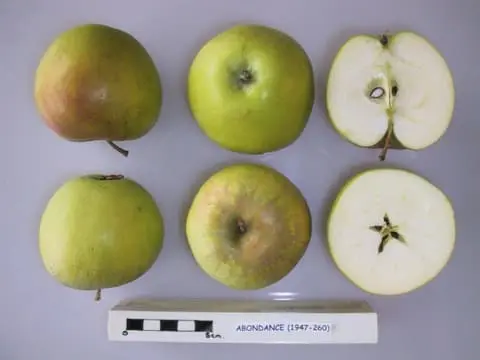
Abondance
-
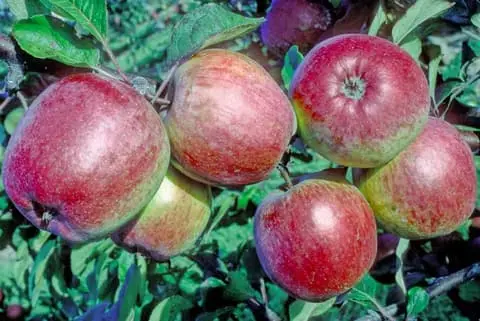
Alfred Jolibois
-
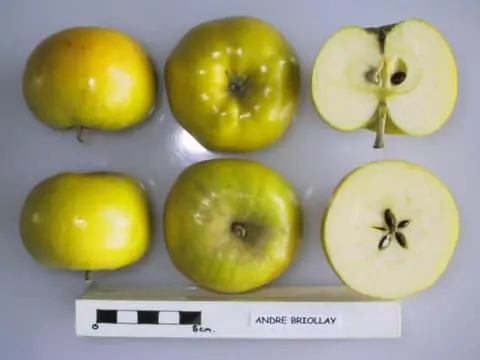
Andre Briollay
-
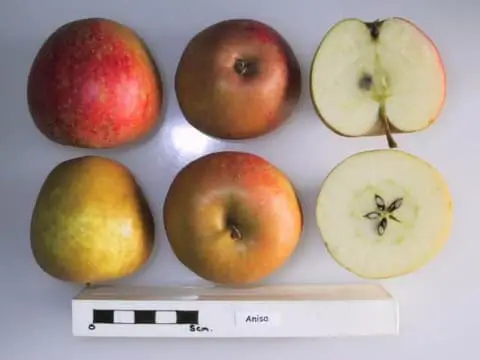
Anisa
-
Api
A tiny, glossy, red-cheeked apple recorded in 1628 and said to have been found wild in a forest in Brittany
-
Api Noir
-
Barre
-
Bassard