Apple varieties, United Kingdom
Golden Pippin
Small, golden and very old; to English connoisseurs, wrote Downing, the queen of all dessert apples
History
Its origin is unknown. All the writers Hogg knew called it English, and some said it was raised at Parham Park, near Arundel in Sussex2,3; Leroy left the question open7. The National Fruit Collection says it was recorded in 16291, the year of John Parkinson’s Paradisi in sole paradisus terrestris4, but Hogg denied that Parkinson’s Golden Pippin, “the greatest and best of all sorts of Pippins”, was this apple: Leonard Meager distinguished a Great Golding from a Small Golding or Bayford, and Parkinson’s was the Great Golding2,3.
It was long valued for cider. John Evelyn recorded an orchard of 1,000 Golden and other cider pippins at Lord Clarendon’s seat at Swallowfield in Berkshire2,3, and according to Thomas Andrew Knight many orchards of it were planted in Herefordshire as cider fruit before 17003. Leroy found no sign of it in France before the last years of La Quintinye, who died in 1688 and thought it a yellow, rather dry apple that looked like a wild one, but in 1712 Angran de Rueneuve called it the queen of apples, ahead even of the Reinette7.
Late in the eighteenth century Knight argued that the Golden Pippin and the other old English apples were dying out, since no variety could last longer than 200 years; Hogg rejected the theory and blamed it for the neglect of the old Herefordshire orchards2. By tradition, the Golden Pippins once plentiful at Covent Garden vanished when they were bought up for the Empress of Russia at a guinea a bushel3. By 1920 Bunyard found it seldom grown5. The National Fruit Collection lists Downton Pippin, Yellow Ingestrie and Court of Wick among its offspring1.
The fruit
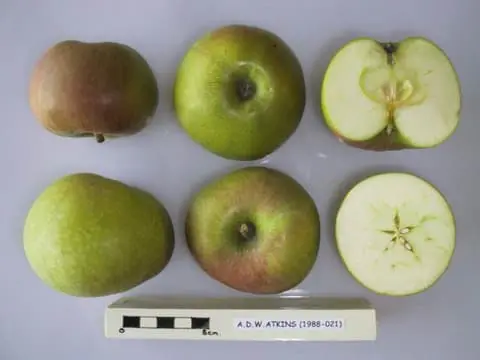
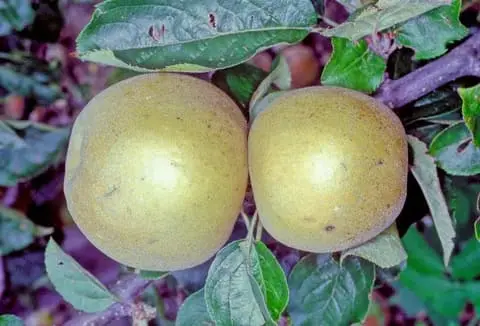
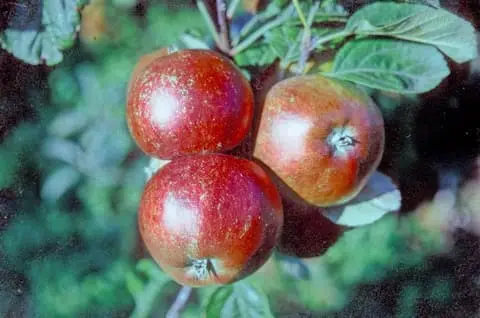
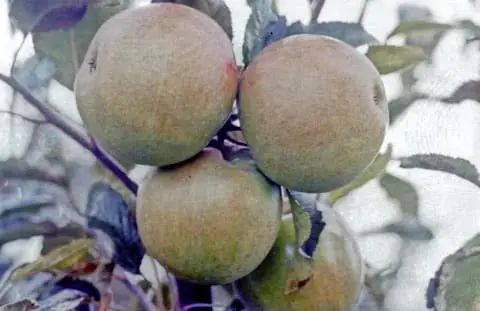
The fruit is small, round or slightly oblong and regular2,5,6, 51 mm high and wide in the National Fruit Collection’s record1. The skin is rich yellow, turning deep gold when ripe, strewn with russet dots and with pearly specks beneath the surface2,6. The flesh is yellow, firm, crisp, very juicy and sweet, with a brisk, vinous and “particularly fine flavour”2; Downing reported that English connoisseurs counted it the queen of all dessert apples6. Hogg’s season was November to April2. At Brogdale it begins to flower about 5 May and is picked in early October1.
Growing
Hogg found it a healthy tree of middle size and an excellent bearer, making handsome bushes and espaliers on dwarfing stocks2; the Herefordshire Pomona heard that it flourished around Oporto3. Bunyard found its growth weak, its cropping moderate and its flavour first-class only in warm years on light soils5, and Downing found that it did not succeed well in America6. It is diploid8. Leroy urged its planting in France, for dessert and for the delicacy it gave to cider, though he thought the Reinette Franche at least its equal and always larger7.
Where the sources disagree
- First record. 1629 for the National Fruit Collection1 and probably the early seventeenth century for Bunyard5, but Hogg rejected Parkinson’s Golden Pippin2. Downing dated Evelyn’s mention to 16606, Leroy to 16727; Evelyn’s Pomona, which Hogg quotes on it, appeared in 16642,4.
- Vigour and soil. A healthy grower and excellent bearer to Hogg2 and abundantly fertile to Leroy7, but weak and moderately fertile to Bunyard5. Bunyard wanted a light soil5, Downing a strong, deep, sandy loam6, and Leroy a clay-limestone soil, on doucin rather than paradise stock7.
- Names. The National Fruit Collection lists Reinette Dorée and Reinette Jaune Tardive among its other names1; Leroy treated these as an old French apple long sold in his nurseries in its place7.
Family tree
Offspring in the atlas
- Court of Wick United Kingdom, by 1790
- Downton Pippin × Orange Pippin; United Kingdom, by 1806
- May Beauty × Newtown Pippin; United Kingdom, by 1945
- Merton Delight × Cox's Orange Pippin; United Kingdom, by 1959
- Pitmaston Pine Apple United Kingdom, about 1785
- Yellow Ingestrie × Orange Pippin; United Kingdom, about 1800
7 varieties in the atlas descend from Golden Pippin.
Sources
- Golden Pippin (accession 1946-024), National Fruit Collection, Brogdale, Kent (Defra). Supports: "Originated in England. It was recorded in 1629"; "firm, crisp flesh with a sweet, subacid and rich flavour"; a dessert apple; the other names, among them Reinette Doree and Reinette Jaune Tardive; mother to Pitmaston Pine Apple and Court of Wick and father to May Beauty, Yellow Ingestrie and Downton Pippin; from the National Apple Register (Smith, 1971): 51 mm high and 51 mm wide, golden ground with a deeper golden tinge, dotted with russet and white, yellow flesh; 10% flowering on 5 May and picking in early October at Brogdale.
- The Fruit Manual, 5th ed., pp. 91–92: Golden Pippin, Robert Hogg, Journal of Horticulture Office, Internet Archive, 1884. Supports: fruit small, about two inches wide and high, roundish inclining to oblong, regular and handsome; skin rich yellow, deep golden when ripe, deeper where sunned, strewn with russety dots and numerous embedded pearly specks; flesh yellow, firm, crisp, very juicy and sweet, "with a brisk vinous and particularly fine flavour"; one of the oldest and most esteemed dessert apples, in season from November till April; a healthy grower of middle size and an excellent bearer, making handsome bushes and espaliers on dwarfing stocks; origin uncertain, all writers calling it English, some saying it was raised at Parham Park, near Arundel, Sussex; not the Golden Pippin of Parkinson, "the greatest and best of all sorts of Pippins", which was the Great Golding, Leonard Meager distinguishing a Great Golding and a Small Golding, or Bayford; Evelyn on Lord Clarendon's orchard of "1,000 Golden and other cider Pippins" at Swallowfield, Berks, and, in the Pomona, on the Golden Pippin as making the most delicious cider about London; Knight's theory, late in the eighteenth century, that the Golden Pippin and all the old English apples were in the last stage of decay, no variety lasting longer than 200 years, rejected by Hogg, who blamed it for the neglect of the old Herefordshire orchards.
- The Herefordshire Pomona, vol. II, plate XXXVII: Golden Pippin, Robert Hogg and H. G. Bull (eds), Woolhope Naturalists' Field Club, Internet Archive, 1876–1885. Supports: origin unknown, all writers calling it English, some saying it was raised at Parham Park, near Arundel, Sussex; not Parkinson's Golden Pippin, which was the Great Golding, Meager distinguishing the Great Golding and the Small Golding or Bayford; Evelyn on the orchard of 1,000 Golden and other cider Pippins at Lord Clarendon's seat at Swallowfield; a century earlier Covent Garden abundantly supplied with Golden Pippins at 4s. to 5s. the bushel, which by tradition disappeared almost suddenly, bought up for the Empress of Russia at a guinea a bushel; many orchards of it planted in Herefordshire before the end of the 17th century as a cider fruit, according to Knight, but not cultivated for that purpose in the present century; said to flourish around Oporto, Portugal.
- The Herefordshire Pomona, vol. I, p. 24: The early history of the apple and pear, Robert Hogg and H. G. Bull (eds), Woolhope Naturalists' Field Club, Internet Archive, 1876–1885. Supports: Parkinson's "great work", Paradisi in sole paradisus terrestris, published in 1629; John Evelyn's Pomona in 1664.
- A Handbook of Hardy Fruits, vol. I, p. 62: Golden Pippin, E. A. Bunyard, John Murray, Internet Archive, 1920. Supports: dessert, November to March; small, oblong-round, regular; golden yellow with slight russet; growth weak, fertility moderate; "Origin, English, probably dating from the early seventeenth century"; very popular in the seventeenth and eighteenth centuries, "but now seldom grown"; first-class flavour only in warm years and on light soils.
- The Fruits and Fruit Trees of America, p. 194: Golden Pippin, A. J. Downing, revised by Charles Downing, John Wiley & Sons, Internet Archive, 1900. Supports: "The Golden Pippin of the English is the queen of all dessert Apples, in the estimation of the English connoisseurs", uniting small size, fine form and colour with high flavour and durability; "a very old variety, being mentioned by Evelyn in 1660"; fruit small, round, regular, gold coloured with grey russety dots and white specks under the skin; flesh yellowish, crisp, "rather acid, but with a rich, brisk, high flavor"; a great bearer needing a strong, deep, sandy loam; November to March; "Does not succeed well here".
- Dictionnaire de pomologie, vol. IV, pp. 510–513: Pomme d'Or d'Angleterre (in French), André Leroy, Paris and Angers, Internet Archive, 1873. Supports: entry no. 304, the Golden Pippin under the name Pomme d'Or d'Angleterre, with 35 synonyms; fertility abundant; growth not very active; dwarf trees best on doucin rather than paradise, on which it does poorly; ripe December to May; first quality; John Evelyn in 1672 the first to speak of the Golden Pippin; its origin left undecided after Hogg; not grown in France, apparently, before the last years of la Quintinye (died 1688), who described without recommendation an apple the English prized, looking like a wild apple, very yellow and round, with little juice; Angran de Rueneuve (1712) holding that it should be "la Reyne des Pommes", ahead of the Reinette; wanting a clay-limestone soil; Leroy recommending it in France, also for cider, to which it gives great delicacy, while rating the Reinette Franche at least its equal in quality and always larger; a renowned Rouen apple called Pépin or Franc-Pepin, sold from 1360, which might have been the same fruit had any description survived; the old French Reinette Dorée or Reinette Jaune Tardive long sold in Leroy's nurseries in its place because of the similar name.
- Using whole-genome SNP data to reconstruct a large multi-generation pedigree in apple germplasm, H. Muranty and others, BMC Plant Biology 20: 2, with Additional file 1, 2020. Supports: Golden Pippin (National Fruit Collection accession 1946024) diploid and dated 1629 (Table S1).