Apple varieties, United Kingdom
Dabinett
A Somerset bittersweet believed to be named after a Mr Dabinett; a small tree with soft, full-bodied juice for blending
History
Dabinett is a cider apple of Somerset. The National Fruit Collection thinks that it arose in the Martock–Kingsbury area in the mid-19th century and believes that it was named after a Mr Dabinett1. The collection also suggests that it may be a seedling of Chisel Jersey1, an apple that Long Ashton’s juice analyses class, like Dabinett, as a late bittersweet2.
The fruit
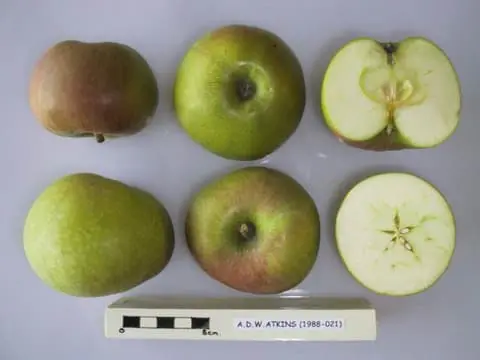
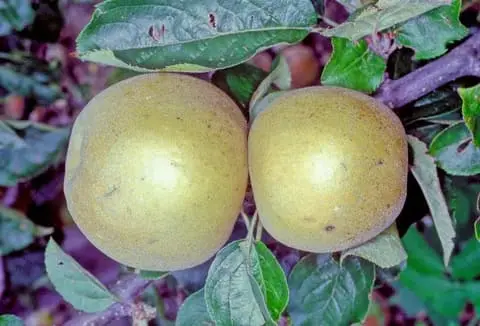
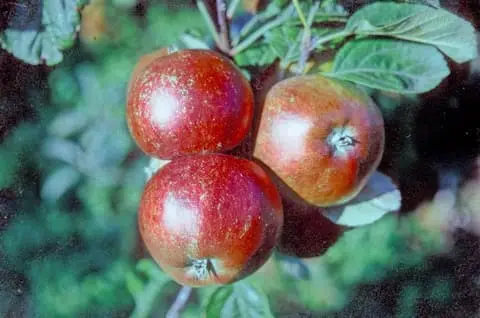
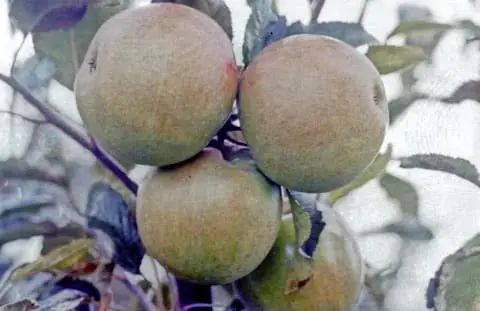
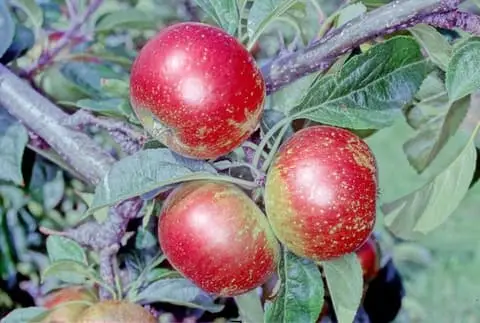
The fruit is small to medium and rounded; at the National Fruit Collection it measured 62.40 mm wide and 50.00 mm high1. The green-yellow skin is mostly covered with a red flush and stripes, with little russet, and the flesh is cream-coloured1. When ripe the flesh is slightly crisp and tastes sweet, astringent and strongly fruity1.
Long Ashton Research Station’s classification, drawn up by B. T. P. Barker, calls an apple a bittersweet when its juice has less than 0.45 per cent acid and more than 0.2 per cent tannin2. Long Ashton’s composite analyses of 1905 to 1975 give Dabinett 0.18 per cent malic acid and 0.29 per cent tannin, and Andrew Lea marks it as one of the cultivars generally regarded as having “vintage quality”2. He calls it a medium bittersweet with “soft but full-bodied tannin”3.
At Brogdale, in Kent, it reaches 10 per cent flowering around 11 May and is picked in mid-November1. Lea gives mid to late flowering and a harvest at the end of October or in November3.
Growing
The National Fruit Collection describes Dabinett as a weak grower that makes a small, spreading tree and crops regularly1. Lea adds that the small tree is quick to come into bearing and grows neatly, and that it needs plenty of potash3. It is diploid4.
Uses
Dabinett is grown for cider, which the National Fruit Collection describes as soft, full-bodied and of high quality1. Lea calls it a “must have” for its “behaviour and blending”3.
Sources
- Dabinett (accession 1989-077), National Fruit Collection, Brogdale, Kent (Defra). Supports: a cider apple "Thought to have originated in the Martock-Kingsbury area of Somerset in the mid-19th Century"; "Believed to have been named after a Mr Dabinett"; "Possibly a seedling of Chisel Jersey"; crops regularly; slightly crisp flesh with "a sweet, astringent, strong fruity flavour when ripe"; a weak grower producing a small, spreading tree; a bittersweet that produces "a soft, full-bodied, high quality cider"; 10% flowering on 11 May and picking in mid-November; size small to medium, height 50.00 mm and width 62.40 mm, globose, green-yellow ground with a high to very high red over colour in a striped and solid flush, low russet, cream flesh.
- Cider Apple Compositional Data, Andrew Lea, cider.org.uk, from Long Ashton Research Station data, 2015-04-21. Supports: Barker's classification at Long Ashton Research Station (founded 1903): bittersweet below 0.45 per cent acid and above 0.2 per cent tannin; composite juice analyses at Long Ashton from 1905 to 1975: Dabinett a late bittersweet with 0.18 per cent malic acid and 0.29 per cent tannin, shown among the cultivars "generally regarded as having" vintage quality; Chisel Jersey a late bittersweet.
- The Science of Cidermaking, Part 2: Fruit and Cultivation, Andrew Lea, cider.org.uk, 1997, lightly updated 2009. Supports: in the table of vintage-quality cultivars Dabinett a medium bittersweet: "Small tree, precocious but grows neatly. Needs high potash"; flowering mid to late; harvest end of October or November; "Soft but full-bodied tannin. A 'must have' for behaviour and blending!".
- Ploidy determination, Malus (study MALUS.PLOIDYDETERMINATION.2008), USDA Agricultural Research Service, GRIN-Global, 2008. Supports: Dabinett (PI 589073) diploid (2x) by flow cytometry.