Apple varieties, United States
Hewe's Crab
Colonial Virginia's prized cider crab, recorded from 1744; the tree now grown as Virginia Crab is another apple
History
Hewe’s Crab, spelt Hughes in the older records, is the small cider crab apple of colonial Virginia1. Its beginnings are unknown: a Kentucky newspaper of 1870 credited “a gentleman named Hughes” with finding it “growing in a thicket in Virginia”1. In 1817 William Coxe wrote of Virginia trees “nearly one hundred years old”2, and in 1814 Timothy Pickering reported a Virginian’s memory of an orchard of nothing else planted in his boyhood, which Zakalik and Peck date to the 1710s1.
In 1744 a county court in North Carolina priced “Hughes Crab Cider” at ten shillings a gallon, twice the rate for other ciders; a nursery in Surry County, Virginia, advertised the trees in 1755; and land near Charles City, Virginia, was offered in 1763 with “150 Hughes’s crabs beginning to bear”1. Thomas Jefferson remembered it as a common apple on the James River before 1754 and gave part of the North Orchard at Monticello to it1. In 1867 Warder still found it in “all extensive and good cider orchards”4, but the last nursery catalogue offering it that Zakalik and Peck could trace dates from 19291. A survey of 2021 found it among the dozen cider varieties North American cider makers named most often, though their trees may not be true to name1.
The fruit
The fruit is very small, about 3.8 cm (1½ inches) across, round or slightly flattened, on a long, slender stalk; Coxe and Downing describe its skin as dull red, faintly streaked with greenish yellow and dotted white2,3,4. The flesh is firm, fibrous and juicy, acid, rough and astringent, though Coxe noted that the juice turns sweet and highly flavoured when pressed from fully ripe fruit2,3,4. It ripens late and keeps: at the USDA’s orchard at Arlington Farm, Rosslyn, Virginia, it was picked in early October in 1925, 1927 and 1931, and fruit picked on 4 October 1927 left store on 8 February 1928 shrivelled but otherwise sound1. Warder gave its season as November to January4.
Growing
Its hard, tough wood never broke under the crops, which usually came every second year, Coxe wrote2; Warder found the tree long-lived and immensely productive in alternate years4. Downing called it very hardy3, and Coxe found that in its bearing year it withstood frosts that often cut off other apples2. Warder knew a Kentucky variety, Beeler’s Crab, with similar fruit on a better-growing tree4.
Uses
It is above all a cider apple2,3,4. Its juice runs clear from the press, “like spring water” in Coxe’s words, and ferments very slowly2,3; connoisseurs, Downing’s revision reported, thought its dry cider “unsurpassed in flavor by any other”3. Coxe mixed its pomace with that of rich cider apples, and Downing noted that it was often blended with rich, pulpy apples2,3. Warder also commended its acid for mince pies4.
Where the sources disagree
- Which tree is Hewe’s Crab. The crab grown today as Virginia Crab, USDA accession PI 589324, has widely been taken for Hewe’s Crab, which Downing also called the Virginia Crab1,3. DNA tests show it to be a triploid offspring of Manchurian, an ornamental crab descended from the Siberian crab, Malus baccata, and the same clone as trees grown as Hewes at Cornell University and Monticello1. Zakalik and Peck conclude that it is another apple, named Virginia by the Iowa nurseryman Suel Foster after it was found among his Hewes trees, which ripens earlier and keeps worse than the old Hewe’s Crab; they would call it Foster’s Virginia Crab, and cannot say whether the true variety survives1. The National Fruit Collection’s ‘Virginia Crab’ (accession 1976-088) has no description5; the study reports the Iowa crab’s genotype under that name in British and other European collections, and no Hughes or Hewes in the collection’s database1.
- Tree and colour. Coxe and Downing describe a small tree with dull red fruit faintly streaked with greenish yellow2,3; Warder, a tree of slender growth that makes a large, spreading top, with fruit striped purplish red on yellow4.
Sources
- Mistaken Identity: Correcting the Conflation of Malus 'Virginia Crab' (Foster) with Malus 'Hughes Virginia Crab', David L. Zakalik and Gregory M. Peck (Cornell University), Journal of the American Pomological Society 79(4): 128–139, 2025. Supports: the older spelling Hughes; the 1744 North Carolina court price of "Hughes Crab Cider", ten shillings a gallon, twice that of other ciders; trees advertised by a nursery in Surry County, Virginia, in 1755; "150 Hughes's crabs beginning to bear" offered near Charles City, Virginia, in 1763; Jefferson's recollection of it as a common apple on the James River before 1754 and part of the North Orchard at Monticello given to it; Pickering's 1814 account of a Mr West's recollection of an orchard wholly of Hughes's crab planted in his boyhood, in the 1710s; origin likely in the early eighteenth century or late seventeenth; an 1870 Kentucky newspaper crediting "a gentleman named Hughes" who found it "growing in a thicket in Virginia"; among the dozen cider cultivars most often reported in a 2021 survey of North American cider makers; the late-ripening, long-hanging, well-keeping Hughes of the old accounts; harvests at the USDA Variety Apple Orchard, Arlington Farm, Rosslyn, Virginia, in early October 1925, 1927 and 1931, and fruit picked on 4 October 1927 shrivelled but "otherwise in good condition" on 8 February 1928; the latest nursery catalogue offering it, 1929; 'Virginia Crab' (PI 589324), widely assumed to be the same, a triploid hybrid of 'Manchurian' and an unknown second parent, 'Manchurian' itself a hybrid of M. baccata; the putative Hughes trees at Cornell and at Monticello genetically identical to PI 589324; the 'Virginia' named by Suel Foster after it was found growing with Hewe's Virginia in his nursery at Muscatine, Iowa (c. 1852–1868); PI 589324 ripening by mid-September at Geneva, New York, and splitting and rotting in store; the same genotype held as 'Virginia Crab' in collections in Switzerland, Germany, France and the United Kingdom; no Malus accession named Hughes or Hewes in the National Fruit Collection's database; the proposal to rename PI 589324 Foster's Virginia Crab; uncertainty whether the true Hughes is still extant.
- A View of the Cultivation of Fruit Trees, pp. 150–151: No. 86, Hewes's Virginia Crab, William Coxe, M. Carey and Son, Philadelphia; Internet Archive, 1817. Supports: fruit "of very small size", nearly round, on a long, thin stem; skin dull red mixed with faint streaks of greenish yellow and numerous small white spots; juice "acid and austere" with the flesh but sweet and highly flavoured when pressed from fully ripe fruit; flesh "singularly fibrous and astringent"; the liquor running through the finest flannel "like spring water", and able to be carried a great distance before fermentation begins; the pomace returned to the vat and mixed with that of strong, rich cider apples; a tree of small size, with hard, tough wood never breaking under its fruit, usually borne every second year; in its bearing year resisting frosts that often cut off other apples; origin traced to Virginia, where trees "nearly one hundred years old" stood in the orchard of a Virginian.
- The Fruits and Fruit Trees of America, pp. 214–215: Hewe's Virginia Crab, A. J. Downing, revised by Charles Downing, John Wiley & Sons (1900 printing); Internet Archive, 1900. Supports: the synonym Hughe's Virginia Crab; "The Virginia Crab makes a very high-flavored dry cider", thought by connoisseurs "unsurpassed in flavor by any other", which keeps sound a long time; a prodigious bearer; the tree very hardy though of small size; fruit about an inch and a half in diameter, nearly round; skin dull red, dotted with white and obscurely streaked with greenish yellow; stalk long and slender; flesh fibrous, with an acid, rough and astringent flavour; the juice running clear from the press and fermenting very slowly; often mixed with rich, pulpy apples.
- American Pomology: Apples, p. 599: Hewes' Crab, J. A. Warder, Orange Judd; Internet Archive, 1867. Supports: "From Virginia. A famous cider apple, found in all extensive and good cider orchards"; a tree of slender growth that makes a large, spreading top, "immensely productive alternate years", long-lived, with slender twigs and sparse foliage; fruit quite small, round, somewhat flattened; striped purplish red on yellow, with numerous large pale or fawn dots; flesh firm, yellowish and greenish, juicy; flavour acid and rich; the must very heavy; best for cider; season November to January; useful for cooking, its acid good in mince pies; Beeler's Crab, a Kentucky crab with similar fruit and a better-growing tree.
- 'Virginia Crab' (accession 1976-088), National Fruit Collection, Brogdale, Kent (Defra). Supports: an accession under the accession name 'Virginia' Crab, genus Malus, with no description or characterisation; material also held in the Tidnor Wood National Collection of cider-making Malus.
More from United States
-
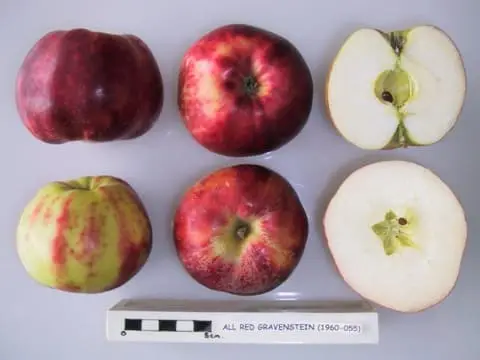
All-Red Gravenstein
-
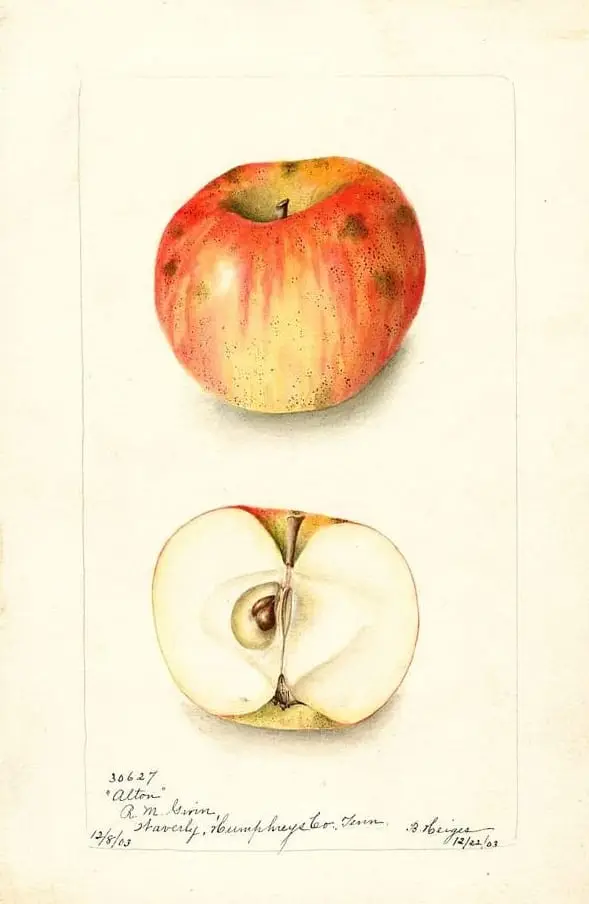
Alton
-
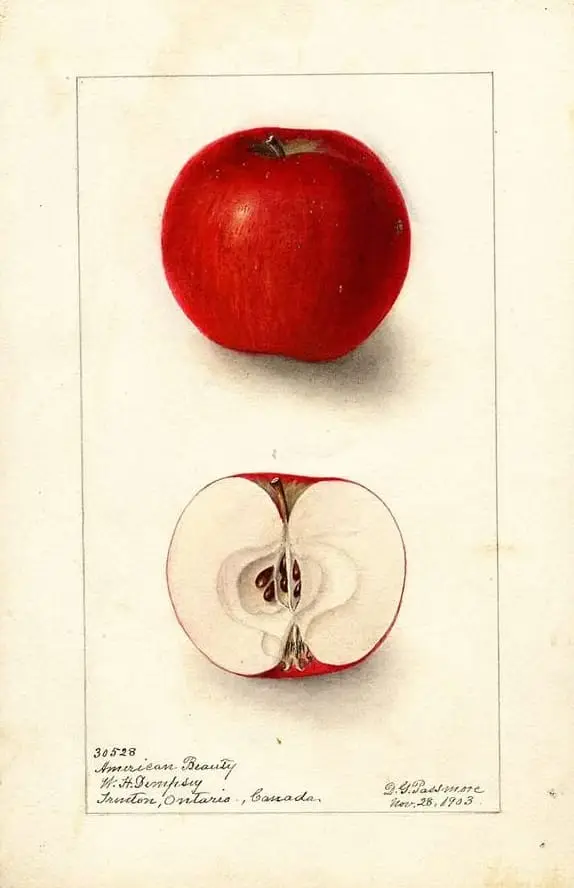
American Beauty
-
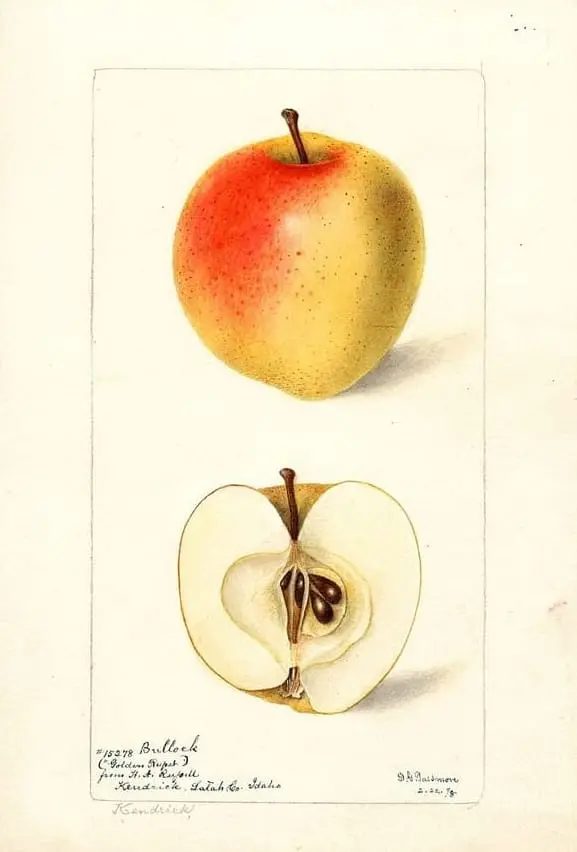
American Golden Russet
A small New Jersey russet whose flesh Downing likened to a buttery pear; Coxe knew it in 1817 as Sheep-nose
-
American Grindling
-
American Summer Pearmain
-
Ames
-
Arkansas