Red Astrachan
A bloom-dusted summer apple, in England from Swedish stock by 1816; a 2025 DNA study names both its parents
History
Where Red Astrachan arose is uncertain. The National Fruit Collection says that it originated in Russia1, and Bunyard thought it “probably from the country of its name”4; Hoskins described Astrachan as “a province of the extreme south of Russia”5. VIR’s collection at Volgograd keeps a Russian folk variety, Астраханское Красное, that is common around Astrakhan6, and the National Fruit Collection lists Astrachanskoe Krasnoe among Red Astrachan’s synonyms1.
The apple reached England from Sweden through William Atkinson of Grove End, Paddington, by 18162,3, and Sutton & Son of Reading later sent it out as Anglesea Pippin2. The Massachusetts Horticultural Society received it from the London Horticultural Society about 1835, though its fruit had already been shown at one of the society’s exhibitions in 18353. By 1905 it was listed from the Atlantic to the Pacific and from Canada to the Gulf states3. Of the three Russian apples first widely planted in America, Hoskins ranked it the least hardy, writing in 1886 that it “will not endure cold much greater than 25° below zero” Fahrenheit, about −32 °C5.
In 2025 Larsen and colleagues gave Passe Pomme Rouge and Saint Germain as its parents, from SNP data8. Muranty and colleagues had found only a parent–offspring link with Saint Germain and, since Red Astrachan is dated 1816 and Saint Germain 1857, took Red Astrachan to be the parent7. It is a parent of Astillisch, with Signe Tillisch, of Stark Earliest, with Jefferis, and of Puritan, with McIntosh7,8.
The fruit
The fruit is of medium size or sometimes large, roundish to oblate and somewhat ribbed3. The pale yellow or greenish skin is nearly covered with light and dark red, splashed and striped with deep crimson, under a heavy bluish bloom3. The white flesh, often stained red, is crisp, tender, juicy, brisk subacid and aromatic, sometimes slightly astringent3. Hogg found it very juicy and sugary2, and the National Fruit Collection describes firm, crisp, fairly juicy flesh with a sweet, fair flavour1.
In New York its season ran from late July to September3. It could be cooked before it was fully ripe and eaten when mellow, but it ripened unevenly, much fruit dropped unless it was picked several times, and it was very perishable3. Hogg called it “an early dessert apple, but only of second-rate quality”, to be eaten straight from the tree “as it soon becomes mealy”2. At the National Fruit Collection it is picked in early August1.
Growing
Hogg found the tree not large but healthy and vigorous, and “an abundant bearer”2; Beach found it a good grower that bore young and cropped reliably, in alternate years or sometimes every year3. Bunyard, however, judged it “too poor a cropper for general use”4. It is diploid7,8.
Where the sources disagree
- Origin. Russian by the National Fruit Collection’s account1, and a variety of that name is common around Astrakhan6; but the first trees in England came from Sweden2,3.
- 1816. Hogg and Bunyard give it as the year the apple was brought to England2,4; Lindley, quoted by Beach, and the National Fruit Collection as the year it first fruited there1,3.
- Parents. Larsen and colleagues name Passe Pomme Rouge and Saint Germain8; Muranty and colleagues, going by dates, took Red Astrachan to be the parent of Saint Germain7.
- Colour. Beach describes a skin splashed and striped with crimson3; Bunyard calls it “deep crimson, unstriped”4.
- Cropping. An abundant or reliable bearer to Hogg and Beach2,3, a poor one to Bunyard4.
Family tree
Parents, grandparents and great-grandparents, as the entries in the atlas record them.
- Red Astrachan Russia, before 1816
- Parent Passe Pomme Rouge
- Parent Saint Germain
Offspring in the atlas
- Astillisch × Signe Tillisch; Germany, 1929
- Beeley Pippin × Golden Russet of Western New York; United Kingdom, about 1880
- Carlton × Autumn Bough; United States, 1912
- Stark's Earliest × Jefferis; United States, 1938
6 varieties in the atlas descend from Red Astrachan.
Sources
- Red Astrachan (accession 1999-084), National Fruit Collection, Brogdale, Kent (Defra). Supports: "Originated from Russia. It first fruited in the UK in 1816"; firm, crisp, fairly juicy flesh with a sweet, fair flavour; synonyms including Anglesea Pippin, Astrachan Red, Astrachan Rouge, Astrachanskoe Krasnoe, Rother Astrachan and Waterloo; mother of Astillisch and father of Carlton; picked in early August.
- The Fruit Manual, 5th ed., pp. 185–186: Red Astrachan, Robert Hogg, Journal of Horticulture Office, Internet Archive, 1884. Supports: the names Anglesea Pippin, Waterloo and Hamper's American; skin almost covered with deep crimson where sunned, with "a fine delicate bloom"; flesh white, crisp, very juicy and sugary; "an early dessert apple, but only of second-rate quality", ripe in August, to be eaten when gathered "as it soon becomes mealy"; a healthy, vigorous tree and "an abundant bearer"; imported from Sweden by William Atkinson of Grove End, Paddington, in 1816, and sent out by Sutton & Son of Reading as Anglesea Pippin.
- The Apples of New York, vol. II, pp. 178–180: Red Astrachan, S. A. Beach, New York Agricultural Experiment Station, Internet Archive, 1905. Supports: Hogg's date of 1816 for the import from Sweden, against Lindley's statement that William Atkinson of Grove End, Paddington, first fruited it in 1816; one of the first Russian apples imported into America, received by the Massachusetts Horticultural Society from the London Horticultural Society about 1835, though its fruit had already been shown at one of the Massachusetts society's exhibitions in 1835; by 1905 listed from the Atlantic to the Pacific and from Canada to the Gulf states; fruit medium to large, roundish to oblate, somewhat ribbed, pale yellow or greenish nearly covered with light and dark red, splashed and striped with deep crimson, with heavy bluish bloom; flesh white, often tinged red, crisp, tender, juicy, brisk subacid, aromatic, sometimes slightly astringent; fit for cooking before fully ripe and for dessert when mellow; season late July to September, ripening unevenly, with much loss from dropping unless picked several times; very perishable; tree a good grower, bearing young, a reliable cropper, biennially or sometimes annually.
- A Handbook of Hardy Fruits, vol. I, p. 20: Astrachan Red, E. A. Bunyard, John Murray, Internet Archive, 1920. Supports: colour "deep crimson, unstriped"; flesh crisp, white and sweet; "fertility poor"; "probably from the country of its name"; introduced to England in 1816; "too poor a cropper for general use".
- The Iron-Clad Tree Fruits, p. 14, in Agriculture of Maine: Twenty-ninth Annual Report of the Secretary of the Maine Board of Agriculture, T. H. Hoskins, Maine Board of Agriculture (Sprague & Son, Augusta); Maine State Law and Legislative Reference Library, 1886. Supports: Red Astrachan, Alexander and Duchess graded in that order for hardiness, Red Astrachan the least hardy; it "will not endure cold much greater than 25° below zero" (Fahrenheit); Astrachan "a province of the extreme south of Russia".
- Genetic diversity of apple varieties of folk selection (Malus × domestica Borkh.) of the Volga region from the VIR collection by NBS profiling (in Russian), A. A. Trifonova and others, Genetika 57 (6): 661–673, 2021. Supports: Астраханское Красное (k-27818), kept at VIR's Volgograd experimental station, described as a Russian folk-selection variety common around Astrakhan (Table 1).
- Using whole-genome SNP data to reconstruct a large multi-generation pedigree in apple germplasm, H. Muranty and others, BMC Plant Biology 20: 2, with Additional files 1, 3 and 6, 2020. Supports: Red Astrachan diploid (2n) and dated 1816, Saint Germain dated 1857 (Table S1); Red Astrachan a parent of Astillisch (with Signe Tillisch) and Stark Earliest (with Jefferis) (Table S3); a parent–offspring pair with Saint Germain, Red Astrachan taken to be the parent because it is the older by date (Table S6).
- Cultivar fingerprinting and SNP-based pedigree reconstruction in Danish heritage apple cultivars utilizing genotypic data from multiple germplasm collections in the world, B. Larsen and others, Genetic Resources and Crop Evolution 72: 2397, supplementary Table S5, 2025. Supports: SNP-confirmed parents of Red Astrachan: Passe Pomme Rouge and Saint Germain, the order arbitrary where no pedigree is recorded; Red Astrachan diploid; Red Astrachan a parent of Puritan (with McIntosh).
More from Russia
-
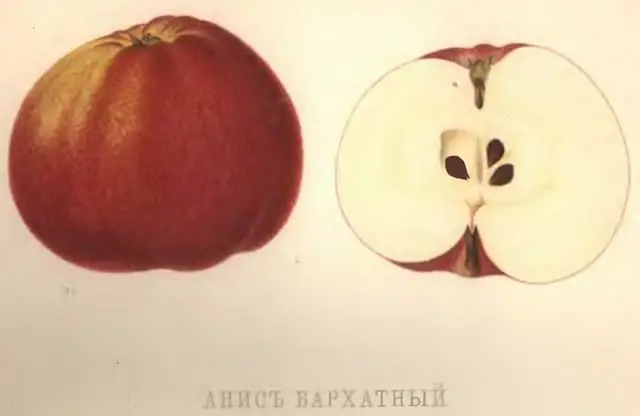
Anis
An old Volga folk apple whose clones bear small, bloom-dusted red fruit; Anis Polosaty has an anise-like scent
-
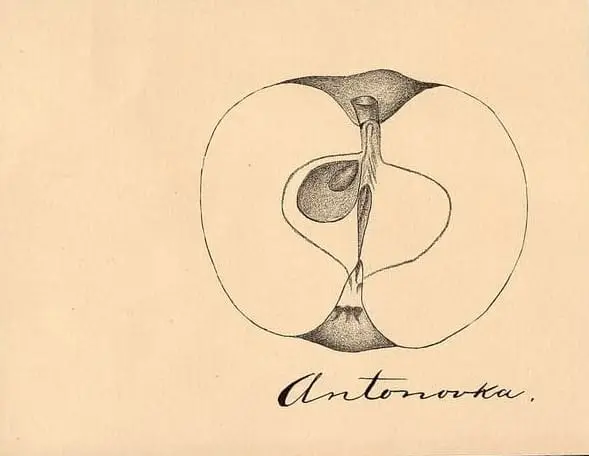
Antonovka
Central Russia's old folk apple, prized for its scent and hardiness; DNA shows Schmidt's Antonovka is the same variety
-
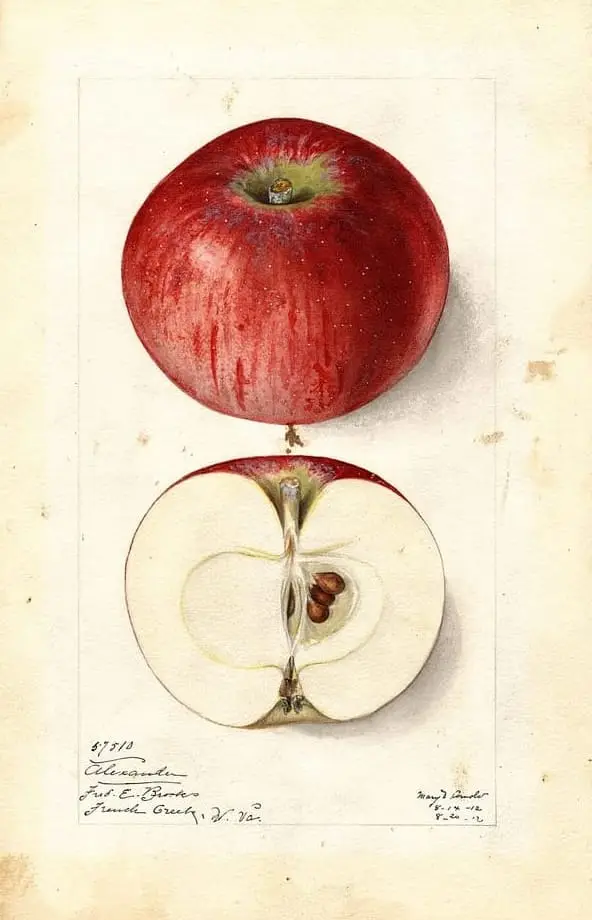
Aport
An old Russian apple, known in the West as Alexander, that became the celebrated Aport of Almaty after 1865
-
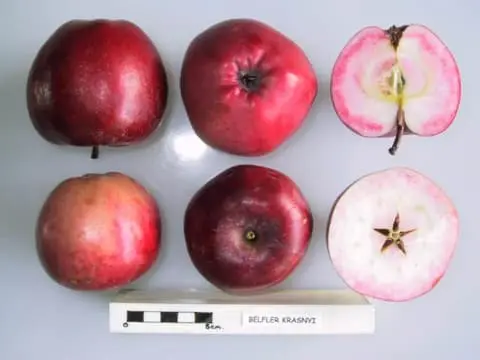
Bellefleur Krasny
-
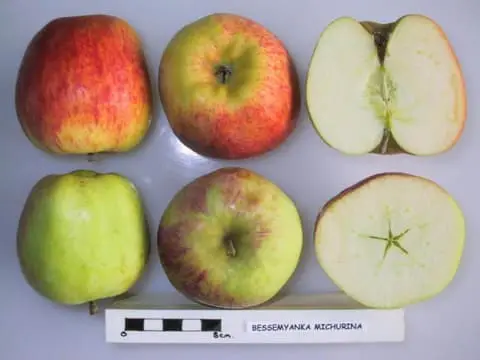
Bessemyanka Michurina
-
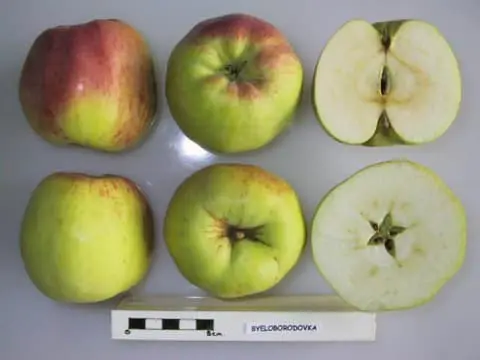
Byeloborodovka
-
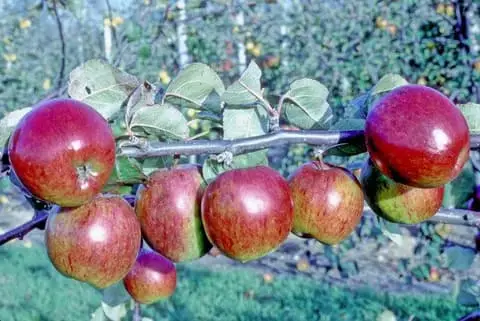
d'Eylau
-
Dolgo
A Siberian crab brought from Russia to South Dakota in 1897 and introduced in 1917 for its ruby-red jelly