Calville Blanc d'Hiver
Described by Jean Bauhin in 1598; DNA points to Calville Rouge and Reinette Franche as its parents
History
Calville Blanc d’Hiver is among the apple names that became established in the sixteenth and seventeenth centuries6. The National Fruit Collection says it was recorded in 1598 and raised in Europe, probably in France or Germany1. In 1598 the naturalist Jean Bauhin described it as the Admirable Blanche, a large white apple from near the Admirable spring in the duchy of Württemberg; Leroy found it in Bauhin under other names at Montbéliard and at Zell, near Zurich, and one picked at Montbéliard kept sound until mid-May2.
André Leroy weighed four rival accounts of its origin and rejected two: that it was a Roman apple, and that it first appeared with Boyceau de la Barauderie, director of the Tuileries garden under Henri IV2. He accepted that it took its name, about 1600, from Calleville near Évreux in Normandy, where it seems to have been grown first in France, but not that it was born there2. The name Calleville is no older than the end of the sixteenth century, when the apple had long been grown under other names in Württemberg, at Montbéliard and at Zell2. One of those neighbouring lands, Leroy thought, was probably its cradle, and it could easily have reached Normandy from the county of Montbéliard2. To Leroy it had the renown among apples of the Bon Chrétien among pears2.
SNP data infer Calville Rouge and Reinette Franche as its parents, the same pair as for Calville Rouge d’Hiver6,7. It is in turn a parent of Adersleber Calville, Transparente de Croncels and others6,7.
The fruit
The fruit is medium to large, flattened or conical, with broad, uneven ribs that run its whole length and end in ridges round the eye1,3; Leroy found its shape very variable, sometimes three- or four-cornered2. The thin, shiny skin is pale yellow, turning golden or straw yellow, sometimes flushed red or pink on the sunny side, with grey-white or brown dots and a little russet1,2,3. The yellowish-white flesh is fine-textured and juicy, soft or melting to the National Fruit Collection and Bunyard but firm to Leroy1,2,4, with a rich, sweet, aromatic flavour and a light acidity1,2,3.
Hogg and Bunyard gave its season as January to April, Leroy as December to May2,3,4. At Brogdale it begins to flower about 7 May and is picked in mid-October, but in the United Kingdom the fruit does not ripen fully1; Bunyard advised growing it under glass or on a wall4.
Growing
Hogg found it rather liable to canker in damp places and better as a dwarf than a standard, the look of its fruit much improved on paradise stock3. Leroy advised paradise or doucin stock and trained forms, warning that on a standard the branches almost always become cankered and the tree is gradually lost2. It is diploid6,7.
Uses
It serves for both dessert and cooking1,3,4, and Leroy recommended its compote as the most exquisite that could be eaten2.
Where the sources disagree
- Where it began. Probably France or Germany1, probably France4; Leroy placed its cradle in Württemberg, at Montbéliard or near Zurich, and only its name in Normandy2.
- First record. 1598 for the National Fruit Collection and for Leroy, after Bauhin1,2; 1600 for Bunyard4.
- Vigour and cropping. A strong grower and good bearer to Hogg3 and abundantly fruitful to Leroy2, but weak and infertile to Bunyard4.
- Merit. Of the first quality to Leroy2; to Downing, in America, “not worthy of cultivation” and “hardly good”5.
- Signe Tillisch. The National Fruit Collection lists it as an offspring1, but SNP data name London Pippin and Alexander as that apple’s parents6.
Family tree
Parents, grandparents and great-grandparents, as the entries in the atlas record them.
- Calville Blanc d'Hiver France, by 1598
- Parent Calville Rouge d'Hiver France, by about 1600
- Parent Calville Rouge d'Hiver France, by about 1600
- Parent Reinette Franche France, by 1540
- Parent Reinette de Saintonge
- Parent Reinette Franche France, by 1540
- Parent Reinette de Saintonge
- Parent Calville Rouge d'Hiver France, by about 1600
Offspring in the atlas
- Adersleber Calville × Aport; Germany, about 1870
- Lombarts Calville Netherlands, 1906
- Minister von Hammerstein × Landsberger Reinette; Germany, 1882
- Transparente de Croncels × Duchess of Oldenburg; France, by 1869
6 varieties in the atlas descend from Calville Blanc d'Hiver.
Sources
- Calville Blanc d'Hiver (accessions 2002-037 and 1952-126), National Fruit Collection, Brogdale, Kent (Defra). Supports: "Raised in Europe, probably France or Germany. Recorded in 1598"; fruit with "a rather soft, fine-textured juicy flesh with a rich, sweet, aromatic flavour"; "Fruits fail to ripen fully in the UK"; culinary and dessert; synonyms including White Winter Calville, White Calville, Calville Blanche d'Hiver, Calleville Blanc d'Hiver, Weisser Winter Calville, Bonnet Carre, Reinette a Cotes, Admirable Blanche and Blanche de Zurich; mother to Adersleber Calville, Signe Tillisch and Lombarts Calville; from the National Apple Register (Smith, 1971; set b): medium to large, flat and conic, with prominent ribs over the whole fruit, yellow ground flushed light red, flesh yellowish white and tender; 10% flowering on 7 May and picking in mid-October at Brogdale.
- Dictionnaire de pomologie, vol. III, pp. 173–178: Calleville Blanc d'Hiver (in French), André Leroy, Paris and Angers, Internet Archive, 1873. Supports: entry no. 82, with synonyms including Blanche de Zurich (Jean Bauhin, 1598), Admirable-Blanche, Bonnet-Carré and Reinette à côtes; fertility abundant; to be worked on paradise or doucin and trained, since as a standard its branches almost always become cankered and the tree is gradually lost; fruit large and very variable in shape, always ribbed and sometimes three- or four-cornered; skin thin, shiny, straw-yellow, dotted grey-white and patched with russet, sometimes tinged soft pink in the sun; flesh yellowish, fine and firm; juice abundant and very sweet, with a light acidity and a most delicate perfume; ripe December to May; first quality; its renown among apples that of the Bon Chrétien among pears; four conflicting accounts of its origin, among them a Roman one and one holding that it was first made known by Boyceau de la Barauderie, director of the Tuileries garden under Henri IV, both rejected; described by Bauhin in 1598 as the Admirable-Blanche from near the Admirable spring in the duchy of Württemberg, and found by Leroy in Bauhin under other names at Montbéliard and at Zell near Zurich, one picked at Montbéliard keeping until mid-May; the name Calleville no older than the end of the sixteenth century; conclusions: first grown in France in Normandy, around Évreux at Calleville, whence about 1600 its name; widespread well before 1598 under local names in Württemberg, at Montbéliard and at Zell, one of which was probably its cradle; able to reach Normandy from the county of Montbéliard; its compote "la plus exquise que l'on puisse manger".
- The Fruit Manual, 5th ed., pp. 36–37: Calville Blanche d'Hiver, Robert Hogg, Journal of Horticulture Office, Internet Archive, 1884. Supports: synonyms Bonnet Carré, Calville Blanche, White Calville and White Winter Calville; fruit large, roundish and flattened, with broad, uneven ribs along its whole length ending in prominent ridges at the eye; skin delicate, pale yellow tinged with green, becoming bright golden yellow, washed with deep red in the sun, strewn with brown dots and a little greyish-white russet; flesh yellowish white, delicate and juicy, with "a rich, lively, and agreeable aromatic flavour"; "admirably adapted for all culinary purposes, and excellent also for the dessert"; in use from January to April; a strong, vigorous grower and good bearer, rather liable to canker in damp situations, better as a dwarf than a standard, the look of its fruit much improved on paradise stock.
- A Handbook of Hardy Fruits, vol. I, pp. 33–34: Calville Blanche d'Hiver, E. A. Bunyard, John Murray, Internet Archive, 1920. Supports: culinary or dessert, January to April; medium, round-conical and irregular; pale yellow; flesh melting, pale yellow and aromatic; growth weak, infertile; "Origin, uncertain; recorded in 1600. Probably French"; "rarely well-finished in this country", and best grown under glass or on a wall.
- The Fruits and Fruit Trees of America, p. 401: White Calville, A. J. Downing, revised by Charles Downing, John Wiley & Sons, Internet Archive, 1900. Supports: "a celebrated old French sauce and cooking Apple" but "not worthy of cultivation"; "Hardly good".
- Using whole-genome SNP data to reconstruct a large multi-generation pedigree in apple germplasm, H. Muranty and others, BMC Plant Biology 20: 2, with Additional files 1 and 3, 2020. Supports: Calville Blanc d'Hiver among the cultivar names that became established in the sixteenth and seventeenth centuries; diploid and dated 1598 (Table S1); Calville Rouge and Reinette Franche inferred as its parents with 15 Mendelian errors, as for Calville Rouge d'Hiver, the threshold being 600 (Table S3); no parents recorded in the literature; inferred as a parent of Adersleber Calville and Transparente de Croncels, among others (Table S3); London Pippin and Alexander inferred as the parents of Signe Tillisch, recorded as its offspring (Table S3).
- Cultivar fingerprinting and SNP-based pedigree reconstruction in Danish heritage apple cultivars utilizing genotypic data from multiple germplasm collections in the world (Supplementary Table S2), B. Larsen and others, Genetic Resources and Crop Evolution 72: 2397, 2025. Supports: Calville Blanc d'Hiver diploid, with Calville Rouge and Reinette Franche as its SNP-confirmed parents, as for Calville Rouge d'Hiver; a parent of Adersleber Kalvill and Transparente de Croncels, among others (pedigree table).
More from France
-
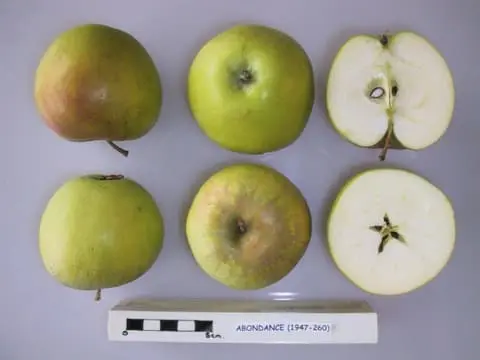
Abondance
-
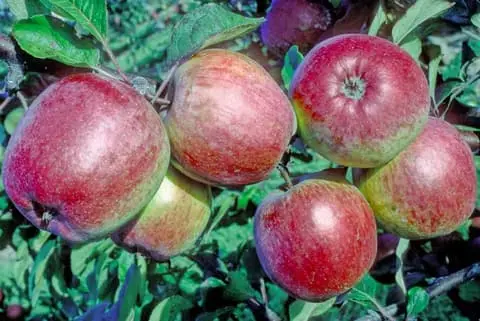
Alfred Jolibois
-
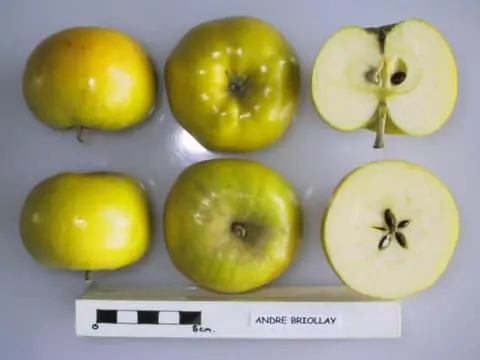
Andre Briollay
-
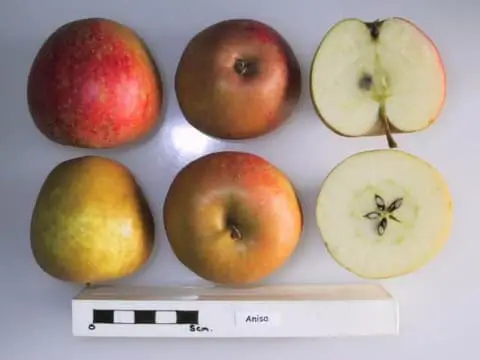
Anisa
-
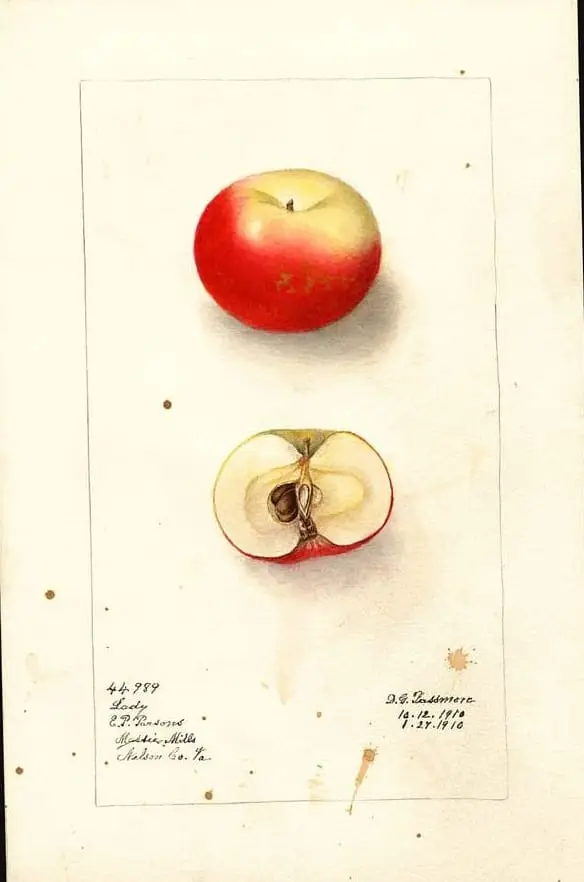
Api
A tiny, glossy, red-cheeked apple recorded in 1628 and said to have been found wild in a forest in Brittany
-
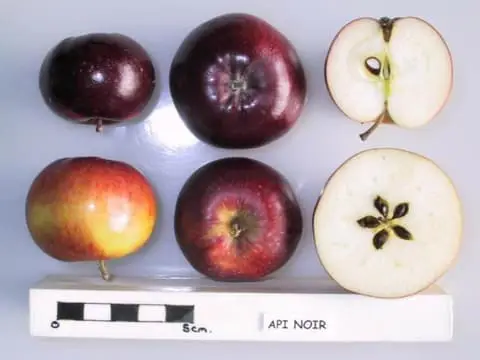
Api Noir
-
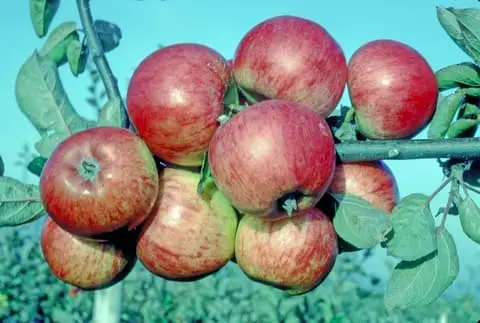
Barre
-
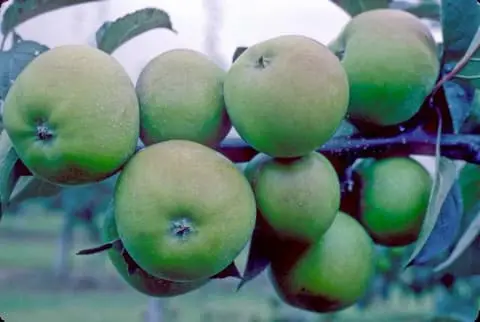
Bassard