Apple varieties, United States
Wolf River
A large, very hardy apple raised by W. A. Springer near the Wolf River at Fremont, Wisconsin; first recorded in 1875
History
Wolf River was first recorded in 18755, at the annual meeting of the Wisconsin State Horticultural Society in Madison that February1. Among a box of mostly seedling apples sent by W. A. Springer of Fremont for the Waupaca County Horticultural Society, the fruit committee noted one called Wolf River: large, red with light yellow, tender and of good flavour, apparently a seedling and “some like the Alexander”1. Beach credited Springer with raising it near the Wolf River, after which it was named2, and Downing added that Springer grew the tree but parted with it before it fruited, to Henry Riflen, near the river’s east bank at Fremont3.
It entered the American Pomological Society’s catalogue in 18812. Hansen, writing in South Dakota in 1902, found that it had “largely superseded Alexander in the western states”2; by 1905 it was being planted to a limited extent in New York, where its large, highly coloured fruit often sold well2.
Hansen and Downing supposed it to be a seedling of Alexander, which it resembles1,2,3, and SNP data confirm Alexander as a parent4. Muranty and colleagues cite it as an example of the influence of Russian varieties brought deliberately to the upper Great Plains of the United States4.
The fruit
The fruit is large1,2; the National Fruit Collection records it as 108 mm wide and 76 mm high5. It is broad and flat at the base, roundish or a little conical, and often somewhat irregular2. The rather thick skin is pale yellow or greenish, blushed with bright deep red and splashed and broadly striped with carmine2; Downing noted that it turns whitish when ripe, under a thin whitish bloom3. Beach found the flesh tinged with yellow, firm, moderately coarse, tender and juicy, subacid and a little aromatic, and rated it “fair to good”2. Downing described white, rather coarse, juicy flesh, mild subacid “with a peculiar spicy, slight quince-like flavor”3.
At Geneva, New York, it was in season from September to December, but it kept only until October in ordinary storage, or until January in cold storage, and it did not stand heat well2. At the National Fruit Collection in Kent it is picked in mid-September5.
Growing
Beach found the tree very hardy and a good grower, cropping moderately to well every other year or sometimes every year2. Downing and Hansen described a strong, spreading tree that is not an early bearer2,3. A USDA germplasm inventory of 1996, citing a nursery catalogue and Bultitude’s Apples (1983), lists it as resistant to scab, mildew, fire blight and cedar apple rust, and its tree as very spreading and slow to form spurs6. Wolf River is diploid4.
Uses
The National Fruit Collection classes it as a cooking and dessert apple5, and the USDA inventory calls it excellent for cooking6.
Where the sources disagree
- Place. Beach, the National Fruit Collection and the USDA inventory place its origin in “Fremont county”2,5,6; Downing gives Fremont, Wisconsin, by the east bank of the Wolf River3, and the 1875 report has Springer at Fremont, sending fruit for the Waupaca County society1.
- The flesh. Beach describes juicy, yellow-tinged flesh2 and Downing white, juicy flesh3; the National Fruit Collection finds it white tinged with green, rather dry and moderately acid5.
- Season. Downing gives October and November3; Beach, September to December2.
Family tree
Parents, grandparents and great-grandparents, as the entries in the atlas record them.
- Wolf River United States, before 1875
- Seed parent Aport Russia, late 18th century
Sources
- Transactions of the Wisconsin State Horticultural Society, annual meeting of 1875, p. 107: Report of Committee on Exhibition of Fruit, Wisconsin State Horticultural Society, E. B. Bolens, State Printer, Madison; Internet Archive, 1876. Supports: the fruit exhibited at the annual meeting held at Madison on 2–4 February 1875; W. A. Springer of Fremont sending a box of apples, "mostly seedlings, in behalf of the Waupaca county Horticultural Society", including "Wolf River, large, red with light yellow, creased, tender, good flavor, appears to be a seedling, some like the Alexander".
- The Apples of New York, vol. II, pp. 245–246: Wolf River, S. A. Beach, New York Agricultural Experiment Station, Internet Archive, 1905. Supports: a variety of the Aport group, resembling Alexander in size, form and colour; Hansen's statement (South Dakota station bulletin, 1902) that it is "supposed to be a seedling of the Alexander", larger and rounder, that it "has largely superseded Alexander in the western states", and that the tree is a strong spreading grower, not an early bearer, productive in alternate years; season September to December at Geneva, with October the commercial limit in ordinary storage and January in cold storage; does not stand heat well; tree very hardy, a good grower, cropping biennially or sometimes annually; large, shapely, highly coloured fruit that often sells well; originated by W. A. Springer near Wolf River, "Fremont county", Wis., hence its name; entered in the American Pomological Society's catalogue in 1881; planted to a limited extent in New York; the fruit large, broad and flat at the base, inclined to conic or roundish, often somewhat irregular; skin rather thick, pale bright yellow or greenish, mottled and blushed with bright deep red, with splashes and broad stripes of carmine; flesh slightly tinged with yellow, firm, moderately coarse, tender, juicy, subacid, a little aromatic, "fair to good".
- The Fruits and Fruit Trees of America, appendix, pp. 113–114: Wolf River, A. J. Downing, revised by Charles Downing, John Wiley & Sons, Internet Archive, 1900. Supports: the tree grown by W. A. Springer and "disposed of before fruiting to the late Henry Riflen, near the east bank of Wolf River, Fremont, Wis."; supposed a seedling of Alexander, darker and rather better in quality; the tree said to be very hardy, strong and spreading, not an early bearer but producing full crops in alternate years; fruit large to very large; skin pale greenish yellow, becoming whitish when mature, shaded with light and dark red or crimson, with a thin whitish bloom; flesh white, rather coarse, half tender, juicy, mild subacid, "with a peculiar spicy, slight quince-like flavor"; season October and November.
- Using whole-genome SNP data to reconstruct a large multi-generation pedigree in apple germplasm, Hélène Muranty and others, BMC Plant Biology 20: 2, with Additional files 1 and 7 (Tables S1 and S6), 2020. Supports: Alexander, a major founder from the Moscow region, giving rise to Wolf River in Wisconsin, "an example of the influence from intentional introduction of Russian cultivars for use in the upper US Great Plains"; Table S6: Wolf River and Alexander a parent–offspring pair, with "probably Alexander" as the parent in the literature; Table S1: Wolf River diploid (2n), dated 1875.
- Wolf River (accession 1943-005), National Fruit Collection, Brogdale, Kent (Defra). Supports: raised by W. A. Springer near Wolf River, "Fremont County, Wisconsin"; first recorded in 1875; parentage "Alexander x Unknown"; culinary and dessert apple; large, 108 mm wide and 76 mm high; white, green-tinged, fine-textured, "rather dry" flesh with a moderately acid flavour; picking in mid-September at Brogdale.
- Plant Inventory No. 204, Part I, p. 322: PI 588807, Wolf River, R. A. Norris (ed.), USDA Agricultural Research Service, 1996. Supports: Wolf River received from Washington State University, Prosser, in 1984; originated near Wolf River, "Fremont County, Wisconsin"; recorded 1875; "Resistant to scab, mildew, fire blight and cedar apple rust"; tree vigorous and very spreading, "Does not produce spurs very freely"; "Excellent cooking"; with the literature cited as a 1992–93 Tsolum River Fruit Trees catalogue and J. Bultitude, Apples (1983).
More from United States
-
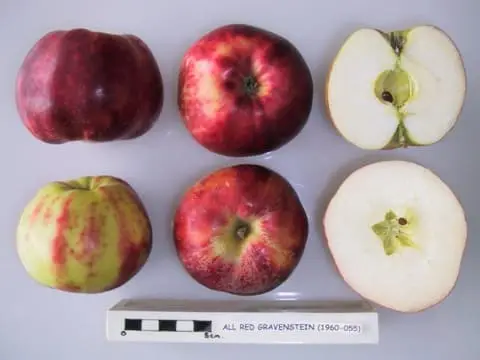
All-Red Gravenstein
-
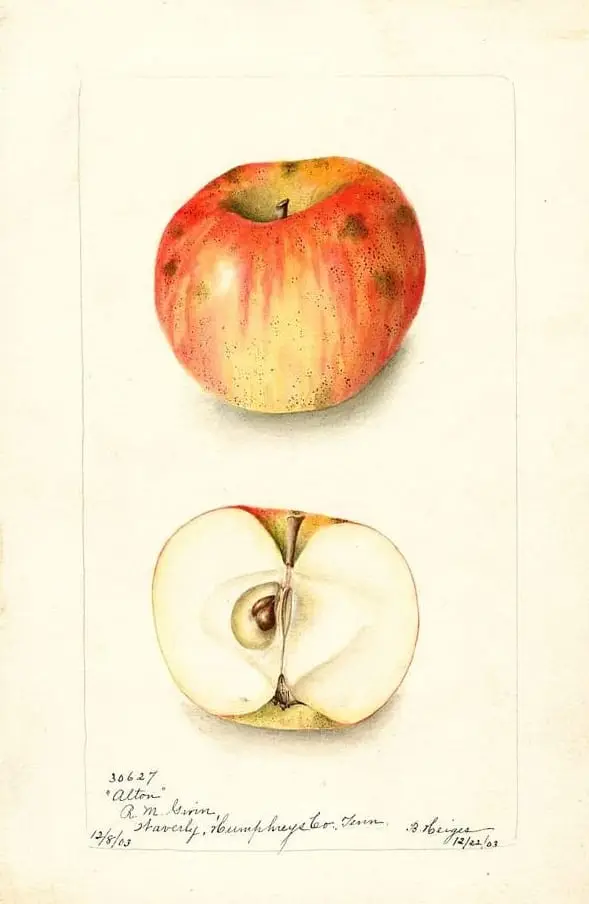
Alton
-
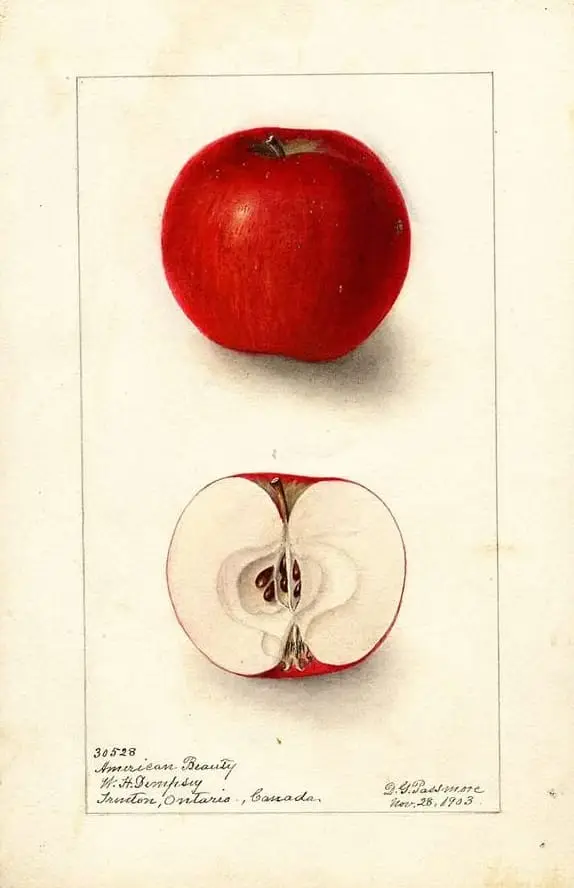
American Beauty
-
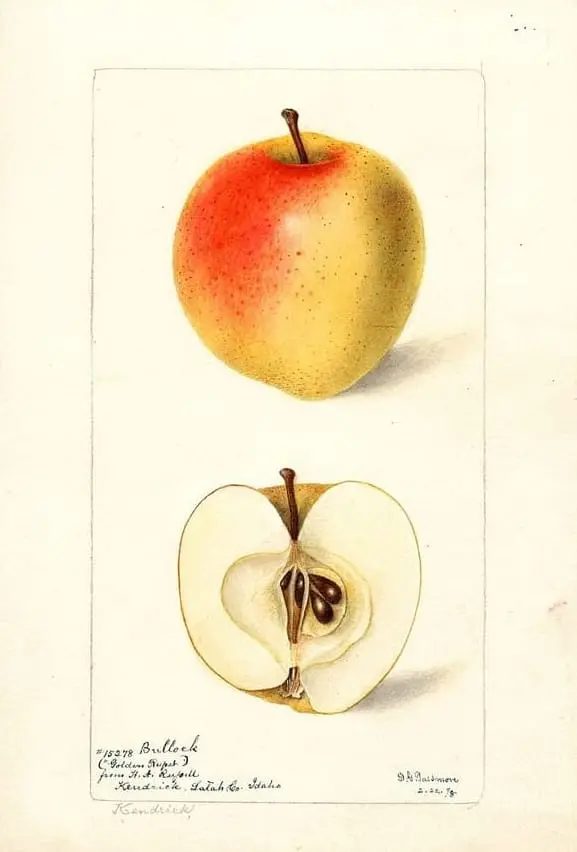
American Golden Russet
A small New Jersey russet whose flesh Downing likened to a buttery pear; Coxe knew it in 1817 as Sheep-nose
-
American Grindling
-
American Summer Pearmain
-
Ames
-
Arkansas