Apples of Italy
32 varieties in the atlas came from Italy. The oldest is Decio, dated about 450 AD.
Harvest
Italy grew 2,398,540 tonnes of apples in 2024, 2.5% of the world's harvest; it ranked sixth among the world's producers.1
The figures
| Year | Tonnes |
|---|---|
| 2024 | 2,398,540 |
| 2023 | 2,267,750 |
| 2022 | 2,256,240 |
| 2021 | 2,211,740 |
| 2020 | 2,462,440 |
| 2019 | 2,303,690 |
| 2018 | 2,466,990 |
| 2017 | 1,921,272 |
| 2016 | 2,455,616 |
| 2015 | 2,473,608 |
| 2014 | 2,473,608 |
| 2013 | 2,216,963 |
| 2012 | 1,991,312 |
| 2011 | 2,411,201 |
| 2010 | 2,204,972 |
| 2009 | 2,325,653 |
| 2008 | 2,210,100 |
| 2007 | 2,230,191 |
| 2006 | 2,130,980 |
| 2005 | 2,192,000 |
| 2004 | 2,136,226 |
| 2003 | 1,953,752 |
| 2002 | 2,199,219 |
| 2001 | 2,299,100 |
| 2000 | 2,232,100 |
| 1999 | 2,343,800 |
| 1998 | 2,143,300 |
| 1997 | 1,966,470 |
| 1996 | 2,071,261 |
| 1995 | 1,940,007 |
| 1994 | 2,232,853 |
| 1993 | 2,143,540 |
| 1992 | 2,394,131 |
| 1991 | 1,830,170 |
| 1990 | 2,050,070 |
| 1989 | 1,924,240 |
| 1988 | 2,331,690 |
| 1987 | 2,235,950 |
| 1986 | 2,019,530 |
| 1985 | 2,014,100 |
| 1984 | 2,210,400 |
| 1983 | 2,032,200 |
| 1982 | 2,602,700 |
| 1981 | 1,741,600 |
| 1980 | 1,936,700 |
| 1979 | 1,991,900 |
| 1978 | 1,846,800 |
| 1977 | 1,790,600 |
| 1976 | 2,143,000 |
| 1975 | 2,127,000 |
| 1974 | 1,886,100 |
| 1973 | 2,050,000 |
| 1972 | 1,884,100 |
| 1971 | 1,697,300 |
| 1970 | 2,062,000 |
| 1969 | 2,010,000 |
| 1968 | 1,932,000 |
| 1967 | 1,932,000 |
| 1966 | 2,288,600 |
| 1965 | 2,185,000 |
| 1964 | 2,381,000 |
| 1963 | 2,336,000 |
| 1962 | 2,182,000 |
| 1961 | 2,167,000 |
Growing regions
- South Tyrol Europe's largest contiguous apple-growing area, in Alpine valleys between 200 and 1,100 m
- Val di Non An Alpine plateau of orchards that keeps part of its crop 300 m underground, in a dolomite mine
Varieties from Italy, oldest first
-
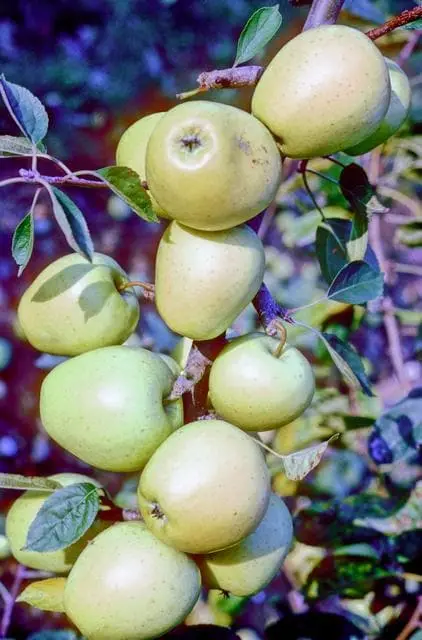
Limoncella
A small, yellow, firm-fleshed apple of southern Italy, first described in 1831 and now in danger of disappearing
-
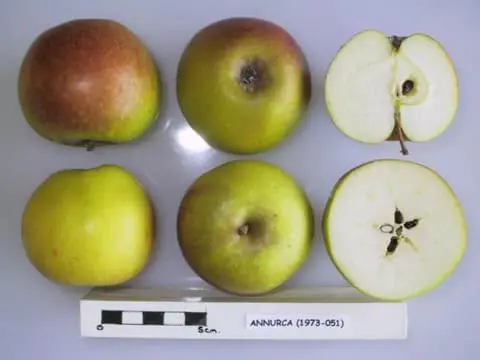
Annurca
Campania's "queen of apples", picked before it is fully red and then coloured on beds laid out on the ground
-
Civni
Bred near Ferrara from a 1988 cross of Gala and Elstar; a late-summer apple run by its breeder, CIV, as a club variety
-
Fubrax
A dark-red, striped sport of Fuji found in an orchard at Girlan, South Tyrol, and first observed in 2002
And 28 more in the catalogue, A to Z
- Abbondanza 1896
- Campanino by 1950
- Caroli d'Italie by 1876
- Cavallotta by 1958
- Ciodo by 1958
- Cola early 1900s
- Cola Gelata early 1900s
- Contessa by 1958
- Decio about 450 AD
- Durello by 1949
- Ed Gould Golden by 1971
- Gambafina about 1900
- Gian Andre by 1958
- Goldjon
- Lappio by 1958
- Lavina by 1949
- Mela Carla by 1817
- Meran 1966
- Montmedy by 1864
- Nasona before 1949
- Renetta Grigia di Torriana by about 1905
- Rosa del Caldaro by 1889
- Rosmarina bianca by the early 1800s
- Rosso del Povero by 1958
- Runse by 1958
- Skinlite 1947
- Tiroler Spitzlederer by 1889
- Verdona by 1958
Sources
- FAOSTAT: Production: Crops and livestock products, Food and Agriculture Organization of the United Nations (FAO), Updated 31 December 2025. Supports: each country's apple harvest by year (item 515, apples, in tonnes, 1961 to 2024), the shares of the world's harvest and the ranks worked out from them, and which figures FAOSTAT estimated or imputed.