Limoncella
A small, yellow, firm-fleshed apple of southern Italy, first described in 1831 and now in danger of disappearing
History
The National Fruit Collection records that Limoncella was first described in 1831 and reached Britain from Italy in 19731. A study by researchers in Naples calls it an ancient, prized cultivar of Campanian origin, grown on a large scale until the early nineteenth century; growers then failed to control pests such as tortrix moths and wood borers, the trees cropped poorly, and many were replaced with hazels2. Its revival is credited to Max Brandmayer, a German hotelier who grew apples with organic treatments near Sant’Agata sui Due Golfi, in the province of Naples, early in the twentieth century2.
The Marche region’s register of agricultural biodiversity calls it typical of Molise and Campania, with a range reaching into Abruzzo, Puglia and Sicily; in the Marche it survives as scattered garden trees, and the register rates its risk of loss as high3. In Molise it grows mainly as single household trees, and in only a few orchards4. The Naples study describes it as gone from the markets and in danger of extinction, and records a red-flushed form, Limoncella Rossa2. SNP data published in 2020 confirmed Limoncella as a parent, with an apple listed as Appio (TN), of Sicilia Piccola5.
The fruit
The fruit is small, 100 to 120 grams in the Marche3 and about 54 mm high and wide at Brogdale, in Kent1, and varies from oblong and truncated-conical to waisted and lopsided2,3. The thin, tough skin is yellow, pale greenish yellow or golden, with no flush1,2,3. The flesh is white or cream and firm to hard1,2,3,4. It tastes very sweet at Brogdale1 and sweet in the Naples study2, but sweet and sharp, with a lemony or citrus note, in the Marche and Molise3,4.
The apple improves in store3. It keeps until January or February in the Marche3, and into late spring in Molise, shrivelling as it keeps4. The flesh browns easily3.
Growing
In the Marche the tree is of medium vigour, quick to bear and a heavy, fairly regular cropper, late-flowering and very hardy3; the Naples study found it upright and weakly vigorous, moderately susceptible to scab and resistant to powdery mildew2. It is prone to bitter pit in Molise4 and suffers in long droughts3. It is diploid5.
Uses
Limoncella is a dessert apple1. In Molise it was once the main ingredient of decoctions against seasonal ailments, and it is still made into jam, though less than before4; the Marche register even calls it a cider apple3.
Where the sources disagree
- Origin. The Naples study gives Limoncella a Campanian origin2; the Marche register says it arose on the slopes of Etna3.
- Season. Picking is put at late September in the Marche3, late September to early October in Molise4 and late October at Brogdale1; flowering at the end of March or early April in Molise4, but in May in the Naples study2 and at Brogdale1.
- Other names. The Marche register gives Zitella and Taffettà bianca d’autunno as other names for Limoncella3, but Molise’s germplasm bank keeps Mela Zitella as a separate variety4.
Sources
- Limoncella (accession 1973-052), National Fruit Collection, Brogdale, Kent (Defra). Supports: "First described in 1831"; received by the National Fruit Trials from Italy in 1973; "Fruits have tough flesh with a very sweet flavour"; a dessert apple; small and conical, height 54.21 mm and width 53.61 mm; whitish-yellow ground with no flush; firm white flesh; 10% flowering on 10 May and picking in late October at the collection.
- Molecular characterisation of ancient apple cultivars (Malus pumila Miller, Rosaceae) of southern Italy (in Italian), P. Cennamo, O. De Castro and L. Paino, Delpinoa n.s. 49: 53–58, Orto Botanico di Napoli, 2007. Supports: Limoncella "un'antica e pregiata cultivar di origine campana"; grown on a large scale until the early 1800s, then lost to apple pests ("tortrice, rodilegno"), the trees becoming much less productive and replaced with hazels; the revival attributed to the German hotelier Max Brandmayer early in the twentieth century, growing apples with organic treatments on his property near Sant'Agata sui Due Golfi (Naples); tree upright and weakly vigorous, moderately susceptible to scab, resistant to powdery mildew; flowering in the first and second ten days of May; fruit small and very variable in shape, from oblong truncated-conical to waisted and asymmetric; skin thin but tough to chew, yellow to light yellowish green, with no flush; flesh white or cream and firm; flavour sweet; a red form, Limoncella Rossa; the cultivar gone from the markets and in danger of extinction.
- Mela Limoncella: regional register entry no. 26 (in Italian), AMAP, Marche region: regional register of agricultural biodiversity; card from S. Virgili and D. Neri, Mela Rosa e mele antiche (ASSAM, 2002), 2005. Supports: entered on 13 October 2005; other names Taffettà bianca d'autunno and Zitella; risk of erosion "Alto"; typical of Molise and Campania, its range extending into Abruzzo, Puglia and Sicily; in the Marche, scattered trees in family orchards and gardens; tree of medium vigour, quick to bear, cropping abundantly and fairly regularly, late-flowering and very hardy; sensitive to long periods of water stress; fruit small (100–120 g), cylindrical-conical and oblong; skin golden yellow; flesh cream-white and firm, sweet-sharp with a lemony flavour ("sapore citrino"), fragrant and aromatic, browning easily; picked at the end of September; keeps until January–February, improving in store; "può essere considerata a tutti gli effetti una mela da sidro"; "nasce alle pendici dell'Etna".
- Mela Limoncella (in Italian), Agenzia Regionale per lo Sviluppo Agricolo, Rurale e della Pesca (ARSARP), Molise: germplasm bank database. Supports: found across almost all of Molise as trees for household use, in only a few specialised orchards; its use for jams declining; formerly the main ingredient of decoctions to treat and prevent seasonal ailments; flesh hard and white, sweet-sharp, with a slightly citrus scent; flowering at the end of March and beginning of April; picked at the end of September and beginning of October; keeps until late spring in cool, dry places, shrivelling as it does; prone to bitter pit; the database lists Mela Zitella as a separate variety.
- Using whole-genome SNP data to reconstruct a large multi-generation pedigree in apple germplasm, H. Muranty and others, BMC Plant Biology 20: 2, supplementary tables S1 and S3, 2020. Supports: Limoncella (MUNQ 708) diploid (2n), dated 1831 (table S1); the trio Sicilia Piccola = Appio (TN) × Limoncella found from the SNP data, confirming both parents recorded in the literature (table S3).
More from Italy
-
Abbondanza
-
Annurca
Campania's "queen of apples", picked before it is fully red and then coloured on beds laid out on the ground
-
Campanino
-
Caroli d'Italie
-
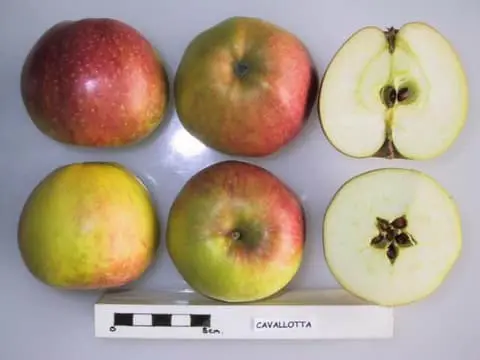
Cavallotta
-
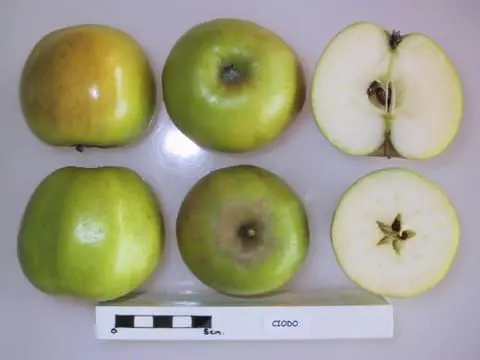
Ciodo
-
Civni
Bred near Ferrara from a 1988 cross of Gala and Elstar; a late-summer apple run by its breeder, CIV, as a club variety
-
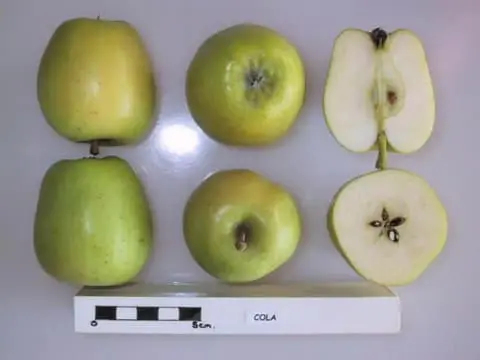
Cola