Fubrax
A dark-red, striped sport of Fuji found in an orchard at Girlan, South Tyrol, and first observed in 2002
History
Fubrax is a strain of Fuji that arose as a naturally occurring branch mutation1. The original tree, planted in 1999, grew in the Merol orchard at Girlan, in the municipality of Eppan in South Tyrol; it was first observed in 2002, when it was also first propagated, and its offspring were first assessed in 20031. The young trees were raised by chip budding in a nursery in Verona1. A United States patent, naming Thomas Braun as inventor and the variety as Fuji Fubrax, was applied for in 2006 and granted in 2008; the company to which it was assigned changed its name to Adema GmbH in 20251. Knoll and colleagues reported in 2022 that it had been protected as a variety in the European Union since 8 September 20142.
Its fruit is sold under the trade mark Kiku2,3. Sansavini and Gregori, writing in 2019, did not list it among the club varieties: they placed it among strains propagated freely under a trade mark, with royalties charged on the trees3. They also counted Kiku among the Italian brands that group several varieties under one name3; Knoll and colleagues use it for both Fubrax and Brak, another striped Fuji strain2.
In South Tyrol, where Fuji covered about 1,069 hectares at the end of 2021, 6 per cent of the apple area, the marketing organisations VOG and VIP and the fruit auction EGMA all recommended Fubrax for new plantings in 2022; VIP advised its members to plant only Fubrax and FUCIV181, the two striped strains2.
The fruit
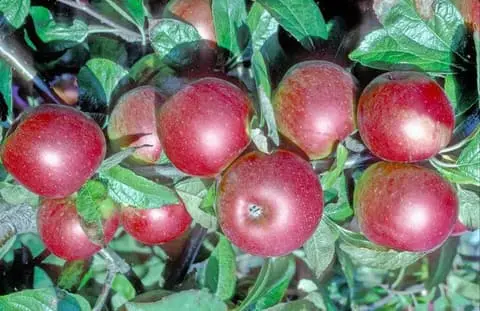
The patent describes a large, globose fruit with little or no ribbing1. The smooth skin has a green-yellow ground almost wholly covered, about 90 per cent, with dark ruby red in a striped blush, and carries some 500 to 5,000 tiny yellowish dots, often in curved lines of four to eight; there is little russet1. The flesh is yellowish and firm, like Fuji’s, and the patent reports more sugar than in Fuji1. On Laimburg’s striping index, on which strains above 3.5 count as striped, Fubrax scored 5.6, against 6.9 for Brak2.
By the patent’s account the fruit colours some weeks earlier than other Fuji strains, even in the shade of the tree: six weeks before harvest it is up to half coloured, while Fuji is still almost green1. As a result, 95 per cent of the crop can be taken at the first picking, and 95 per cent of the fruit is saleable, against 40 per cent for Fuji1. The patent also reports less watercore and browning of the flesh in store than in Fuji, though over-ripe or late-picked fruit can develop watercore1. It ripens late, about 170 to 180 days after flowering1.
Growing
The tree is vigorous, like Gloster’s, branching and drooping in habit, and flowers at the same time as Fuji, from 10 to 25 April in South Tyrol1. It is not self-fertile; the patent names Gala, Golden Gem, Evereste and Professor Sprenger as compatible pollinators1. It is susceptible to scab1. In commercial plantings 99 per cent of the trees stay true to type, and 1 per cent revert1. In checks of eight South Tyrolean orchards in autumn 2021, between 97.1 and 100 per cent of its trees coloured well at the right time, and the recommended strains proved very stable in colour2.
Family tree
Parents, grandparents and great-grandparents, as the entries in the atlas record them.
- Fubrax Italy, 2002
- Sport of Fuji Japan, 1939
- Seed parent Ralls Janet United States, about 1800
- Pollen parent Delicious United States, 1872
- Parent Winesap United States, by 1817
- Sport of Fuji Japan, 1939
Sources
- US Plant Patent 18,761: Apple tree named 'Fuji Fubrax', Thomas Braun; United States Patent and Trademark Office, via Google Patents, 2008-04-29. Supports: variety denomination "Fuji Fubrax"; a naturally occurring branch mutation of Fuji; the original tree in the Merol orchard at Girlan, Eppan, South Tyrol, planted in 1999, first observed and first propagated in 2002, its next generation first observed in 2003; propagation by chip budding in a nursery in Verona; 99% true to type and 1% reversion in commercial plantings; Thomas Braun as inventor; filed in 2006 and granted on 29 April 2008; the assignee's change of name to Adema GmbH, recorded in 2025; fruit large and globose, ribbing absent or very weak; smooth skin, green-yellow ground, about 90% overcolour of dark ruby red, blush-striped, with about 500 to 5,000 small yellowish dots, often on curved lines of 4 to 8; russet absent or low; flesh firm like Fuji's, yellowish; more sugar than Fuji; colouring some weeks before other Fuji strains, even in the shade, and up to 50% coloured six weeks before harvest, when Fuji is almost green; 95% of the crop harvested at the first picking; 95% of fruit saleable against 40% for Fuji; less watercore and browning of the flesh in storage than Fuji, though over-ripe or late-picked fruit can develop watercore; late ripening, about 170–180 days from flowering to harvest; a vigorous tree like Gloster, ramified, with a drooping habit; flowering at the same time as Fuji, from 10 to 25 April in South Tyrol; not self-fertile, with Gala, Golden Gem, Evereste and Prof. Sprenger as compatible pollinators; susceptible to scab.
- Fuji – una varietà interessante, ma "difficile", Markus Knoll (South Tyrol fruit advisory service), Edmund Ebner (Laimburg Research Centre), Maria Niedermayr and Nadia Sanin (South Tyrol variety innovation consortium), issue 6/2022, pp. 23–28; Free University of Bozen-Bolzano repository, 2022. Supports: Fuji in South Tyrol on about 1,069 ha at the end of 2021, 6% of the apple area; Fubrax given as "Fuji Fubrax/Kiku" under the heading "clone/marchio" (clone/trade mark) in Tables 1 and 2, protected as a variety in the EU "dal 08/09/2014" (Table 2); the same trade mark, Kiku, used for the striped strain Brak; Laimburg's striping index, with 3.5 the threshold between washed-out and striped strains: Fubrax 5.6 and Brak 6.9; in autumn 2021, in 8 orchards, 97.1–100% (mean 99.1%) of Fubrax trees in the colour class of optimal colour at the right time, the recommended strains proving very stable in colour; recommended for planting in 2022 by the marketing organisations VOG and VIP and the fruit auction EGMA, VIP advising its members to plant only Fubrax and FUCIV181, the two striped strains.
- Which distribution strategy will support new exclusive apple varieties: club, trademark, or free production?, Silviero Sansavini and Roberto Gregori, Chronica Horticulturae 59(4): 6–12, International Society for Horticultural Science, 2019. Supports: Fubrax, with its trade mark written "Fuji Kiku", in Table 2 of the main clones "freely propagated with trademark name (royalties on plants)", as distinct from the club varieties of Table 1; Kiku counted among the Italian brands that "aggregate together a number of varieties" under one name (p. 11).
More from Italy
-
Abbondanza
-
Annurca
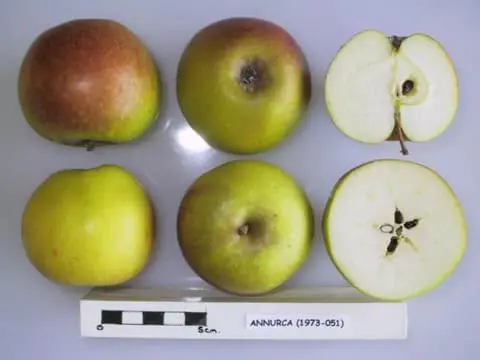
Campania's "queen of apples", picked before it is fully red and then coloured on beds laid out on the ground
-
Campanino
-
Caroli d'Italie
-
Cavallotta
-
Ciodo
-
Civni
Bred near Ferrara from a 1988 cross of Gala and Elstar; a late-summer apple run by its breeder, CIV, as a club variety
-
Cola