Berner Rose
A chance seedling from the canton of Bern that first fruited in 1888; its parents were found by DNA
History
The Berner Rose arose as a chance seedling at Oppligen, in the canton of Bern2,3,5. By the Bavarian horticultural association’s account, Fritz Baumann, a farmer at Oppligen, found the young tree in his woods in the late 1860s and planted it in his garden, where it first bore fruit in 18882; the Pomologen-Verein’s network of variety keepers also names F. Baumann as the finder3. A. Daepp, a nurseryman of Oppligen, noticed the fruit and took the variety into his range as Neuer Berner Rosenapfel2. The Daepp nursery’s own account dates the seedling to 1870, on the Baumann family’s land, and says that its founder, Adolf Daepp, saw its promise and grafted it, the first fruit following in the autumn of 18885.
DNA has identified its parents. A 2016 study using SSR markers proposed Sauergrauschapfel and Calville Rouge d’Hiver, and SNP data confirmed both in 20206; a 2025 study found the same pair7. With Peasgood’s Nonsuch, the Berner Rose is in turn a parent of Alro6.
It counts today as a widespread variety, though not a very common one, still sold by nurseries and kept in collections3, and it remains well liked in gardens2.
The fruit
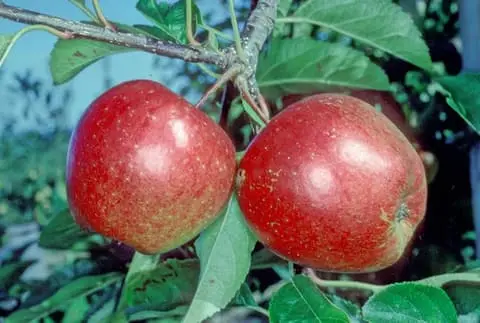
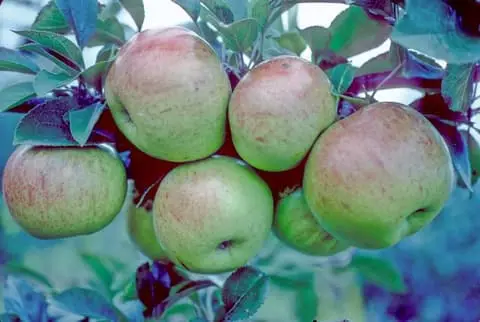
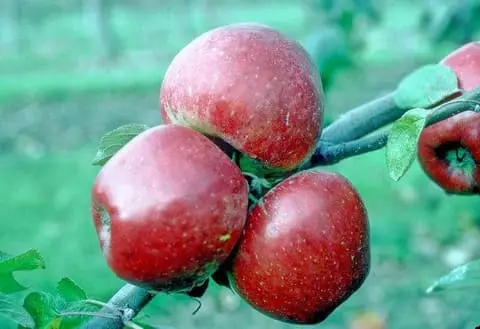
The fruit is medium-sized, about 90 grams2, 55–65 mm high and 60–70 mm wide4; the UK’s National Apple Register of 1971 gives 57.5 mm by 62.5 mm1. It is round to cylindrical or slightly conical, with broad, flat ribs, and five-sided in cross-section2,3,4. The smooth, firm skin is yellowish green, mostly covered by a pink-carmine to dark red flush that a heavy bloom makes look bluish; the lenticels are slightly sunken, so the bloom stays on them as conspicuous grey-white dots2,3,4. The flesh is whitish, often tinged or streaked red, medium-firm to tender and juicy2,4. It is sweet-sour: Arche Noah finds it pleasantly spiced and winy4 and the National Fruit Collection aromatic1, while the Bavarian association and the Pomologen-Verein find little aroma2,3.
It is picked from early to late September in Germany2,3, in early October at Brogdale, Kent1, and in mid-October by Arche Noah’s Austrian account4. It keeps about four months before turning mealy, or until March or April in a cold store2.
Growing
The tree grows strongly when young, forming a tall, rounded crown whose branches hang with age, and is hardy in the wood2,4. It bears early, heavily and every year, which can exhaust it, so regular pruning and thinning are advised2,3,4. It flowers over a long period, is little troubled by weather and is a good pollinator2,4. It needs moist, fertile soil and does well on high ground, but is prone to scab in valleys and enclosed sites2,3,4, and also to mildew, canker and woolly aphid2,4. It is diploid4,6,7.
Uses
The National Fruit Collection and the Pomologen-Verein treat it as a dessert apple1,3. Arche Noah calls it an excellent dessert and a very good culinary apple4; the Bavarian association counts it mainly a culinary apple, and a dessert apple too at higher altitudes2.
Where the sources disagree
- Who found it, and when. The farmer F. (Fritz) Baumann2,3, in the late 1860s2; a seedling of 1870 on the Baumann family’s land, recognised by Adolf Daepp5; the nurseryman Daepp, by the National Fruit Collection’s record1; or a farmer, about 1890, by an Arche Noah variety sheet4. All but Arche Noah give 1888 for its first fruit1,2,3,5.
- Season. Picked in September in Germany2,3; in October at Brogdale and in Austria1,4.
Family tree
Parents, grandparents and great-grandparents, as the entries in the atlas record them.
- Berner Rose Switzerland, about 1870
- Parent Sauergrauschapfel
- Parent Calville Rouge d'Hiver France, by about 1600
- Parent Calville Rouge d'Hiver France, by about 1600
- Parent Reinette Franche France, by 1540
- Parent Reinette de Saintonge
Sources
- Berner Rosen (accession 1947-067), National Fruit Collection, Brogdale, Kent (Defra). Supports: "Discovered by nurseryman Daepp of Oppligen, Switzerland. First fruited in 1888"; "fine, greenish white tinged red flesh with a subacid, aromatic flavour"; a dessert apple; 57.5 mm high and 62.5 mm wide, dark red, striped (Smith, 1971); picked in early October at Brogdale; the other names listed as synonyms.
- Berner Rosenapfel (in German), Streuobst in Bayern, Bayerischer Landesverband für Gartenbau und Landespflege. Supports: the name Berner Rosenapfel; Fritz Baumann, a farmer at Oppligen, canton of Bern, found a seedling tree in his woods in the late 1860s and planted it in his garden, where it first fruited in 1888; the nurseryman A. Daepp of Oppligen took it into his range as Neuer Berner Rosenapfel; a connoisseur's variety still well liked in gardens, recommended especially for higher ground; long flowering, not sensitive, a good pollinator; thinning advised; fruit medium, about 90 g, slightly tall with broad, flat ribs; skin smooth, firm, slightly bluish-bloomed, yellow-green with a pink to carmine flush and conspicuous lenticels; flesh almost white, sometimes reddish under the skin, medium firm, juicy, sweet-sour, of weak aroma; picked early to mid-September; keeps about four months, then turns mealy and bland, or until March or April in a cold store; mainly a culinary apple, a dessert apple at higher altitudes; bearing early, high and regular; tall, rounded crown with hanging branches in age, strong growth at first, weak later, frost-hardy wood; no dry, poor soils, otherwise undemanding up to high ground; scab only in valley sites, also mildew, canker and woolly aphid.
- Berner Rosenapfel (in German), Jan Bade, Erhalternetzwerk Obstsortenvielfalt, Pomologen-Verein, 2026-01-25. Supports: the names Berner Rosenapfel, Neuer Berner Rosenapfel and Pomme Rose de Berne; found as a chance seedling in a wood in Switzerland by F. Baumann, first cropping in 1888; a standard variety, widespread though not very common, still sold by nurseries and kept in collections; picked mid to late September and keeping until December; medium, cylindrical fruit, five-sided in cross-section; a dark red flush that looks bluish under heavy bloom, with slightly sunken lenticels on which the bloom shows as grey-white dots; whitish-yellow, sweet-sour flesh "ohne ausgeprägtes Aroma" (without marked aroma); vigorous when young, exhausted later by high annual crops, kept vital by regular pruning and thinning; a dessert apple for gardens and meadow orchards, of limited use in enclosed sites because of some susceptibility to scab.
- Berner Rosenapfel (in German), Arche Noah, Schiltern, with the Lower Austrian provincial government. Supports: the name Berner Rosenapfel, with the synonyms Neuer Berner Rosenapfel and Berner Rosen; a chance seedling found by a farmer at Oppligen about 1890; fruit 55–65 mm high and 60–70 mm wide, round to slightly conical, faintly ribbed; skin smooth, yellowish green to greenish yellow with a bright carmine, purple to dark red flush over half to all of the fruit, bloomed bluish on the tree; flesh greenish to yellowish white, often reddened and red-streaked, tender, juicy, pleasantly spiced and sweet-winy; picked in mid-October, eaten from November to February; mid-season flowering, fairly weather-resistant, good pollen (diploid); vigorous when young, crown tall and rounded, branches hanging later, frost-hardy wood; needs good, moist soil but tolerates rough sites, not for low-lying ground (scab); bearing early, regular and high; needs pruning; susceptible to scab, to canker on heavy, wet soils, and to woolly aphid and mildew in dry sites; an excellent dessert and very good culinary apple.
- The Berner Rosenapfel (in German), Baumschule Daepp, Münsingen (the nursery that introduced it). Supports: the nursery's own account, cited for want of a better source on these points: the seedling came up by chance in 1870 on the land of the Baumann family at Oppligen; the firm's founder, Adolf Daepp, saw its promise and grafted it; the first fruit hung on the mother tree in the autumn of 1888.
- Using whole-genome SNP data to reconstruct a large multi-generation pedigree in apple germplasm, H. Muranty and others, BMC Plant Biology 20: 2, with Additional files 1, 3 and 4, 2020. Supports: Table S1: Rose de Berne diploid (2n), dated 1888; Table S3: Sauergrauschapfel and Calville Rouge d'Hiver the SNP-inferred parents of Rose de Berne, both confirming the parents given in the literature (source 23), and Peasgood's Nonsuch and Rose de Berne the parents of Alro; Additional file 4: source 23 is Lassois and others (2016), a study of French apple germplasm based on SSR markers.
- Cultivar fingerprinting and SNP-based pedigree reconstruction in Danish heritage apple cultivars utilizing genotypic data from multiple germplasm collections in the world, B. Larsen and others, Genetic Resources and Crop Evolution 72: 2397, with supplementary tables, 2025. Supports: Table S5: Berner Rosen diploid, with Zavergravelu Rouge and Calville Rouge d'Hiver as SNP-confirmed parents; Table S1: Zavergravelu Rouge is the genotype (MUNQ 670) of an accession named Sauergrauch, the genotype that Muranty and others call Sauergrauschapfel.