Apple varieties, United States
Enterprise
A late, long-keeping red apple from the Purdue–Rutgers–Illinois scab-resistance programme, and a parent of WA 38
History
Enterprise comes from the cooperative scab-resistance breeding programme of Purdue University, Rutgers University and the University of Illinois (PRI), and the letters “pri” in its name commemorate that programme1. In 1971, at West Lafayette, Indiana, the breeders crossed two sister selections, PRI 1661-2 and PRI 1661-12. Both were seedlings of McIntosh and PRI 612-1, a selection whose recorded ancestry includes Golden Delicious, Rome Beauty and Malus floribunda 821, the source of their scab resistance4. The cross yielded only 19 seeds; eleven seedlings survived inoculation with the scab fungus and were planted out, and Enterprise was the only one selected2.
The seedling grew in the CL block of the Purdue Horticulture Research Farm, row 4, tree 38, where E. B. Williams selected it in October 19781,2. It was released for advanced testing as Co-op 30 in 1990 and named Enterprise in 19931,3; trees were to reach licensed nurseries in 19941, and US Plant Patent 9,193 was granted in July 19952. Its resistance to scab comes from the Vf gene of M. floribunda 821, which its breeding behaviour indicates it carries in one copy1.
A DNA study published in 2017 reconstructed the paternal side of its pedigree and found Cox’s Orange Pippin there5, a variety absent from the pedigree the breeders recorded4. Enterprise is the seed parent of WA 386.
The fruit
The fruit is 70–76 mm across, round to elongated and sometimes lopsided1,2. The glossy, moderately thick and tough skin is washed 80 to 100 per cent with medium red, slightly orange, over a green-yellow to yellow ground, with inconspicuous dots; it turns waxy after about four months in store1,2. The pale yellow to cream flesh is firm, crisp and juicy, with a spicy, full and rich flavour1. Sprightly and acid at harvest, it mellows in store, and the breeders found its quality outstanding after one or two months1.
It ripens three weeks after Delicious, from 15 to 25 October at West Lafayette, and keeps its quality for up to six months at 1 °C1.
Growing
The tree is moderately to highly vigorous, spreading and round-topped, and bears its fruit singly on spurs spread evenly through the canopy, cropping every year1. It needs cross-pollination for a full crop and thinning for good size; its branch angles are less than ideal and may need spreading2. It flowers late in midseason, with or after Golden Delicious1.
In greenhouse tests none of races 1 to 5 of the scab fungus sporulated on it, and it has shown no cedar-apple rust1. It proved highly resistant to fire blight at Lafayette and Vincennes, Indiana, with only an occasional strike confined to first-year wood, and moderately resistant to powdery mildew1. The 2017 DNA study located two of its genetic factors for fire blight resistance, inherited from Cox’s Orange Pippin and from Golden Delicious5. Enterprise is diploid7.
Uses
Enterprise is a winter dessert apple, suited to medium- and long-term storage1,2.
Where the sources disagree
- When the seedling was planted. The patent says May 19722; the release paper, as reproduced on the PRI programme’s website, says 1982, four years after the seedling was selected1.
- Which parent bore the seed. The patent names PRI 1661-2 as the seed parent2, and the USDA’s inventory also lists it first4; the release paper writes the cross as PRI 1661-1 × PRI 1661-21.
- Season. Three weeks after Delicious, 15–25 October, in the release paper1; two and a half weeks after Delicious, 17–25 October, in the patent2.
Family tree
Parents, grandparents and great-grandparents, as the entries in the atlas record them.
- Enterprise United States, 1971
- Seed parent PRI 1661-2
- Pollen parent PRI 1661-1
Offspring in the atlas
- WA 38 × Honeycrisp; United States, 1997
Sources
- 'Enterprise' Apple, Jeffrey A. Crosby, Jules Janick, Paul C. Pecknold, Joseph C. Goffreda and Schuyler S. Korban, HortScience 29(7): 825–826; reproduced on the PRI programme's website, Purdue University, 1994-07. Supports: the letters "pri" in the name commemorating the Purdue-Rutgers-Illinois programme; "the ninth apple cultivar" of the programme; the original seedling (row 4, tree 38 of the CL block of the Purdue Horticulture Farm; PRI 2693-1) planted "In 1982", from a sib cross written "PRI 1661-1 x PRI 1661-2" made in West Lafayette; Vf from Malus floribunda 821, its breeding behaviour indicating one copy; selected in October 1978 by E. B. Williams; released for advanced testing as Co-op 30 (Korban and others, 1990); fruit 70–76 mm, round to elongated, occasionally lopsided, 80 to 100 per cent medium red to slightly orange over green-yellow to yellow, with a bright, glossy, moderately thick and tough skin and inconspicuous lenticels, waxy after 4 months of storage; flesh fine-grained, pale yellow to cream, firm, crisp, juicy, with a spicy, full, rich flavour; sprightly at harvest, mellowing in storage, quality outstanding after 1 to 2 months; quality kept "for up to 6 months" at 1 °C; maturity 3 weeks after Delicious, 15 to 25 October at Lafayette; tree moderately to highly vigorous, spreading, round-topped, fruit borne singly on spurs distributed through the canopy, annual bearing; flowering in late midseason with or after Golden Delicious; no sporulation after repeated greenhouse inoculation with scab races 1 to 5; no infection by cedar-apple rust; high resistance to fire blight at Lafayette and Vincennes, Indiana, with only an occasional strike limited to first-year wood; moderate resistance to powdery mildew; a winter dessert apple for medium- and long-term storage; trees from licensed nurseries in 1994.
- Apple tree named Co-op 30 (US Plant Patent 9,193), Jeffrey A. Crosby, Jules Janick, Edwin B. Williams, Schuyler S. Korban, Joseph Goffreda and Paul C. Pecknold, Purdue Research Foundation; Google Patents, 1995-07-11. Supports: "also known as Enterprise"; the cross of PRI 1661-2 (seed parent) and PRI 1661-1 (pollen parent) made in 1971 at West Lafayette; 19 seeds, of which eleven survived inoculation with the scab fungus and were planted, Co-op 30 the single selection; the seedling planted in May 1972 in the CL block of the Purdue Horticulture Research Farm (row 4, tree 38) and discovered in October 1978; fruit 70–76 mm, 95 per cent red, waxy after 4 months of storage; maturity 17 to 25 October at West Lafayette, two and a half weeks after Delicious; requires cross-pollination and thinning; "less than optimum branch angles", which may need spreading; a winter dessert apple; application filed 2 June 1993, granted 11 July 1995.
- About PRI, PRI disease resistant apple breeding program (Purdue University, Rutgers University and the University of Illinois), Purdue University. Supports: the cooperative programme of Purdue, Rutgers and Illinois, begun in 1945 to breed apples resistant to scab; Enterprise named in 1993.
- Plant Inventory No. 204, Part II (Plant Materials Introduced July 1 to December 31, 1995), pp. 97, 102 and 161: PRI 1661-1, PRI 1661-2 and Enterprise, R. A. Norris (ed.), USDA Agricultural Research Service, 1996-08. Supports: PI 589774, PRI 1661-1 (p. 97), and PI 589806, PRI 1661-2 (p. 102): each "McIntosh x 612-1", with 612-1's recorded ancestry including 14-126 (Golden Delicious x "F2" 26829-2-2) and "F2" 26829-2-2 from two seedlings of Rome Beauty x M. floribunda 821; scab resistance from M. floribunda 821; PI 590210, Enterprise (p. 161): "PRI 1661-2 x PRI 1661-1".
- Epistatic fire blight resistance QTL alleles in the apple cultivar 'Enterprise' and selection X-6398 discovered and characterized through pedigree-informed analysis, Eric van de Weg and others, Molecular Breeding 38: 5 (abstract), 2017-12-11. Supports: the paternal lineage of Enterprise "reconstructed and showed to include 'Cox's Orange Pippin'"; two fire blight resistance QTLs, on linkage groups 7 and 13, with the favourable alleles inherited by Enterprise from Cox's Orange Pippin and Golden Delicious respectively.
- Apple tree named 'WA 38' (US Plant Patent 24,210), Bruce H. Barritt, Washington State University Research Foundation; Google Patents, 2014-02-04. Supports: WA 38 from a cross of Enterprise (US Plant Patent 9,193) and Honeycrisp, Enterprise its "maternal parent".
- Ploidy determination, Malus (study MALUS.PLOIDYDETERMINATION.2008), USDA Agricultural Research Service, GRIN-Global, 2008. Supports: Enterprise (PI 590210) diploid (2x).
More from United States
-
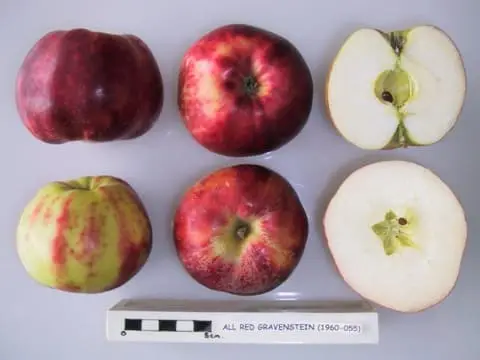
All-Red Gravenstein
-
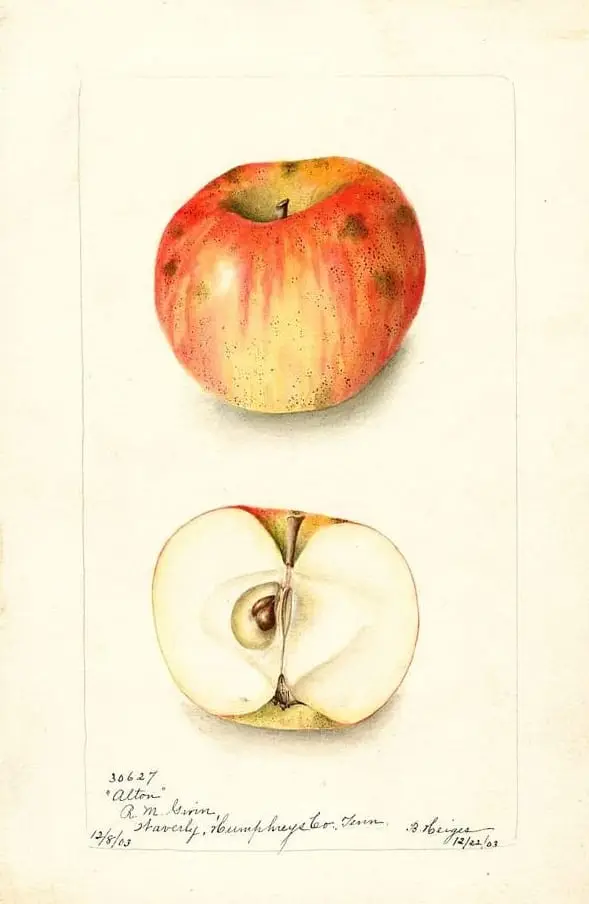
Alton
-
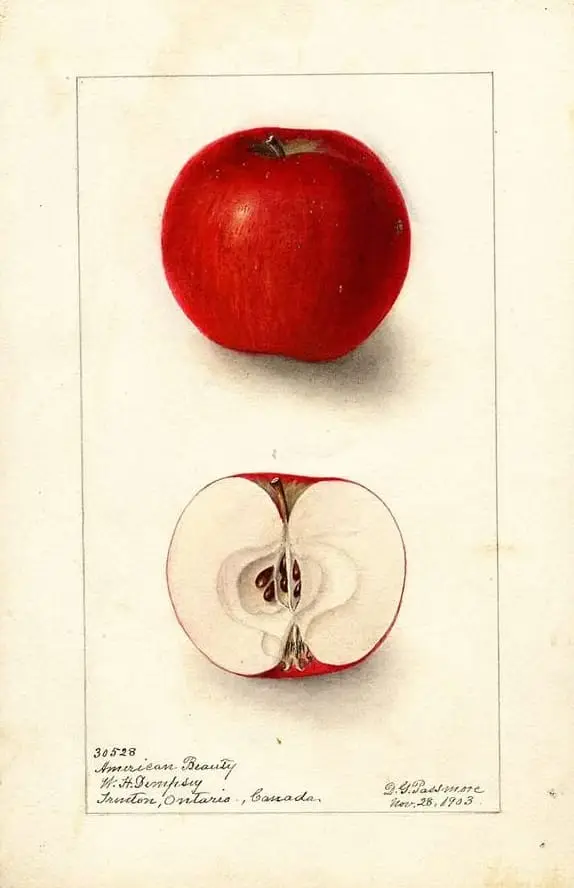
American Beauty
-
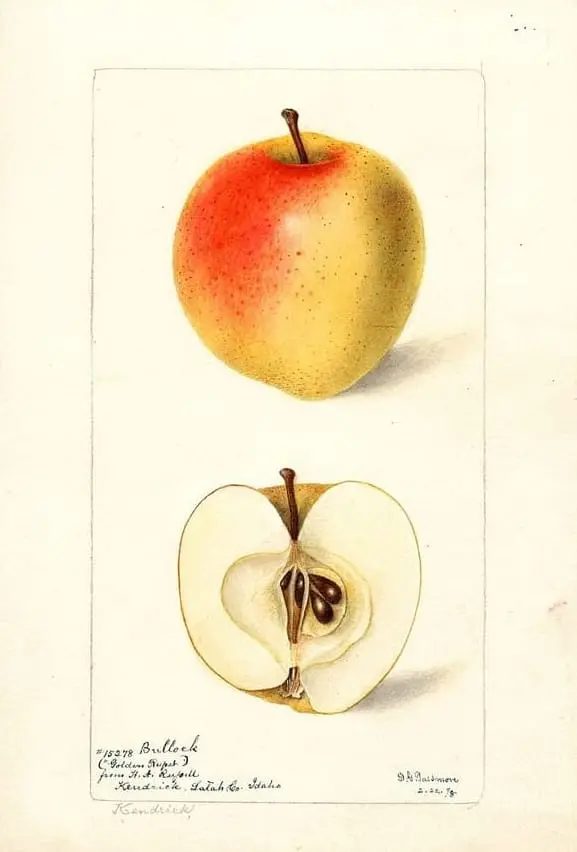
American Golden Russet
A small New Jersey russet whose flesh Downing likened to a buttery pear; Coxe knew it in 1817 as Sheep-nose
-
American Grindling
-
American Summer Pearmain
-
Ames
-
Arkansas