Apple varieties, United Kingdom
Newton Wonder
A Derbyshire cooker introduced about 1887; DNA gives its parents as Maharaji and Northern Greening, not those on record
History
Newton Wonder was raised by a Mr Taylor at King’s Newton, in Melbourne, Derbyshire, and introduced by Messrs Pearson & Co. about 18871,2, when it also received a First Class Certificate from the Royal Horticultural Society1. In 1920 Bunyard counted it “one of the best half-dozen cooking apples”2.
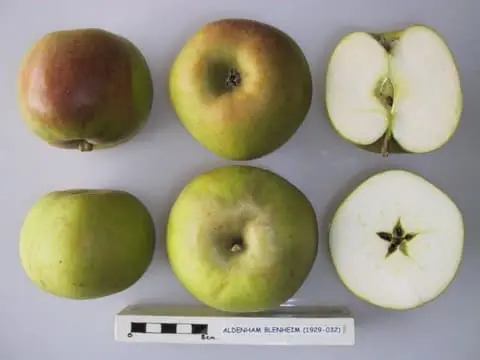
Its parents were recorded as Dumelow’s Seedling and Blenheim Orange1. SNP data published in 2025 name two others, Maharaji and Northern Greening, the same pair that the study found for Annie Elizabeth3. Blenheim Orange is a triploid, and a 2022 study found that recorded pedigrees naming triploids as parents of diploid apples were false in 18 of the 19 cases it examined5; Newton Wonder is diploid3.
The collection lists three sports, Crimson Newton, Marston Scarlet Wonder and Red Newton Wonder, and names Newton Wonder as the father of Howgate Wonder1; SNP data, however, give Howgate Wonder the parents Annie Elizabeth and Peasgood’s Nonsuch4. In Denmark, a tree grown as Newton Wonder at the University of Copenhagen’s Pometum proved to be Kasseler Renette3.
The fruit
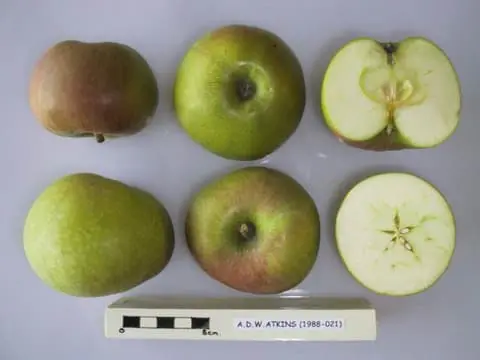
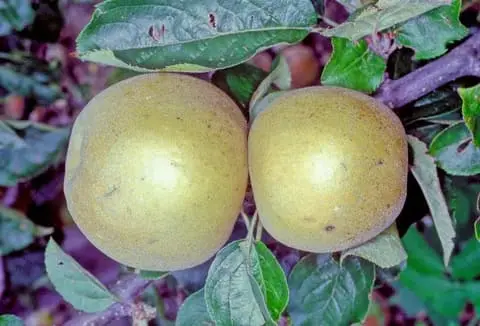
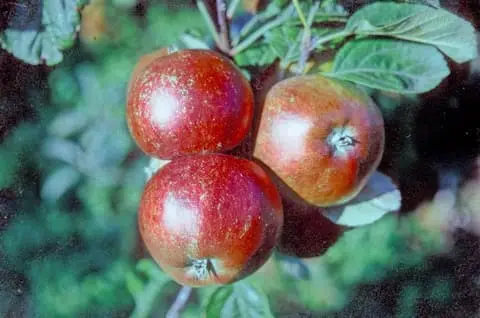
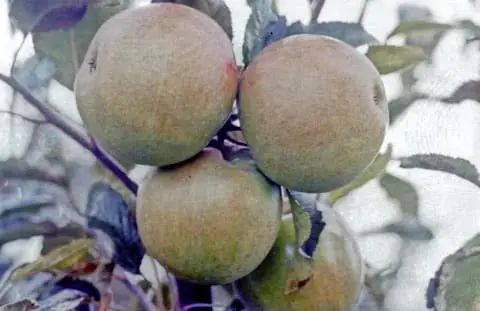
The fruit is large, round and flattened, and regular2; the 1971 National Apple Register, quoted on the collection’s record, gives it as 82 mm wide and 63 mm high1. Its bright yellow skin has a slight scarlet flush and broad, broken stripes1,2. The flesh is yellow, crisp and juicy1,2; the collection describes it as rather coarse-textured and moderately juicy, with a subacid flavour, and says that it “cooks very well”1. Bunyard found it acid and excellent for cooking, and “quite a welcome dessert fruit in March”2.
It keeps until March2. At Brogdale, Kent, it reaches 10 per cent flowering around 9 May and is picked in mid October1.
Growing
Bunyard described its growth as vigorous and fertile, and wrote that it “makes a fine spreading standard”2.
Where the sources disagree
- Parents. Dumelow’s Seedling and Blenheim Orange according to the collection1; Maharaji and Northern Greening according to SNP data3.
- Offspring. The collection names it as the father of Howgate Wonder1; SNP data give Howgate Wonder other parents4.
- Flavour. Subacid in the collection’s description, but acid in the 1971 register quoted on the same record, and in Bunyard1,2.
Family tree
Parents, grandparents and great-grandparents, as the entries in the atlas record them.
- Newton Wonder United Kingdom, introduced about 1887
- Parent Maharaji
- Parent Northern Greening United Kingdom, by 1826
Offspring in the atlas
- Crimson Newton United Kingdom, 1921
- Marston Scarlet Wonder United Kingdom, about 1909
- Red Newton Wonder United Kingdom, by 1958
Sources
- Newton Wonder (accession 1973-140), National Fruit Collection, Brogdale, Kent (Defra). Supports: "Raised by Taylor at King's Newton, Melbourne, Derbyshire, England"; "Introduced in about 1887 when it also received a First Class Certificate from the Royal Horticultural Society"; "rather coarse-textured, moderately juicy flesh with a subacid flavour. Cooks very well"; parentage "Dumelow's Seedling x Blenheim Orange"; father of Howgate Wonder; sports Crimson Newton, Marston Scarlet Wonder and Red Newton Wonder; from the National Apple Register (Smith, 1971), a large, flat fruit 82 mm wide and 63 mm high, bright yellow with a scarlet flush and stripes, yellow, firm, crisp flesh and an acid flavour; 10% flowering on 9 May and picking in mid October at Brogdale; a culinary apple.
- A Handbook of Hardy Fruits, vol. I, p. 94: Newton Wonder, E. A. Bunyard, John Murray, Internet Archive, 1920. Supports: culinary, "till March"; large, round flattened, regular; bright yellow with a slight scarlet flush and broad, broken stripes; flesh crisp, juicy, yellow, acid, "cooks excellently"; growth vigorous, fertile; "raised by a Mr. Taylor, of King's Newton, in Melbourne, Derby, and introduced by Messrs. Pearson & Co., about 1887"; "One of the best half-dozen cooking apples. Quite a welcome dessert fruit in March. Makes a fine spreading standard".
- Cultivar fingerprinting and SNP-based pedigree reconstruction in Danish heritage apple cultivars utilizing genotypic data from multiple germplasm collections in the world, B. Larsen and others, Genetic Resources and Crop Evolution 72: 2397, with supplementary Table S5, 2025. Supports: Newton Wonder diploid, with SNP-confirmed parents Maharaji and Northern Greening, the same two parents as Annie Elizabeth (Table S5); an accession labelled Newton Wonder at the Pometum, University of Copenhagen, matching the genotype of Kasseler Renette (text, "Genotypic duplication").
- Using whole-genome SNP data to reconstruct a large multi-generation pedigree in apple germplasm, H. Muranty and others, BMC Plant Biology 20: 2, Additional file 3 (Table S3), 2020. Supports: Howgate Wonder, recorded as Blenheim Orange × Newton Wonder, inferred from SNP data to be a child of Annie Elizabeth and Peasgood's Nonsuch, neither recorded parent being confirmed.
- Pedigree reconstruction for triploid apple cultivars using single nucleotide polymorphism array data, N. P. Howard and others, Plants, People, Planet 5(1): 98–111 (online 2022); University of Reading repository, 2022. Supports: Blenheim Orange a triploid; of nineteen pedigrees in the literature listing triploids as parents of diploids, the relationships "deemed false" in 18.