Apple varieties, United Kingdom
Laxton's Superb
Raised at Bedford in 1897; DNA names its parents as Cellini and Cox's Orange Pippin, not the recorded Wyken Pippin
History
Laxton’s Superb was raised in 1897 at Bedford by Laxton Bros., who introduced it in 1922; the Royal Horticultural Society had given it an Award of Merit in 1919 and a First Class Certificate in 19211. Its parents are recorded as Wyken Pippin and Cox’s Orange Pippin1, but SNP studies in 2020 and 2025 found Cellini in the place of Wyken Pippin2,3. Muranty and colleagues found the same for Laxton’s Pearmain, recorded with the same parents, and suggest that the tree Laxton Bros. used as a parent may have been misidentified2.
In a Commons debate on apple imports in December 1969, Sir Gerald Nabarro chose a single grade, Class I Laxton’s Superb dessert apples, to show the fall in English wholesale prices: over five weeks of October and November they averaged 38½ per cent below the year before4. In Danish collections, trees labelled Grevinde Ahlefeldt and Fredskovsæble have proved to have the DNA of Laxton’s Superb3.
The National Fruit Collection lists Tydeman’s Late Orange and Merton Pearmain as its offspring, and among its sports Red Laxton’s Superb and Russet Superb1.
The fruit
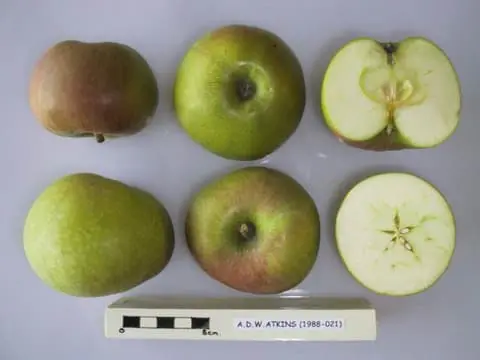
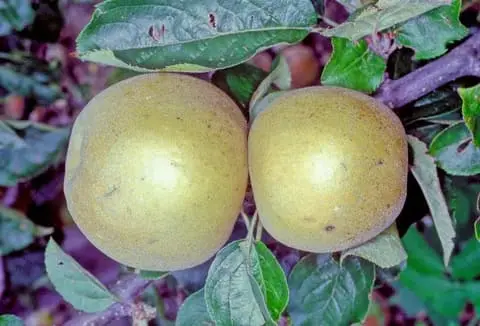
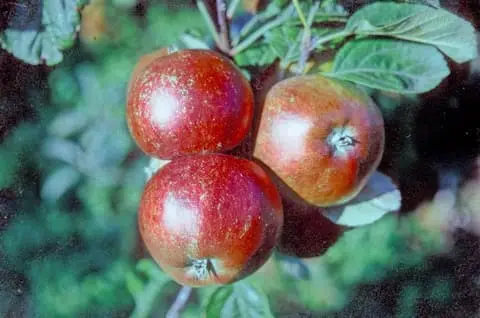
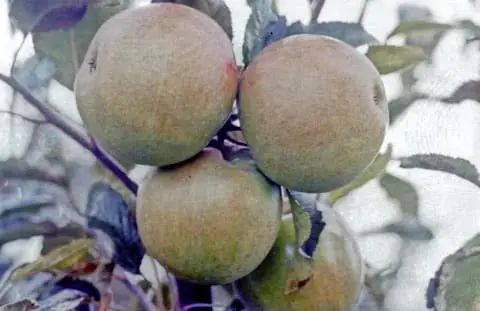
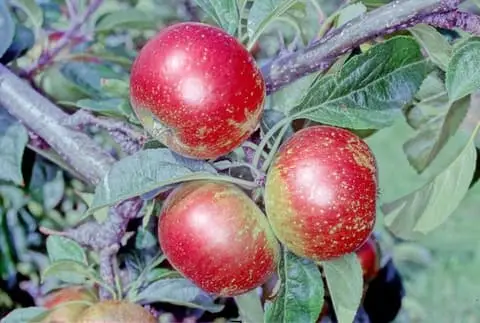
The fruit is medium to large and round to conical; the 1971 National Apple Register gives 64–76 mm in width and 51–64 mm in height, and the collection’s staff measured about 75 by 64 mm1. The greenish-yellow to yellow skin is largely flushed crimson or red, with darker streaks1. The cream flesh is firm, fine and very juicy, with “a sweet, pleasant and refreshing flavour”1.
At Brogdale, Kent, it reaches 10 per cent flowering about 7 May and is picked in early October1. UK storage recommendations of 1978 and 1986 keep it in a cold air store at 1.5–3.5 °C until February5.
Growing
The trees tend towards biennial bearing, cropping in alternate years1. A table compiled for a 1997 report to the agriculture ministry rates it susceptible to scab but resistant to canker and to mildew5. It is diploid2.
Where the sources disagree
Family tree
Parents, grandparents and great-grandparents, as the entries in the atlas record them.
- Laxton's Superb United Kingdom, 1897
- Parent Cellini United Kingdom, by about 1828
- Seed parent Hubbardston Nonsuch United States, by 1832
- Parent Cox's Orange Pippin United Kingdom, about 1825
- Parent Margil France, probably by 1608
- Parent Rosemary Russet United Kingdom, by 1831
- Parent Nonpareil France, by the mid 1500s
- Parent Cellini United Kingdom, by about 1828
Offspring in the atlas
- Crimson Superb United Kingdom, by 1950
- Laxton's Superb Sport United Kingdom, by 1941
- Maxton United Kingdom, 1939
- Merton Pearmain × Cox's Orange Pippin; United Kingdom, 1934
- Russet Superb United Kingdom, 1963
- Tydeman's Late Orange × Cox's Orange Pippin; United Kingdom, 1930
Sources
- Laxton's Superb (accession 1979-170), National Fruit Collection, Brogdale, Kent (Defra). Supports: "Raised in 1897 at Bedford by Laxton Bros., and introduced by them in 1922"; an Award of Merit from the RHS in 1919 and a First Class Certificate in 1921; "firm, very juicy flesh with a sweet, pleasant and refreshing flavour"; "Trees tend to be subject to biennial bearing"; a dessert apple; synonyms Laxton Superb and Superb; parentage "Wyken Pippin x Cox's Orange Pippin"; mother to Tydeman's Late Orange and Merton Pearmain; sports including Red Laxton's Superb and Russet Superb; from the National Apple Register (Smith, 1971), marked b: medium, truncate-conic, height 51–64 mm, width 64–76 mm, a greenish yellow to yellow ground flushed crimson with darker streaks, cream, firm, fine flesh; from NFC staff, marked a: large, globose, height 64.43 mm, width 75.14 mm, juicy, picking in early October (Brogdale); 10% flowering on 7 May (accession 1979-170).
- Using whole-genome SNP data to reconstruct a large multi-generation pedigree in apple germplasm, H. Muranty and others, BMC Plant Biology 20: 2, with Additional files 1 and 3 (Tables S1 and S3), 2020. Supports: Laxton's Superb diploid, dated 1897 (Table S1); inferred as the offspring of Cellini and Cox's Orange Pippin with 8 Mendelian errors, against the documented Wyken Pippin × Cox's Orange Pippin (Table S3); Laxton's Superb and Laxton's Pearmain, "both generally documented as 'Wyken Pippin' x 'Cox's Orange Pippin' (or reciprocal cross)", both inferred from Cox's Orange Pippin and Cellini, which "could be due to an erroneous identification of the tree originally used as a parent by Laxton Bros.".
- Cultivar fingerprinting and SNP-based pedigree reconstruction in Danish heritage apple cultivars utilizing genotypic data from multiple germplasm collections in the world, B. Larsen and others, Genetic Resources and Crop Evolution 72: 2397, supplementary Tables S1 and S5, 2025. Supports: Table S5: Laxton's Superb, ploidy 2, with SNP-confirmed parents Cellini and Cox's Orange Pippin; Table S1: accessions labelled Grevinde Ahlefeldt and Fredskovsæble in Danish collections having the genotype of Laxton's Superb (MUNQ 667) and marked not true to type.
- Apples (Import Quotas), House of Commons debate, Hansard, vol. 792, cols 1661–72 (the passage at cols 1666–7), 1969-12-03. Supports: Sir Gerald Nabarro, member for Worcestershire South: "I pick one grade only—Laxton's Superb, Dessert Apples, Class (I)", quoting weekly wholesale prices per cwt for 1968 and 1969 from the Agricultural Marketing Report; over five weeks from the third week of October to the end of November, an average drop in 1969 against 1968 of "38½ per cent.".
- Storage of organically produced crops (MAFF project OF0127T), Tables 24 and 25, pp. 138 and 144, J. R. Bevan, C. Firth and M. Neicho, Henry Doubleday Research Association, for the Ministry of Agriculture, Fisheries and Food; Organic Eprints, December 1997. Supports: Table 24 (from Crawford, 1997): Laxton's Superb with a maximum storage life in air to February, susceptible (S) to scab and resistant (R) to canker and to mildew; Table 25, compiled from Sharples and Stow (1978 and 1986) and Johnson (1997): air storage at 1.5–3.5 °C, with "Feb" as the terminate month (1978 and 1986).