White Transparent
A thin-skinned summer apple long common in Russia's Baltic provinces; SNP data name Aspa and Saint Germain as parents
History
André Leroy wrote in 1873 that White Transparent had long been very common in the Baltic provinces of Russia, where it was known as Transparente jaune, Transparente blanche and Pomme de Revel and was thought to be native2. He received it in 1852 from Wagner, a nurseryman at Riga, with other early apples then unknown in France; the Angers nurseries called it Grand Sultan between 1855 and 1860, and in Belgium it was named Transparente de Saint-Léger after the pomological congress at Namur in 18622. The United States Department of Agriculture imported it in 1870, from St Petersburg according to Downing3,4. Dr T. H. Hoskins of Newport, Vermont, first made its merits known in the United States, and by 1905 it had spread from the Atlantic to the Pacific4.
SNP studies have found its parents to be Aspa and Saint Germain6,7. Aspa is a genotype so far known only from the collection at Balsgård, Kristianstad, in Sweden, and it is a parent of only one other cultivar in the study, Rivers’ Early Peach; Saint Germain is a parent of fourteen others, nine of them Swedish6. Muranty and colleagues give Papirovka, Klarapfel and Pomme de Revel as other names for it6, and accessions in Danish collections named Klarapfel, Klarapple and Transparante Blanche share its genotype7.
The National Fruit Collection records it as a parent of Milton, Early McIntosh and Lodi1, and SNP data add others, among them Slava Pobeditelyam, from a cross with McIntosh7. A tetraploid bud mutation, Perrine Yellow Transparent, found about 1930 at Centralia, Illinois, ripens a week earlier10.
The fruit
The fruit is medium-sized or larger, round-conical and somewhat ribbed or five-sided1,2,4,5, about 64–66 mm wide1. The very thin, smooth, waxy skin looks almost transparent; it is pale greenish yellow, ripening to yellowish white or the palest milky yellow, with no flush1,2,4,5. The white flesh is crisp, tender and juicy1,4: acid to Bunyard5, sprightly subacid to Beach4, and acid with a little sweetness at the National Fruit Collection1.
At Brogdale in Kent it starts to flower around 1 May and is picked in late July1. Leroy gave mid-July to early August for its season2; in New York it ripened over three or four weeks from July, sometimes into early September, and needed two or more pickings4. It does not keep, soon turning woolly and dry1,3.
Growing
Leroy and Bunyard found the tree vigorous and fertile2,5; in America it was hardy, healthy and moderately vigorous, bearing very young and cropping every year or nearly so3,4. The tender skin bruises easily, and on old, overloaded trees the fruit stays small unless thinned4. Beach reported fire blight on it in parts of the American West, but not in New York4. It is diploid6,7.
Uses
Beach ranked it “one of the best of the extra early apples”, excellent for cooking and acceptable for dessert, and Bunyard called it “a delicious summer fruit, brisk and digestible”4,5.
Where the sources disagree
- When it was introduced. Bunyard wrote that it was introduced early in the nineteenth century5; Leroy received it in 18522, and the National Fruit Collection dates its introduction to western Europe to the mid-1800s1.
- Where it comes from. Downing and Bunyard call it Russian, and Beach says it was imported from Russia3,4,5; Leroy places its home in Russia’s Baltic provinces2, the National Fruit Collection in Russia or the Baltic States1, and Muranty and colleagues in the Baltic States6.
- Yellow Transparent. The National Fruit Collection also lists Yellow Transparent among the names of Transparente de Croncels, a French apple introduced in 18698; SNP data show the two to be different apples6,7.
- Papirovka. The National Fruit Collection and Muranty and colleagues give Papirovka as another name for White Transparent1,6, but the collection also keeps an accession received as Papirovka from Switzerland in 1949, whose fruit is striped with pink and picked in mid-August9.
Family tree
Parents, grandparents and great-grandparents, as the entries in the atlas record them.
- White Transparent Russia, by 1852
- Parent Aspa
- Parent Saint Germain
Offspring in the atlas
- Early McIntosh × McIntosh; United States, 1909
- Lodi × Autumn Bough; United States, 1911
- Milton × McIntosh; United States, 1909
- Perrine Yellow Transparent United States, about 1930
- Wrixparent United States, 1920
11 varieties in the atlas descend from White Transparent.
Sources
- White Transparent (accession 2000 - 096), National Fruit Collection, Brogdale, Kent (Defra). Supports: "Introduced to Western Europe in the mid 1800s from Russia or the Baltic States"; white, rather coarse-textured flesh, acid and a little sweet; "Soon becomes woolly and dry"; other names including Yellow Transparent, Transparente Blanche, Transparente Jaune, Transparente de Saint-Leger, Grand Sultan, Pomme de Revel, Klarapfel, Weisser Klarapfel and Papirovka; mother to Milton, Early McIntosh and Wrixparent, father to Lodi; from Smith (1971), fruit medium, conic, 64–66 mm wide, with prominent ribs, pale yellow or whitish ground, flesh crisp, tender and coarse; from the collection's own characterisation, no over-colour, juicy flesh; 10% flowering on 1 May and picking in late July at the collection.
- Dictionnaire de pomologie, vol. IV, pp. 846–847: Transparente Jaune (in French), André Leroy, Paris and Angers, Internet Archive, 1873. Supports: entry no. 514, with the synonyms De Revel (in Russia, in the Baltic provinces), Grand-Sultan (Angers nurseries, 1855 to 1860) and Transparente de Saint-Léger; very common for a very long time in Russia's Baltic provinces under the names Transparente jaune, Transparente blanche and Pomme de Revel, and regarded as native there; offered to Leroy in 1852 by Wagner, a nurseryman of Riga, with other early apples then unknown in France; the same as the Transparente de Saint-Léger so named in Belgium after the pomological congress at Namur on 28 September 1862; wood strong and fertility "Remarquable"; fruit above medium, conical and distinctly five-sided; skin very thin and as if transparent, greenish white in shade, yellowish white in the sun; flesh white, tender and crisp; juice sweet, delicately acid and perfumed; ripe from mid-July to early August.
- The Fruits and Fruit Trees of America, appendix, pp. 114–115: Yellow Transparent, A. J. Downing, revised by Charles Downing, John Wiley & Sons, Internet Archive, 1900. Supports: "imported from St. Petersburg in 1870 by the Department of Agriculture, Washington, D. C."; an early fruit that "does not continue long in use"; the tree said to have proved very hardy, moderately vigorous and upright, and an early and good bearer every year.
- The Apples of New York, vol. II, pp. 247–249: Yellow Transparent, S. A. Beach, New York Agricultural Experiment Station, Internet Archive, 1905. Supports: imported from Russia by the United States Department of Agriculture in 1870; its merits first made known by Dr T. H. Hoskins of Newport, Vermont; disseminated from the Atlantic to the Pacific and "commonly listed by nurserymen"; "one of the best of the extra early apples", excellent for culinary use and acceptable for dessert; tender skin showing bruises readily; ripening over three or four weeks from July, sometimes until early September, needing two or more pickings; fruit small on mature, overloaded trees unless thinned; tree moderately vigorous, hardy and healthy, bearing very young and cropping annually or nearly so; twig blight (fire blight) in parts of the West but not in New York; fruit medium or above, roundish conic and slightly ribbed; skin thin, smooth and waxy, pale greenish yellow changing to yellowish white; flesh white, fine-grained, crisp, tender, juicy and sprightly subacid.
- A Handbook of Hardy Fruits, vol. I, p. 133: White Transparent, E. A. Bunyard, John Murray, Internet Archive, 1920. Supports: the names Transparente jaune, Grand Sultan, Transparent de St. Leger and Yellow Transparent; culinary or dessert, early August; fairly large, round, conical and irregular; palest milky yellow; flesh greenish white, crisp and acid; growth vigorous, fertile; "Origin, Russian. Introduced early in the nineteenth century"; "A delicious summer fruit, brisk and digestible".
- Using whole-genome SNP data to reconstruct a large multi-generation pedigree in apple germplasm, Hélène Muranty and others, BMC Plant Biology 20:2, with Additional files 1 and 3 (Tables S1 and S3), 2020. Supports: White Transparent (synonyms Papirovka, Klarapfel and Pomme de Revel) from the Baltic States and dated from the mid-1800s; Aspa and St Germain inferred as its parents (Table S3, with no parents recorded in the literature); Aspa a genotype so far found only at Balsgård, Kristianstad, Sweden, and inferred as the parent of only one other cultivar, Rivers' Early Peach; St Germain inferred as the parent of 14 other cultivars, nine from Sweden; White Transparent and Transparente de Croncels distinct genotypes (MUNQ 25 and 62) and both diploid (Table S1).
- Cultivar fingerprinting and SNP-based pedigree reconstruction in Danish heritage apple cultivars utilizing genotypic data from multiple germplasm collections in the world, Bjarne Larsen and others, Genetic Resources and Crop Evolution 72:2397, supplementary table S2, 2025. Supports: Yellow Transparent (MUNQ 25): SNP-confirmed parents Saint Germain and Aspa, diploid; accessions in Danish collections named Transparante Blanche, Klarapfel and Klarapple with the same genotype; Yellow Transparent and McIntosh the parents of Slava Pobeditelyam; Transparente de Croncels a separate genotype (MUNQ 62).
- Transparente de Croncels (accession 1948 - 683), National Fruit Collection, Brogdale, Kent (Defra). Supports: raised by Ernest Baltet and introduced in 1869 by Baltet Frères of Croncels, Troyes, France; Yellow Transparent among its other names.
- Papirovka (accession 1949 - 112), National Fruit Collection, Brogdale, Kent (Defra). Supports: "Originated in Russia. Received by the National Fruit Trials in 1949 from Switzerland"; over-colour pink, striped; picking in mid-August.
- Perrine Yellow Transparent (accession 1954 - 054), National Fruit Collection, Brogdale, Kent (Defra). Supports: "A tetraploid bud mutation of White Transparent, ripening one week earlier"; discovered in about 1930 by D. B. Perrine at Centralia, Illinois.
More from Russia
-
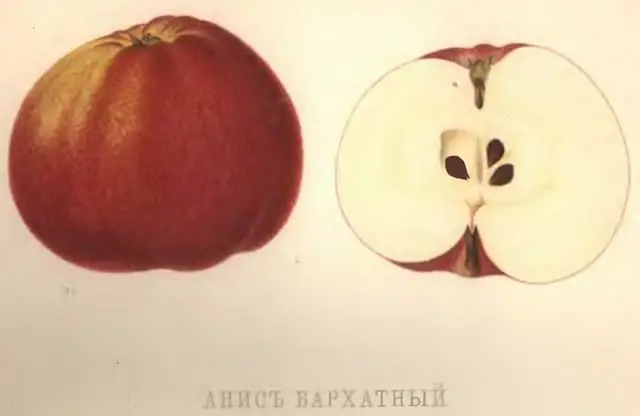
Anis
An old Volga folk apple whose clones bear small, bloom-dusted red fruit; Anis Polosaty has an anise-like scent
-
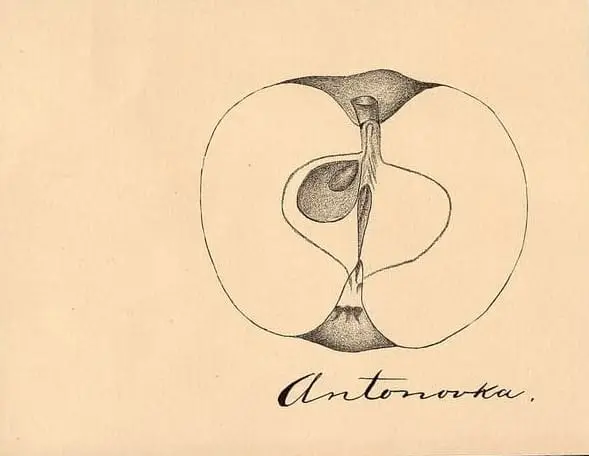
Antonovka
Central Russia's old folk apple, prized for its scent and hardiness; DNA shows Schmidt's Antonovka is the same variety
-
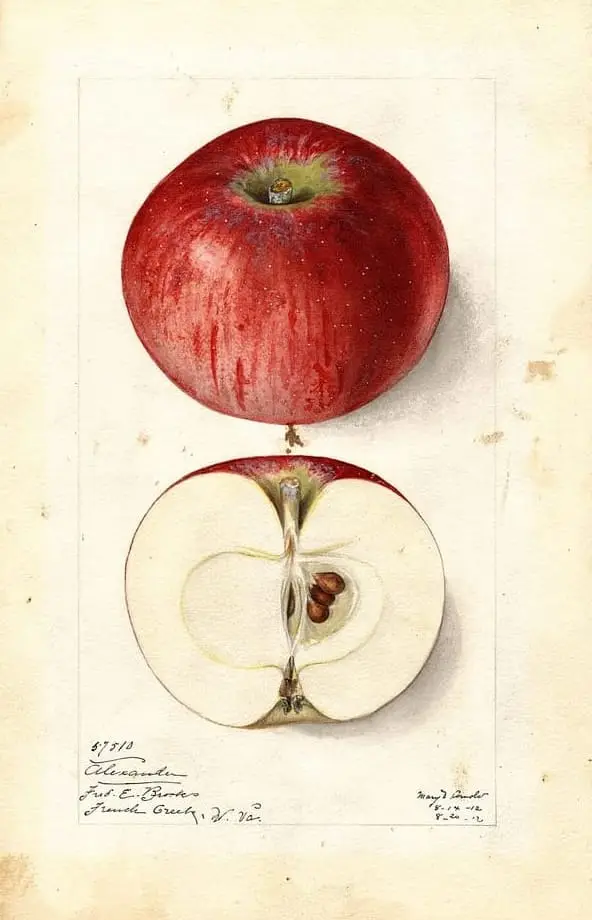
Aport
An old Russian apple, known in the West as Alexander, that became the celebrated Aport of Almaty after 1865
-
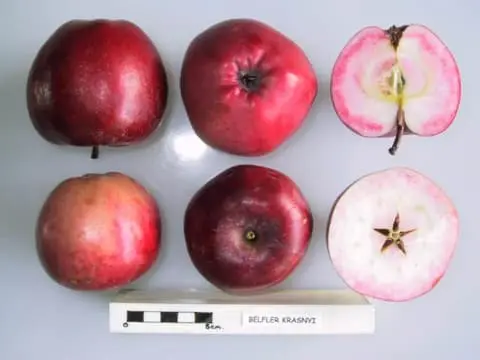
Bellefleur Krasny
-
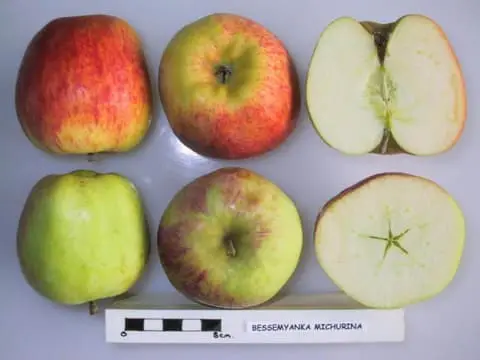
Bessemyanka Michurina
-
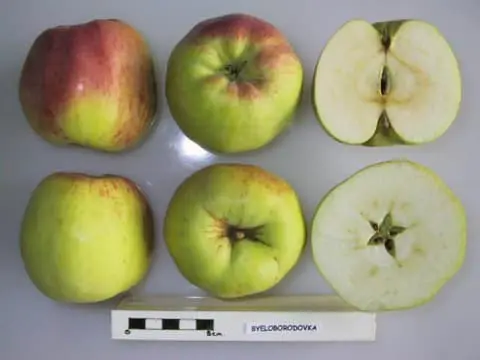
Byeloborodovka
-
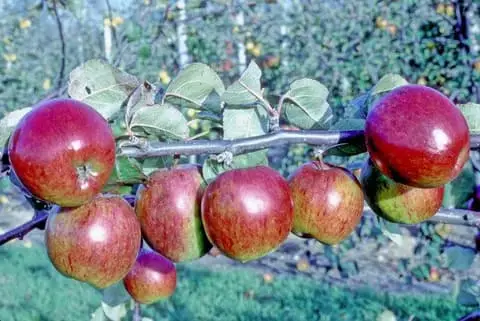
d'Eylau
-
Dolgo
A Siberian crab brought from Russia to South Dakota in 1897 and introduced in 1917 for its ruby-red jelly