Bravo de Esmolfe
A scented, whitish apple from the village of Esmolfe in central Portugal, an EU protected designation since 1996
History
Bravo de Esmolfe comes from the village of Esmolfe, in Penalva do Castelo, central Portugal1,2,3. The application for its protected name, citing a 1946–47 study by the national fruit board, the Junta Nacional das Frutas, says that it appeared there about two hundred years ago, probably from a seedling tree whose fruit was so liked that the demand for grafts spread it2. Grafted trees carried it through the Beira Alta and part of the Cova da Beira1, and by the middle of the twentieth century it was the dominant variety there2.
From October 1946 to June 1947 the board, at the instigation of its president, Luís Quartin Graça, recorded every fruit tree in the variety’s main growing area3. Joaquim Vieira da Natividade called it the legitima ufania da fruticultura beirense, the rightful pride of Beira fruit-growing3.
Traditionally grown for the household, with any surplus sold in Lisbon and Porto, it was by the time of the application eaten mostly outside the region, chiefly in those cities, where it could fetch more than twice the price of Golden Delicious of the same grade and size2. In the 1992–93 season cooperatives and firms in the region sold about 1,000 tonnes, more than three-quarters of a national crop of 1,200 to 1,500 tonnes, and few farmers there were without a tree or two2. In 1996 the European Union registered Maçã Bravo de Esmolfe as a protected designation of origin4, covering about 7,900 square kilometres in the districts of Viseu, Guarda, Coimbra and Castelo Branco1,2.
The fruit
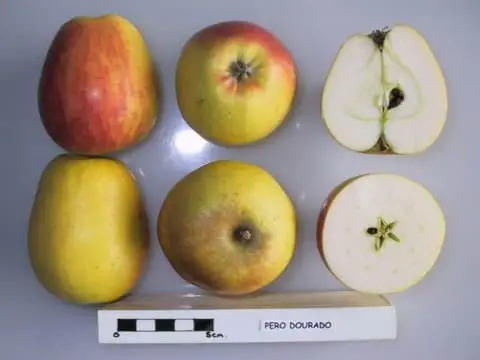
The apple is medium to small and oblong-conical1,2. Its whitish skin sometimes has reddish patches, and russet, spotted or streaked, spreads from the stalk cavity over up to a fifth of the surface2. The white flesh is soft, juicy and sweet, and the fruit is known for its intense, pleasant and distinctive scent1,2. It is picked from the second half of September and keeps for four to five months in cold store2; the directorate-general calls it long-keeping and particularly fragrant1.
Growing
The tree is very vigorous and upright, with narrow-angled branches2. It flowers late, which suits a district where late frosts are common, and it needs a great deal of winter cold to break its dormancy1,2. It is very slow to bear, crops mainly on wood two or more years old, yields moderately to poorly and tends to bear in alternate years1,2. It does best at 350 to 550 metres, on the plateaus among the Estrela, Caramulo, Montemuro, Nave and Lapa ranges1,2. Growers for the protected name may use growth regulators only to thin the crop2.
Where the sources disagree
- When and how it arose. The application for the protected name puts its appearance about two hundred years ago, from a seedling2, and Portugal’s directorate-general for agriculture says it has been known since the eighteenth century1. Isabel Dinis, a researcher quoted by the Centre’s regional development commission, says the nineteenth century, and suggests an accidental cross between two older varieties or a mutation of a wild apple tree3.
Sources
- Maçã Bravo de Esmolfe DOP (in Portuguese), Direção-Geral de Agricultura e Desenvolvimento Rural (DGADR), Produtos Tradicionais Portugueses. Supports: a regional variety "conhecida desde o séc. XVIII", originating in the village of Esmolfe (Penalva do Castelo), probably from a tree grown from seed; grafts spread it through fruit-growing areas, especially the Beira Alta and part of the Cova da Beira; fruit medium to small and oblong-conical, whitish skin sometimes with reddish patches, intense, pleasant aroma, white, soft, juicy and sweet flesh; late flowering suiting a region with a high risk of late frost; best altitude 350–550 m; very slow to bear, with alternate bearing, fruiting mainly on wood of two or more years; picked from the second half of September; long-keeping and "particularmente perfumada"; the production area in municipalities of the districts of Guarda, Castelo Branco, Coimbra and Viseu.
- Application for registration of the designation of origin "Maçã Bravo de Esmolfe", with its main characteristics and production rules (in Portuguese), Frutas da Beira and Ministério da Agricultura; specification file published by DGADR. Supports: citing "A Região Frutícola da Macieira Bravo de Esmolfe" (Junta Nacional das Frutas, 1949), from a study of 1946–47: the variety appeared in the village of Esmolfe, Penalva do Castelo, "há cerca de 200 anos", probably from a seedling tree whose much-liked fruit created a demand for grafting wood; spread to neighbouring municipalities and the dominant variety by the middle of the century; fruit medium to small, oblong-conical, whitish skin with occasional reddish patches, russet spotted or streaked in the stalk cavity reaching up to 20% of the skin, white, soft, juicy and sweet flesh, an intense, pleasant and "sui generis" aroma; picked from the second half of September; keeps 4–5 months in cold store; tree upright with narrow-angled branches and very vigorous; late flowering; medium to low productivity, mainly on wood of two or more years; very slow to bear; alternate bearing; a high winter chilling need; an area of about 7,900 km²; only apples of categories Extra, I and II under the EC apple marketing standard (Regulation (EEC) No 920/89) may bear the name; about 1,000 t sold in 1992–93 by cooperatives and firms in the area, over 75% of national production of 1,200–1,500 t; plateaus between the Estrela, Caramulo, Montemuro, Nave and Lapa ranges, best at 350–550 m; few farmers there without trees of it; traditionally grown for home use or sale in Lisbon and Porto, now mostly eaten outside the region, at prices sometimes more than double those of Golden for the same categories and sizes; no growth regulators except for fruit thinning.
- Maçã Bravo de Esmolfe DOP (in Portuguese), Comissão de Coordenação e Desenvolvimento Regional do Centro (CCDR Centro), 2025-09-30. Supports: the region Centro; Joaquim Vieira da Natividade's description of it as the "legitima ufania da fruticultura beirense"; the fruit survey of its main producing region by the Junta Nacional das Frutas on the initiative of its president, Luís Quartin Graça, recording all fruit trees there from October 1946 to June 1947; Isabel Dinis (2007): "conhecida desde o séc. XIX", from the village of Esmolfe, and probably the result of an accidental cross between two older varieties or of a mutation of a wild apple tree.
- Commission Regulation (EC) No 1107/96 of 12 June 1996 on the registration of geographical indications and designations of origin under the procedure laid down in Article 17 of Council Regulation (EEC) No 2081/92 (in Spanish), European Commission, Official Journal of the European Communities L 148, pp. 1–10; Boletín Oficial del Estado database, 1996-06-12. Supports: the annex registers "Maça Bravo de Esmolfe (DOP)" for Portugal, among fruit, vegetables and cereals.