Fameuse
The Snow apple of Quebec, of obscure origin in Canada or France; SNP data make it a likely grandparent of McIntosh
History
Its history is obscure, and nineteenth-century writers disputed whether it was Canadian or French1. In 1851 Chauncey Goodrich of Burlington, Vermont, wrote that the French had planted it 120 years before at Chimney Point, on the eastern shore of Lake Champlain, from where grafts spread through Vermont as the Chimney apple1. A seigneur living below Quebec told him that the old trees on his estate had come from France; French settlers, he added, had also planted it at Ogdensburg, Detroit and Kaskaskia, Illinois1. The National Fruit Collection likewise has it planted in the United States about 17302.
Waugh, writing for the Vermont station in 1900, found that most European authors called it Canadian, while Leroy, the great French authority, did not know it1. He was “firmly convinced” that it “originated in Canada from seed brought from France”, and spread with the first French missionaries and settlers1. Downing thought it probably an old French variety3, Hogg and Bunyard probably Canadian4,5.
In New York it did best along Lake Champlain and the St Lawrence, where in 1905 it was among the most important commercial apples; further south it often coloured poorly, and Beach advised growers there to plant McIntosh instead1. The Fameuse type tends to come true from seed, and in Quebec, where grafted trees were scarce or dear, its seedlings were planted by the hundred; Waugh counted McIntosh among the named varieties of this group1. SNP data point to Fameuse as a likely grandparent of McIntosh, and are consistent with its being a grandchild of Api, though that link is unconfirmed7.
In 2024 Le Devoir reported that this heritage apple, whose roots in Quebec go back to the first settlers of New France and which was widely eaten until the twentieth century, had been reintroduced into Quebec orchards6.
The fruit
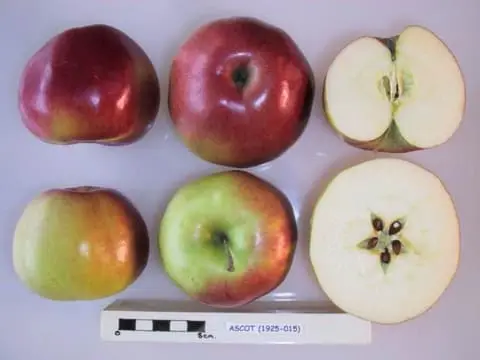
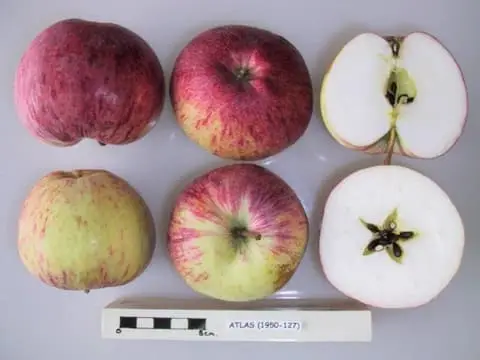
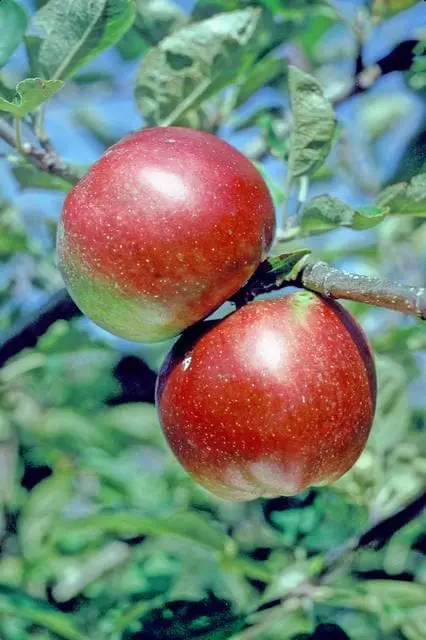
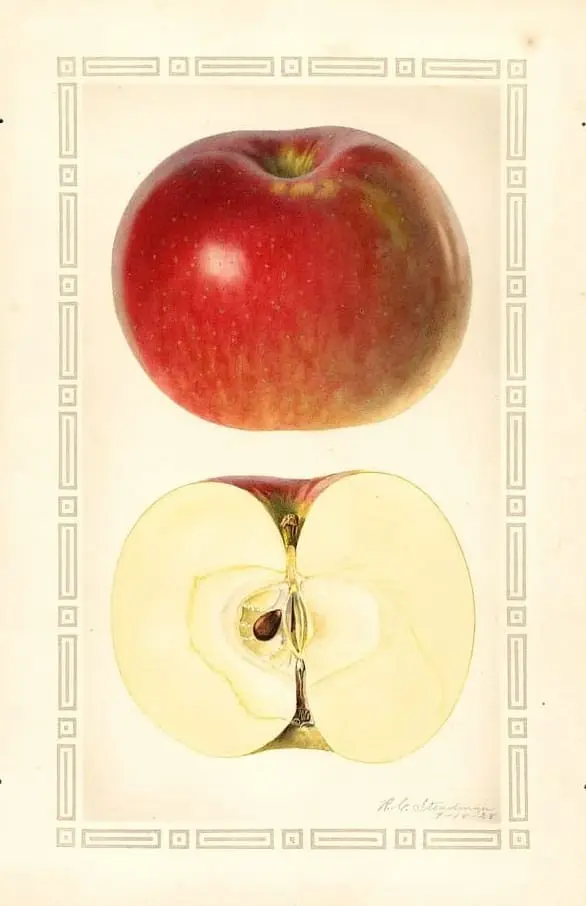
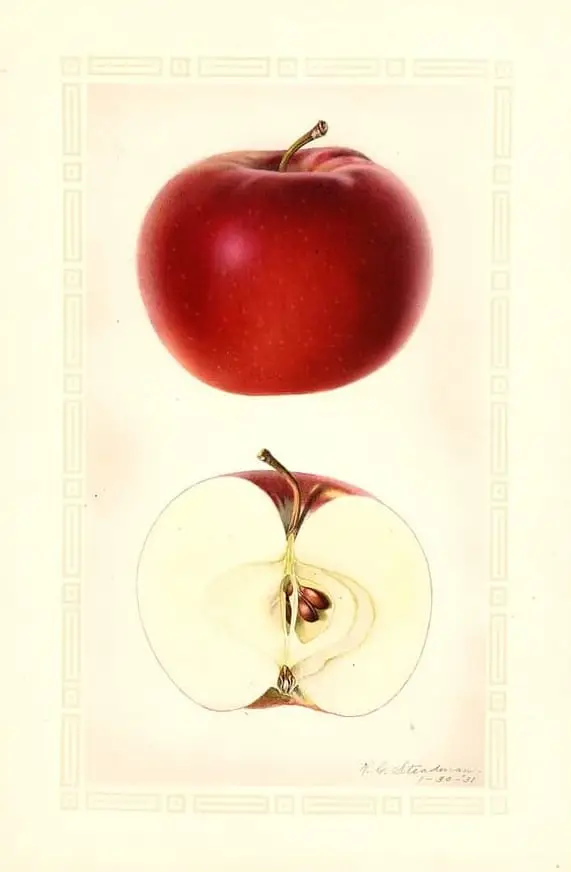
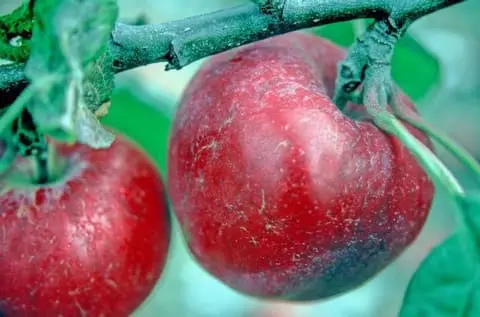
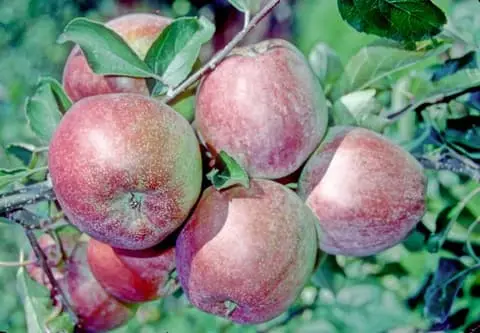
The fruit is small to medium1,4,5; the National Fruit Collection records it as 63 mm wide and 50 mm high2. The thin, smooth skin is light bright red, deepening to almost purplish black in well-coloured fruit, with a somewhat striped look towards the apex1; on the shaded side it is pale waxen yellow tinged with red4. The flesh is white, sometimes stained with red, very tender and juicy1,3. Beach found it mild subacid to sweetish and aromatic1, Downing lightly perfumed3, and the National Fruit Collection very sweet and vinous, like McIntosh2. A Striped Fameuse, more striped and less highly coloured, was sometimes sold under its name1,3.
In New York its season ran from October to midwinter, and it kept well in cold storage1; Hogg and Bunyard gave November to January in England4,5. It is picked in late September at the National Fruit Collection in Kent2.
Growing
Beach described a medium-sized tree, hardy, healthy and rather long-lived, cropping well every other year or nearly every year, though much of the fruit was too small for market1. The fruit is often badly marked by scab, which preventive treatment readily controls1. Hogg found the tree small but hardy and fruitful, though liable to canker in some soils4. Fameuse is diploid8.
Uses
Beach ranked Fameuse among the most desirable dessert apples of its season but “decidedly inferior” for cooking1; Le Devoir recommends it both fresh and cooked into smooth compotes6. Hogg thought it handsome “but not of great merit”, and Bunyard found its flavour poor and the apple “of no value in Britain”4,5.
Where the sources disagree
- Origin. Waugh, Hogg, Bunyard and the National Fruit Collection think it Canadian, perhaps from French seed1,2,4,5; Downing thought it probably an old French variety3.
- Age. Bunyard says it was known before the seventeenth century5; Hogg traced the name Pomme de Neige to the beginning of that century but thought it then meant another, long-lost apple4. Waugh dated its arrival in Vermont to about 1700, citing Goodrich, whose own figure of 120 years before 1851 points to about 17301, the date the National Fruit Collection gives2; Muranty and colleagues date it before 17308.
Family tree
Offspring in the atlas
- Crimson Beauty (Canada) × Duchess of Oldenburg; Canada, about 1880
- Dodd × Tolman Sweet (original name Tolman Sweeting); United States
- Lawfam × Lawver; Canada, 1898
- Young's Pinello × Golden Russet of Western New York; United Kingdom, by 1935
7 varieties in the atlas descend from Fameuse.
Sources
- The Apples of New York, vol. II, pp. 65–69: Fameuse, S. A. Beach, New York Agricultural Experiment Station, Internet Archive, 1905. Supports: synonyms including Snow, Pomme de Neige, La Fameuse, Chimney Apple, De Neige and Sanguineus; "one of the most desirable dessert apples of its season", "decidedly inferior" for cooking; season October to the holidays in market and October to midwinter; keeping well in cold storage; often badly injured by scab, readily controlled by preventive treatment; among the most important commercial varieties in the Champlain district and parts of the St Lawrence valley, poorly coloured further south, where McIntosh should be planted instead; tree of medium size, hardy, healthy, rather long-lived, cropping biennially or nearly annually, much fruit too small for market; Waugh's historical account (Vermont station bulletin, 1900): the history "obscure"; Chauncey Goodrich of Burlington, Vermont, in 1851 on the French planting at Chimney Point "one hundred and twenty years since", the Chimney apple of Vermont, the seigneur below Quebec whose old trees came from France, and plantings at Ogdensburg, Detroit and Kaskaskia; most European authors calling it Canadian; Leroy not knowing the variety; Goodrich's date for its arrival in Vermont put at about 1700; distribution by the earliest French missionaries and settlers; Waugh "firmly convinced" it "originated in Canada from seed brought from France"; the fruit: below to above medium size, thin smooth skin, light bright red deepening to almost purplish black, somewhat striped towards the apex; flesh white, sometimes stained red, very tender, juicy, subacid to very mild subacid or sweetish, aromatic; Striped Fameuse; the Fameuse type's tendency to come true from seed and the raising of such seedlings by the hundred in Quebec; McIntosh listed in the Fameuse group.
- Fameuse (accession 1952-174), National Fruit Collection, Brogdale, Kent (Defra). Supports: "Thought to be a Canadian variety and may have been raised from seed brought from France by early settlers"; "planted in the USA in about 1730"; dessert apple; flesh "rather soft, fine-textured, juicy" with "a very sweet and vinous flavour - similar to McIntosh"; 50 mm high and 63 mm wide; picking in late September at Brogdale; synonyms including Snow, Snow Apple, Pomme de Neige, Chimney Apple, Royal Snow and Sanguineus.
- The Fruits and Fruit Trees of America, pp. 171–172: Fameuse, A. J. Downing, revised by Charles Downing, John Wiley & Sons, Internet Archive, 1900. Supports: "A very celebrated Canada fruit (probably an old French variety)"; especially valuable in northern latitudes; flesh "remarkably white, very tender, juicy, and with a slight perfume"; "Very good, almost best"; ripe in October and November; a regular bearer; Striped Fameuse, more striped and less highly coloured.
- The Fruit Manual, 5th ed., p. 58: De Neige, Robert Hogg, Journal of Horticulture Office, Internet Archive, 1884. Supports: the synonyms Fameuse and La Fameuse; about medium size; skin tender, smooth and shining, pale waxen yellow tinged with pale red on the shaded side, deeper red in the sun; flesh pure white, very tender, sweet; "A very beautiful and handsome apple, but not of great merit"; dessert, November to January; tree small, hardy, bearing well, liable to canker in some soils; supposed Canadian origin; the name Pomme de Neige traceable to the beginning of the seventeenth century, but then given to an apple, apparently an early White Codlin, long since disappeared.
- A Handbook of Hardy Fruits, vol. I, p. 55: Fameuse, E. A. Bunyard, John Murray, Internet Archive, 1920. Supports: the names Snow, Royal Snow and Sanguineous; dessert, November to January; small; flesh crisp, white, "flavour poor"; "Origin, probably Canadian; known before the seventeenth century"; "Of no value in Britain".
- Apples worth biting into (in French), Sophie Ginoux, Le Devoir, special section, 2024-09-28. Supports: the Fameuse, also called "pomme de neige", a heritage apple whose roots in Quebec go back to the first settlers of New France, much eaten until the twentieth century and reintroduced into Quebec orchards; very white, juicy, sweet flesh; good for eating fresh or cooking into smooth compotes.
- The use of shared haplotype length information for pedigree reconstruction in asexually propagated outbreeding crops, demonstrated for apple and sweet cherry, Nicholas P. Howard and others, Horticulture Research 8: 202, 2021. Supports: "'Fameuse' was deduced to be a likely grandparent of 'McIntosh'", a double great-grandparent relationship not ruled out; haplotype sharing "consistent with a possible GPGC relationship between 'Fameuse' and 'Api'", which phased data were not available to confirm, Api being recorded as older than both.
- Using whole-genome SNP data to reconstruct a large multi-generation pedigree in apple germplasm, Hélène Muranty and others, BMC Plant Biology 20: 2, with Additional file 1 (Table S1), 2020. Supports: Table S1: Fameuse (MUNQ 303) diploid (2n), dated "before 1730".