Åkerö
Named after a Södermanland manor where its 18th-century mother tree still stood in 2020; described by Eneroth in 1858
History
Åkerö is named after Åkerö, a manor in Bettna parish, Södermanland, which stands on a hilly island on the north shore of Lake Yngaren2,3. Where the apple came from is uncertain. In 1759 the owner, Count C. G. Tessin, ordered some sixty fruit trees from Holland, and the apple may have come with them; or it may have grown from a pip on the estate1,3. Norway’s Institute of Bioeconomy Research (NIBIO) counts it Swedish, the mother tree having been an imported seedling2. The National Fruit Collection says it was known in the mid-18th century5.
The mother tree in the manor garden grew unusually large1,3; more than 150 years old in 19223, it was protected in 1921 and still stood in 20202.
The Swedish pomologist Olof Eneroth described the variety in 1858, finding that it resembled no known apple, and named it after the manor2. Around the middle of the century he recommended it for growing throughout Sweden for its hardiness and fruitfulness1, and it spread through the Nordic countries1. It reached Norway in 1860 and was much planted there, especially in the east2. In England, Bunyard found it rarely grown in 1920 and “of interest only from its remarkable coloration”4.
Colour mutants include a white-fruited tree at Åkerö noted by Eneroth, seven types recorded at Gripsholm in 1918, and Åkerø Hassel, a darker red mutant found at Vestfossen, Norway, in 19812.
SNP studies give its parents as Grågylling, a Swedish apple, and Saint Germain, which was found to be a parent of many Swedish varieties; Vitgylling and Sandbergs Röda are Åkerö’s full siblings6,7. Åkerö is in turn a parent, with Sävstaholm, of Kramforsäpple6.
The fruit
The fruit is medium-sized to large, tall and shaped like a blunt egg or cylinder1,2; a nose-like growth sometimes appears at the stalk1. The skin is whitish to greenish yellow, flushed brick red on the sunny side and often all over, sometimes with darker red dots or stripes1,2; Bunyard saw a “crimson peach-like flush and bloom”4. The flesh is firm2,4,5, whitish yellow and almost coarse, with a sweet, mildly acid taste and a good aroma2; SLU calls the flavour refreshing1.
In Norway the fruit is picked at the start of October and eaten from November until January or February2.
Growing
The tree is vigorous and upright, with narrow branch angles, at first forming a tall crown that later becomes broad and round2. It is slow to come into bearing and tends to crop in alternate years2. Where Eneroth praised its fruitfulness1, Bunyard found its growth and cropping moderate4. The tree is prone to canker, and to scab in wet weather; the fruit suffers from scab, bitter pit and sometimes Fusarium core rot2. Åkerö is diploid6,7.
Uses
Åkerö is mainly eaten fresh2,4, but it also suits baking and other cooking; SLU calls it the winter apple of grandmother’s garden, as Transparent Blanche is the summer one1.
Where the sources disagree
- Origin. NIBIO says that the mother tree was shown to be a seedling imported from Holland in 17592. SLU treats the Dutch shipment as only one possibility, the other being a seedling that grew on the estate1.
- Dates in the pedigree. The 2020 DNA study flags Åkerö’s parentage as at odds with the documented dates, since Saint Germain is first recorded in 1857, a century after Åkerö; the authors note that such dates are often only those of first record, which can lie far from a variety’s origin6.
- Season and juiciness. Bunyard found the flesh juicy and gave its season as September to October4, and at Brogdale the fruit is picked in late August5. NIBIO calls the flesh not very juicy and the apple a keeper until January or February2, and SLU counts it a winter apple1.
Family tree
Parents, grandparents and great-grandparents, as the entries in the atlas record them.
- Åkerö Sweden, mid-18th century
- Parent Grågylling
- Parent Saint Germain
Sources
- Apple 'Åkerö' (in Swedish), Inger Hjalmarsson, Swedish University of Agricultural Sciences (SLU), Programme for Diversity of Cultivated Plants (POM), Grönt kulturarv, 2025-12-15. Supports: in 1759 C. G. Tessin, then owner of the Åkerö estate in Södermanland, ordered some sixty fruit trees from Holland, and Åkerö perhaps came with them; the other possibility, a seedling on the estate; the mother tree unusually large; in the mid-19th century the pomologist Olof Eneroth recommended it for growing throughout Sweden for its hardiness and fruitfulness; spread with great success through the Nordic countries; prized for its refreshing, mildly acid flavour; the winter apple of grandmother's garden, as Transparent Blanche is the summer one; eaten fresh but also suited to baking and other cooking; a majestic tree; brick-red, markedly egg-shaped fruit, sometimes with a nose-like growth at the stalk cavity.
- Apple varieties: Åkerø (in Norwegian), NIBIO (Norwegian Institute of Bioeconomy Research), plant genetic resources: fruit varieties, 2020-03-30. Supports: origin somewhat uncertain; perhaps among the fruit trees that C. G. Tessin, owner of Åkerö manor in Södermanland, imported from Holland in 1759; resembling no known variety, described in 1858 by the Swedish pomologist O. Eneroth, who named it after Åkerö manor, "where the mother tree still stands"; the tree protected in 1921; study of the mother tree showed it to be a seedling imported in 1759, so that Åkerø can be regarded as Swedish; to Norway in 1860, much planted since, especially in eastern Norway; colour mutants: a white-fruited tree at Åkerö mentioned by Eneroth, seven types described at Gripsholm in 1918, a brick-red type sold as Åkerö from Gripsholm, and Åkerø Hassel, a darker red mutant found on Einar Hassel's farm at Vestfossen, Buskerud, in 1981; tree vigorous and upright with narrow branch angles, a tall crown later broad and round; late to bear, tending to biennial bearing; prone to canker, and to scab in wet weather; fruit medium to large, tall, blunt egg- or cylinder-shaped, yellow-green to whitish yellow with a brick-red flush on the sunny side and often all over, sometimes dark red dots or stripes; skin medium thick, matt, rarely greasy; flesh whitish yellow, firm, almost coarse and not very juicy, sweet and mildly acid with a good aroma; fruit prone to scab, bitter pit and sometimes Fusarium core rot; picked in early October, eating ripe from November to January or February; a dessert apple.
- Nordisk familjebok, vol. 33, cols 975–976: Åkerö (in Swedish), Nordisk familjeboks förlag, Stockholm; Project Runeberg, 1922. Supports: Åkerö, an estate in Bettna parish, Södermanland, on a hilly island on the north shore of Lake Yngaren; bought in 1748 by Count K. G. Tessin, who built the house in 1752–57; the garden holding "the more than 150-year-old original tree" of the Åkerö glass apple (glasäpplen).
- A Handbook of Hardy Fruits, vol. I, p. 15: Akero, E. A. Bunyard, John Murray; Internet Archive, 1920. Supports: the names Akera and Okera; dessert, September to October; medium, conical; "pale creamy yellow with crimson peach-like flush and bloom"; flesh white, firm and juicy; growth moderate, fertility moderate; origin probably Swedish; "now rarely grown, but is of interest only from its remarkable coloration".
- Akero (accession 1927-013), National Fruit Collection, Brogdale, Kent (Defra). Supports: "Thought to have originated in Sweden. Known in the mid 1700s and brought to notice by pomologist Eneroth in about 1850. Fruits have firm, coarse flesh with a sweet to subacid aromatic flavour."; synonyms including Aakero, Akera, Akero-apple, Akeroaple, Akeroaeble and Akeroapfel (run together in the record), Akeroglasaplen, Apfel von Akero, Okera, Okere, Schmidt's Junkerapfel and Schmidts Junkerapfel; a dessert apple; National Apple Register: medium-large, truncate conical, whitish yellow with red, firm, yellowish flesh; picking in late August at Brogdale.
- Using whole-genome SNP data to reconstruct a large multi-generation pedigree in apple germplasm, H. Muranty and others, BMC Plant Biology 20: 2, with Additional files 1 and 3, 2020. Supports: Table S3: Åkerö inferred from Grågylling and Saint Germain, no parents documented, date consistency marked "dubious" for Grågylling and "WRONG" for Saint Germain; Table S1: Åkerö dated "mid 1700s" and Saint Germain 1857, Åkerö diploid; the text: Saint Germain a parent of 14 cultivars besides White Transparent, nine of them Swedish, among them Åkerö, Vitgylling and Sandbergs Röda, full siblings with "the Swedish 'Grågylling'" as the other parent; documented dates in most apparently inconsistent trios being dates of first record or of receipt in a collection, "rather far from the true date of origination"; Table S3: Kramforsäpple from Sävstaholm and Åkerö, as documented.
- Cultivar fingerprinting and SNP-based pedigree reconstruction in Danish heritage apple cultivars utilizing genotypic data from multiple germplasm collections in the world, B. Larsen and others, Genetic Resources and Crop Evolution 72: 2397–2411, with supplementary file 2, 2025. Supports: Table S5: Åkerö with the SNP-confirmed parents Saint Germain and Grågylling, diploid; Table S1: the Pometum accession Åkerø.
More from Sweden
-
Alfa 68
-
Alice
-
Alnarps Favorit
-
Amorosa
-
Aroma
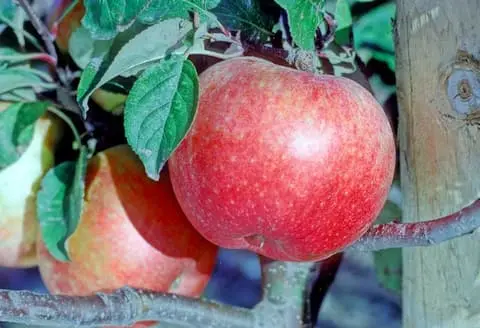
Crossed in 1947 from Ingrid Marie and Filippa and released by Balsgård in 1973; second in Swedish orchards in 2023
-
Astrachan Large Fruited
-
Birgit Bonnier
-
Eva Lotta